

126
4 Mine Ventilation Networks
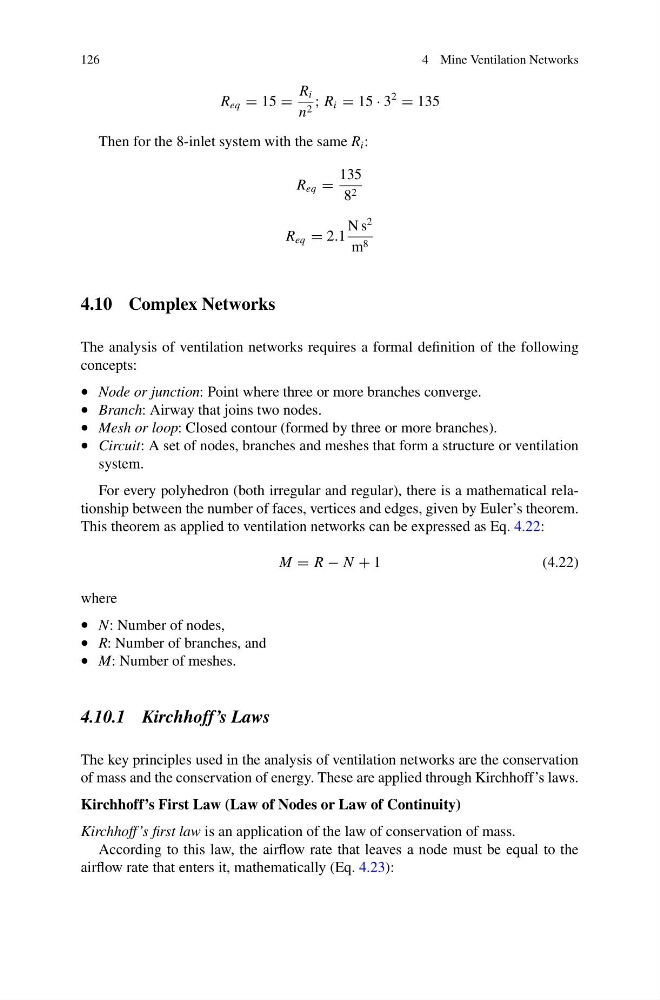
R eq = 15 =
R i
n 2 ; R i = 15 · 3
2
= 135
Then for the 8-inlet system with the same R i :
R eq =
135
8 2
R eq = 2.1
N s
2
m 8
4.10 Complex Networks
The analysis of ventilation networks requires a formal definition of the following
concepts:
• Node or junction: Point where three or more branches converge.
• Branch: Airway that joins two nodes.
• Mesh or loop: Closed contour (formed by three or more branches).
• Circuit: A set of nodes, branches and meshes that form a structure or ventilation
system.
For every polyhedron (both irregular and regular), there is a mathematical relationship between the number of faces, vertices and edges, given by Euler’s theorem.
This theorem as applied to ventilation networks can be expressed as Eq. 4.22:
M = R − N + 1
(4.22)
where
• N: Number of nodes,
• R: Number of branches, and
• M: Number of meshes.
4.10.1 Kirchhoff’s Laws
The key principles used in the analysis of ventilation networks are the conservation
of mass and the conservation of energy. These are applied through Kirchhoff’s laws.
Kirchhoff’s First Law (Law of Nodes or Law of Continuity)
Kirchhoff’s first law is an application of the law of conservation of mass.
According to this law, the airflow rate that leaves a node must be equal to the
airflow rate that enters it, mathematically (Eq. 4.23):
4 Mine Ventilation Networks
R eq = 15 =
R i
n 2 ; R i = 15 · 3
2
= 135
Then for the 8-inlet system with the same R i :
R eq =
135
8 2
R eq = 2.1
N s
2
m 8
4.10 Complex Networks
The analysis of ventilation networks requires a formal definition of the following
concepts:
• Node or junction: Point where three or more branches converge.
• Branch: Airway that joins two nodes.
• Mesh or loop: Closed contour (formed by three or more branches).
• Circuit: A set of nodes, branches and meshes that form a structure or ventilation
system.
For every polyhedron (both irregular and regular), there is a mathematical relationship between the number of faces, vertices and edges, given by Euler’s theorem.
This theorem as applied to ventilation networks can be expressed as Eq. 4.22:
M = R − N + 1
(4.22)
where
• N: Number of nodes,
• R: Number of branches, and
• M: Number of meshes.
4.10.1 Kirchhoff’s Laws
The key principles used in the analysis of ventilation networks are the conservation
of mass and the conservation of energy. These are applied through Kirchhoff’s laws.
Kirchhoff’s First Law (Law of Nodes or Law of Continuity)
Kirchhoff’s first law is an application of the law of conservation of mass.
According to this law, the airflow rate that leaves a node must be equal to the
airflow rate that enters it, mathematically (Eq. 4.23):