

108
4 Mine Ventilation Networks
Therefore, the equivalent orifice replaces the entire airway, as it concerns the
pressures and quantities supplied by the fan. The equivalent orifice of an entire mine
allows for their classification. Thus, mines with an equivalent orifice of more than
5 m
2 are generally considered to be very easy to ventilate, orifices of 2 m
2 are within
the norm in European mines and orifices smaller than 1.5 m
2 indicate mines difficult
to ventilate.
Demonstration of the Equation of the Equivalent Orifice
The definition of the equivalent orifice assumes stationary, laminar, incompressible
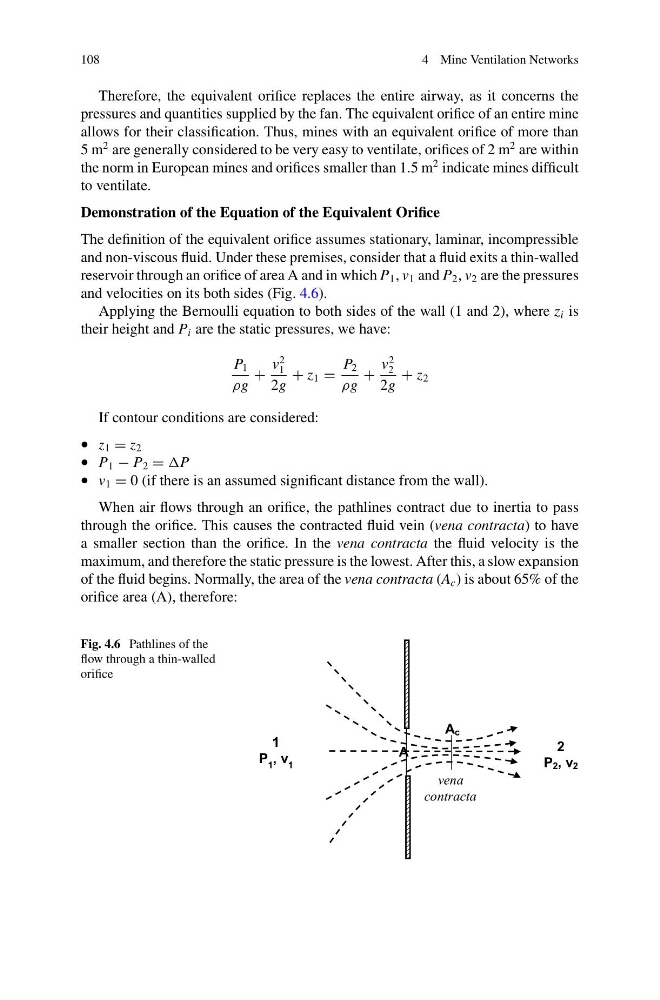
and non-viscous fluid. Under these premises, consider that a fluid exits a thin-walled
reservoir through an orifice of area A and in which P 1 , v 1 and P 2 , v 2 are the pressures
and velocities on its both sides (Fig. 4.6).
Applying the Bernoulli equation to both sides of the wall (1 and 2), where z i is
their height and P i are the static pressures, we have:
P 1
ρg
+
v
2
1
2g
+ z 1 =
P 2
ρg
+
v
2
2
2g
+ z 2
If contour conditions are considered:
• z 1 = z 2
• P 1 − P 2 =
• v 1 = 0 (if there is an assumed significant distance from the wall).
When air flows through an orifice, the pathlines contract due to inertia to pass
through the orifice. This causes the contracted fluid vein (vena contracta) to have
a smaller section than the orifice. In the vena contracta the fluid velocity is the
maximum, and therefore the static pressure is the lowest. After this, a slow expansion
of the fluid begins. Normally, the area of the vena contracta (A c ) is about 65% of the
orifice area (A), therefore:
Fig. 4.6 Pathlines of the
flow through a thin-walled
orifice
A
A c
vena
contracta
2
P 2 , v 2
1
P 1 , v 1
4 Mine Ventilation Networks
Therefore, the equivalent orifice replaces the entire airway, as it concerns the
pressures and quantities supplied by the fan. The equivalent orifice of an entire mine
allows for their classification. Thus, mines with an equivalent orifice of more than
5 m
2 are generally considered to be very easy to ventilate, orifices of 2 m
2 are within
the norm in European mines and orifices smaller than 1.5 m
2 indicate mines difficult
to ventilate.
Demonstration of the Equation of the Equivalent Orifice
The definition of the equivalent orifice assumes stationary, laminar, incompressible
and non-viscous fluid. Under these premises, consider that a fluid exits a thin-walled
reservoir through an orifice of area A and in which P 1 , v 1 and P 2 , v 2 are the pressures
and velocities on its both sides (Fig. 4.6).
Applying the Bernoulli equation to both sides of the wall (1 and 2), where z i is
their height and P i are the static pressures, we have:
P 1
ρg
+
v
2
1
2g
+ z 1 =
P 2
ρg
+
v
2
2
2g
+ z 2
If contour conditions are considered:
• z 1 = z 2
• P 1 − P 2 =
• v 1 = 0 (if there is an assumed significant distance from the wall).
When air flows through an orifice, the pathlines contract due to inertia to pass
through the orifice. This causes the contracted fluid vein (vena contracta) to have
a smaller section than the orifice. In the vena contracta the fluid velocity is the
maximum, and therefore the static pressure is the lowest. After this, a slow expansion
of the fluid begins. Normally, the area of the vena contracta (A c ) is about 65% of the
orifice area (A), therefore:
Fig. 4.6 Pathlines of the
flow through a thin-walled
orifice
A
A c
vena
contracta
2
P 2 , v 2
1
P 1 , v 1