

4.7 Equivalent Orifice
109
A C = 0.65A
As the flow rate exiting the orifice is:
Q = A C v 2
Therefore:
v 2 =
Q
0.65A
According to the Bernoulli equation, we have:
P 1
ρ
−
P 2
ρ
=
v
2
2
2
Which can be rearranged as:
P 1 − P 2 =
1
2
ρ v
2
2
Therefore:
P 1 − P 2 =
1
2
ρ
Q
0.65A
2
Then:
P = 1.42
Q
A
2
Which corresponds to the family of parabolas in Fig. 4.7:
P =
1.42
A 2 Q
2
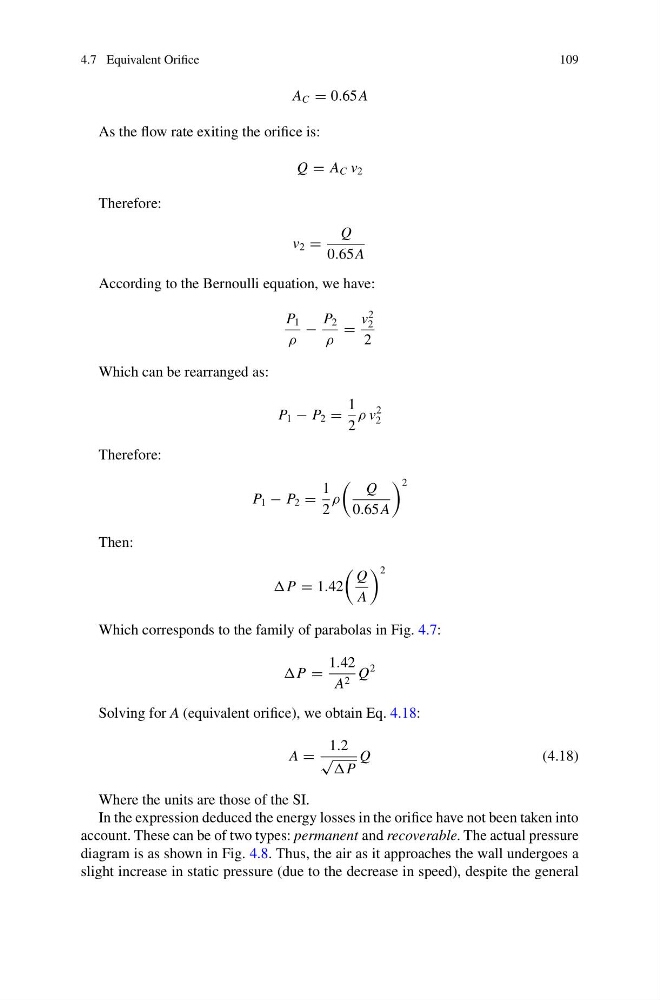
Solving for A (equivalent orifice), we obtain Eq. 4.18:
A =
1.2
√ P
Q
(4.18)
Where the units are those of the SI.
In the expression deduced the energy losses in the orifice have not been taken into
account. These can be of two types: permanent and recoverable. The actual pressure
diagram is as shown in Fig. 4.8. Thus, the air as it approaches the wall undergoes a
slight increase in static pressure (due to the decrease in speed), despite the general
109
A C = 0.65A
As the flow rate exiting the orifice is:
Q = A C v 2
Therefore:
v 2 =
Q
0.65A
According to the Bernoulli equation, we have:
P 1
ρ
−
P 2
ρ
=
v
2
2
2
Which can be rearranged as:
P 1 − P 2 =
1
2
ρ v
2
2
Therefore:
P 1 − P 2 =
1
2
ρ
Q
0.65A
2
Then:
P = 1.42
Q
A
2
Which corresponds to the family of parabolas in Fig. 4.7:
P =
1.42
A 2 Q
2
Solving for A (equivalent orifice), we obtain Eq. 4.18:
A =
1.2
√ P
Q
(4.18)
Where the units are those of the SI.
In the expression deduced the energy losses in the orifice have not been taken into
account. These can be of two types: permanent and recoverable. The actual pressure
diagram is as shown in Fig. 4.8. Thus, the air as it approaches the wall undergoes a
slight increase in static pressure (due to the decrease in speed), despite the general