

4.6 Shock Resistance and Equivalent Length
107
=
0.012
kg
m 3 · 16 m · (500 + 40.31) m
15 m 2
3
·
1.15
1.2
= 0.02945
N s 2
m 8
And also as:
R T = (0.0273 + 0.00219)
N s
2
m 8 = 0.02945
N s
2
m 8
(e) Finally, the total pressure loss (omitting inlet and outlet losses) can be obtained
as:
P = R T Q
2
= 0.02945
N s
2
m 8 ·
80
m
3
s
2
= 188.48 Pa
4.7 Equivalent Orifice
The equivalent orifice is a concept used to characterize ducts, galleries or mines
according to their ease of ventilation. Thus, the larger the section of the equivalent
orifice compared to that of the airway, the easier it will be to ventilate it. The concept
could be enunciated for any airway as the surface of the opening offering to the flow
passing through it,
8 the same resistance as the path traveled by air in the airway. A
more technical alternative is its definition as the section of the thin-walled orifice
(S) through which flows the same quantity (Q) as through the airway, if the pressure
difference on both sides of the thin wall (P) coincides with that provided by the
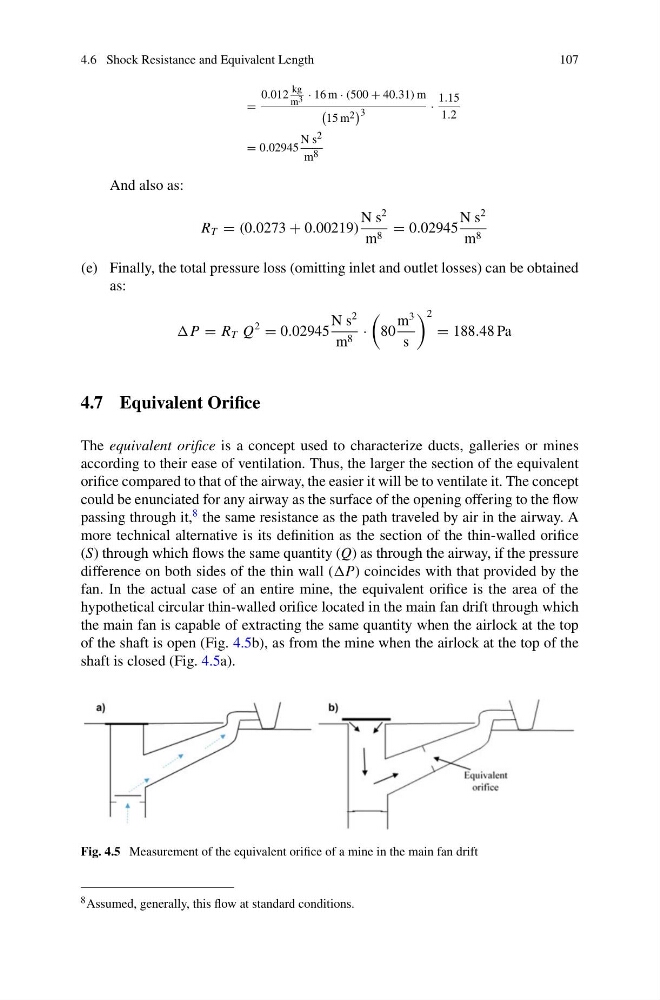
fan. In the actual case of an entire mine, the equivalent orifice is the area of the
hypothetical circular thin-walled orifice located in the main fan drift through which
the main fan is capable of extracting the same quantity when the airlock at the top
of the shaft is open (Fig. 4.5b), as from the mine when the airlock at the top of the
shaft is closed (Fig. 4.5a).
Fig. 4.5 Measurement of the equivalent orifice of a mine in the main fan drift
8 Assumed, generally, this flow at standard conditions.
107
=
0.012
kg
m 3 · 16 m · (500 + 40.31) m
15 m 2
3
·
1.15
1.2
= 0.02945
N s 2
m 8
And also as:
R T = (0.0273 + 0.00219)
N s
2
m 8 = 0.02945
N s
2
m 8
(e) Finally, the total pressure loss (omitting inlet and outlet losses) can be obtained
as:
P = R T Q
2
= 0.02945
N s
2
m 8 ·
80
m
3
s
2
= 188.48 Pa
4.7 Equivalent Orifice
The equivalent orifice is a concept used to characterize ducts, galleries or mines
according to their ease of ventilation. Thus, the larger the section of the equivalent
orifice compared to that of the airway, the easier it will be to ventilate it. The concept
could be enunciated for any airway as the surface of the opening offering to the flow
passing through it,
8 the same resistance as the path traveled by air in the airway. A
more technical alternative is its definition as the section of the thin-walled orifice
(S) through which flows the same quantity (Q) as through the airway, if the pressure
difference on both sides of the thin wall (P) coincides with that provided by the
fan. In the actual case of an entire mine, the equivalent orifice is the area of the
hypothetical circular thin-walled orifice located in the main fan drift through which
the main fan is capable of extracting the same quantity when the airlock at the top
of the shaft is open (Fig. 4.5b), as from the mine when the airlock at the top of the
shaft is closed (Fig. 4.5a).
Fig. 4.5 Measurement of the equivalent orifice of a mine in the main fan drift
8 Assumed, generally, this flow at standard conditions.