

102
4 Mine Ventilation Networks
Airflow rate
ΔP
P=RQ
P=RQ 2
Laminar
flow
Transition
Trubulent flow
P=RQ
α
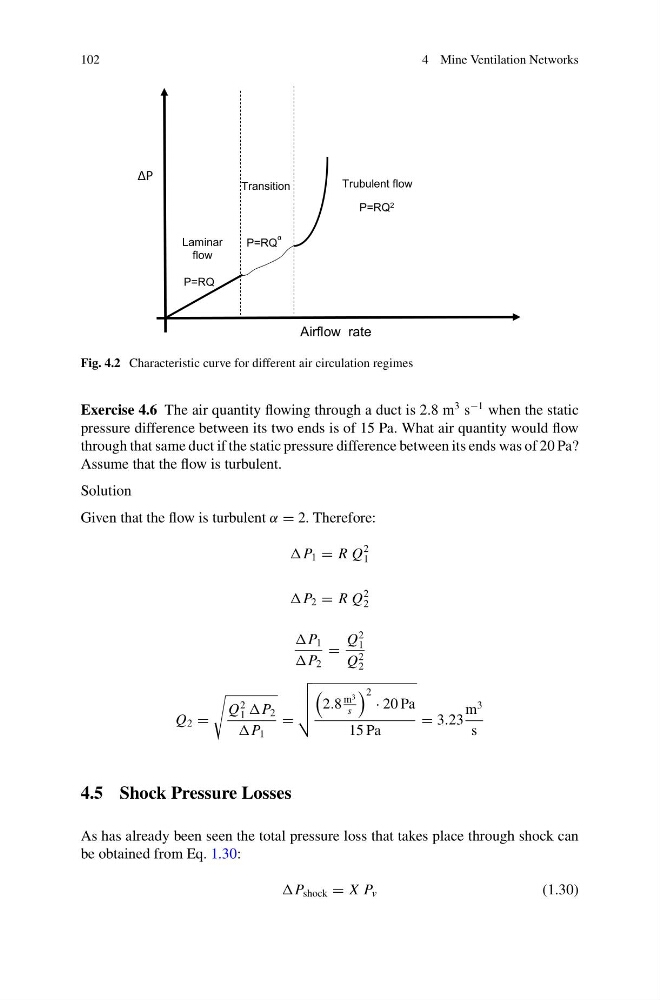
Fig. 4.2 Characteristic curve for different air circulation regimes
Exercise 4.6 The air quantity flowing through a duct is 2.8 m
3 s
−1 when the static
pressure difference between its two ends is of 15 Pa. What air quantity would flow
through that same duct if the static pressure difference between its ends was of 20 Pa?
Assume that the flow is turbulent.
Solution
Given that the flow is turbulent α = 2. Therefore:
1 = R Q
2
1
2 = R Q
2
2
1
2
=
Q
2
1
Q
2
2
Q 2 =
Q
2
1 2
P 1
=
2.8
m 3
s
2 · 20 Pa
15 Pa
= 3.23
m
3
s
4.5 Shock Pressure Losses
As has already been seen the total pressure loss that takes place through shock can
be obtained from Eq. 1.30:
shock = X P v
(1.30)
4 Mine Ventilation Networks
Airflow rate
ΔP
P=RQ
P=RQ 2
Laminar
flow
Transition
Trubulent flow
P=RQ
α
Fig. 4.2 Characteristic curve for different air circulation regimes
Exercise 4.6 The air quantity flowing through a duct is 2.8 m
3 s
−1 when the static
pressure difference between its two ends is of 15 Pa. What air quantity would flow
through that same duct if the static pressure difference between its ends was of 20 Pa?
Assume that the flow is turbulent.
Solution
Given that the flow is turbulent α = 2. Therefore:
1 = R Q
2
1
2 = R Q
2
2
1
2
=
Q
2
1
Q
2
2
Q 2 =
Q
2
1 2
P 1
=
2.8
m 3
s
2 · 20 Pa
15 Pa
= 3.23
m
3
s
4.5 Shock Pressure Losses
As has already been seen the total pressure loss that takes place through shock can
be obtained from Eq. 1.30:
shock = X P v
(1.30)