

4.5 Shock Pressure Losses
103
Flat tube
Sharp edges
Conical
Bell mouth
X=0.9
X=0.5
X=0.2
X=0.05
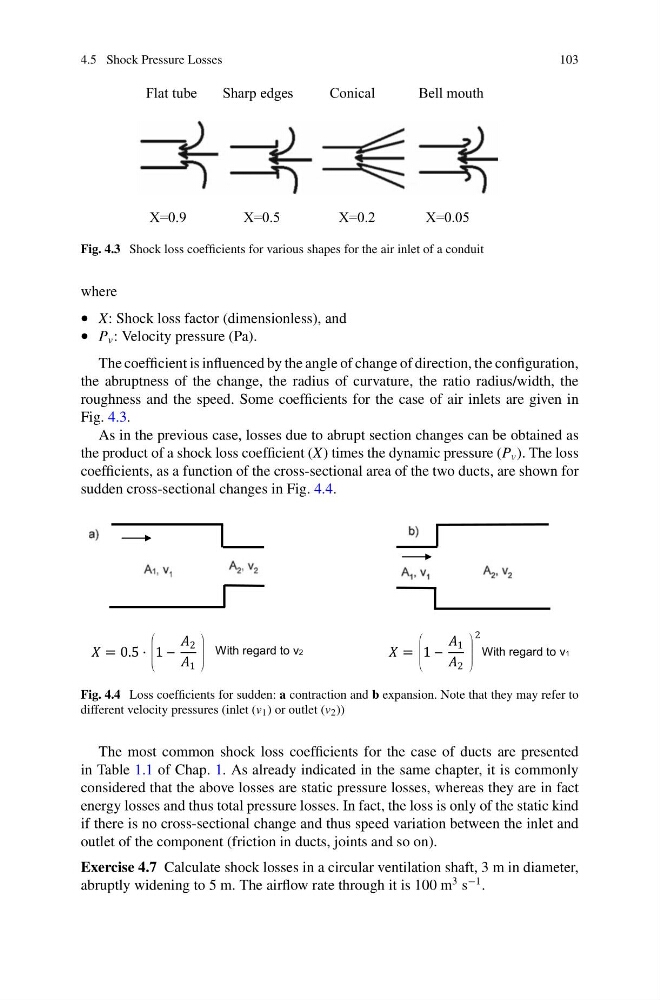
Fig. 4.3 Shock loss coefficients for various shapes for the air inlet of a conduit
where
• X: Shock loss factor (dimensionless), and
• P v : Velocity pressure (Pa).
The coefficient is influenced by the angle of change of direction, the configuration,
the abruptness of the change, the radius of curvature, the ratio radius/width, the
roughness and the speed. Some coefficients for the case of air inlets are given in
Fig. 4.3.
As in the previous case, losses due to abrupt section changes can be obtained as
the product of a shock loss coefficient (X) times the dynamic pressure (P v ). The loss
coefficients, as a function of the cross-sectional area of the two ducts, are shown for
sudden cross-sectional changes in Fig. 4.4.
−
−
With regard to v2
With regard to v1
Fig. 4.4 Loss coefficients for sudden: a contraction and b expansion. Note that they may refer to
different velocity pressures (inlet (v 1 ) or outlet (v 2 ))
The most common shock loss coefficients for the case of ducts are presented
in Table 1.1 of Chap. 1. As already indicated in the same chapter, it is commonly
considered that the above losses are static pressure losses, whereas they are in fact
energy losses and thus total pressure losses. In fact, the loss is only of the static kind
if there is no cross-sectional change and thus speed variation between the inlet and
outlet of the component (friction in ducts, joints and so on).
Exercise 4.7 Calculate shock losses in a circular ventilation shaft, 3 m in diameter,
abruptly widening to 5 m. The airflow rate through it is 100 m
3 s
−1 .
103
Flat tube
Sharp edges
Conical
Bell mouth
X=0.9
X=0.5
X=0.2
X=0.05
Fig. 4.3 Shock loss coefficients for various shapes for the air inlet of a conduit
where
• X: Shock loss factor (dimensionless), and
• P v : Velocity pressure (Pa).
The coefficient is influenced by the angle of change of direction, the configuration,
the abruptness of the change, the radius of curvature, the ratio radius/width, the
roughness and the speed. Some coefficients for the case of air inlets are given in
Fig. 4.3.
As in the previous case, losses due to abrupt section changes can be obtained as
the product of a shock loss coefficient (X) times the dynamic pressure (P v ). The loss
coefficients, as a function of the cross-sectional area of the two ducts, are shown for
sudden cross-sectional changes in Fig. 4.4.
−
−
With regard to v2
With regard to v1
Fig. 4.4 Loss coefficients for sudden: a contraction and b expansion. Note that they may refer to
different velocity pressures (inlet (v 1 ) or outlet (v 2 ))
The most common shock loss coefficients for the case of ducts are presented
in Table 1.1 of Chap. 1. As already indicated in the same chapter, it is commonly
considered that the above losses are static pressure losses, whereas they are in fact
energy losses and thus total pressure losses. In fact, the loss is only of the static kind
if there is no cross-sectional change and thus speed variation between the inlet and
outlet of the component (friction in ducts, joints and so on).
Exercise 4.7 Calculate shock losses in a circular ventilation shaft, 3 m in diameter,
abruptly widening to 5 m. The airflow rate through it is 100 m
3 s
−1 .