

100
4 Mine Ventilation Networks
Note that we have performed inference for an area of 1 m
2 which lies at a region
of the function where it grows exponentially. It is, therefore, to be expected that the
results obtained will be accompanied by a large error.
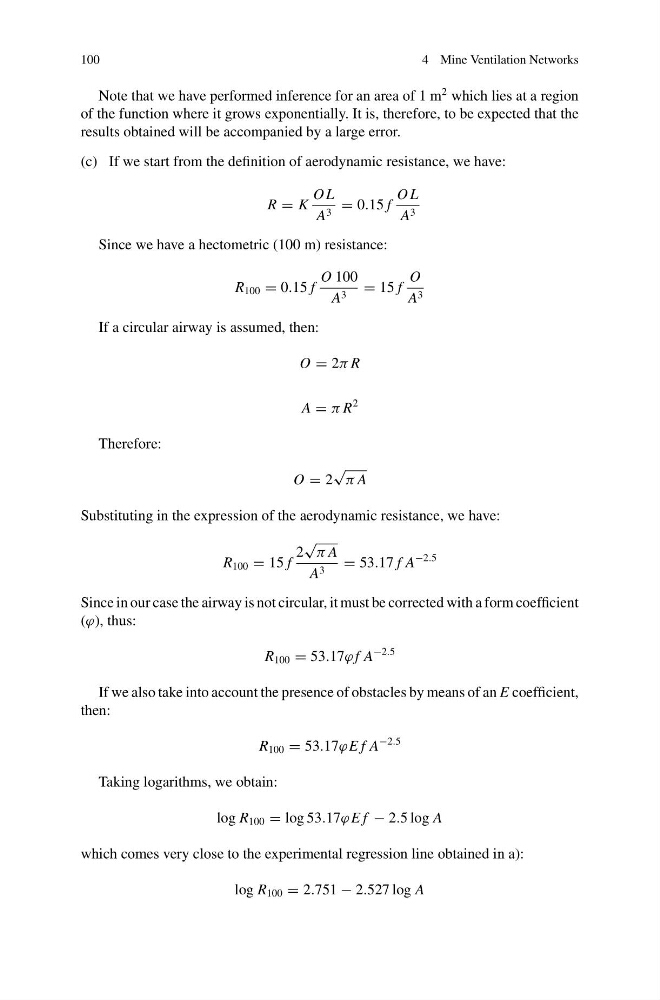
(c) If we start from the definition of aerodynamic resistance, we have:
R = K
O L
A 3 = 0.15 f
O L
A 3
Since we have a hectometric (100 m) resistance:
R 100 = 0.15 f
O 100
A 3 = 15 f
O
A 3
If a circular airway is assumed, then:
O = 2π R
A = π R
2
Therefore:
O = 2
√ π A
Substituting in the expression of the aerodynamic resistance, we have:
R 100 = 15 f
2
√ π A
A 3 = 53.17 f A
−2.5
Since in our case the airway is not circular, it must be corrected with a form coefficient
(ϕ), thus:
R 100 = 53.17ϕ f A
−2.5
If we also take into account the presence of obstacles by means of an E coefficient,
then:
R 100 = 53.17ϕ E f A
−2.5
Taking logarithms, we obtain:
log R 100 = log 53.17ϕ E f − 2.5 log A
which comes very close to the experimental regression line obtained in a):
log R 100 = 2.751 − 2.527 log A
4 Mine Ventilation Networks
Note that we have performed inference for an area of 1 m
2 which lies at a region
of the function where it grows exponentially. It is, therefore, to be expected that the
results obtained will be accompanied by a large error.
(c) If we start from the definition of aerodynamic resistance, we have:
R = K
O L
A 3 = 0.15 f
O L
A 3
Since we have a hectometric (100 m) resistance:
R 100 = 0.15 f
O 100
A 3 = 15 f
O
A 3
If a circular airway is assumed, then:
O = 2π R
A = π R
2
Therefore:
O = 2
√ π A
Substituting in the expression of the aerodynamic resistance, we have:
R 100 = 15 f
2
√ π A
A 3 = 53.17 f A
−2.5
Since in our case the airway is not circular, it must be corrected with a form coefficient
(ϕ), thus:
R 100 = 53.17ϕ f A
−2.5
If we also take into account the presence of obstacles by means of an E coefficient,
then:
R 100 = 53.17ϕ E f A
−2.5
Taking logarithms, we obtain:
log R 100 = log 53.17ϕ E f − 2.5 log A
which comes very close to the experimental regression line obtained in a):
log R 100 = 2.751 − 2.527 log A