

72
2 Basic Components
( . )
m
D v
−
is negative for the four configurations in Fig. 2.14. This is the situation
that we intuitively expect and that is always correct for stator components. With
rotor components, the displacement work of the drag force may be positive. This
requires a rather high blade speed compared to the other velocity components (see
Exercise 2.5.6). Equation (2.26) demonstrates that the concept of displacement
work should be applied with care. Only in the case of a purely active force, without
any deformation work associated, as a lift, does the displacement work equal the
total work.
2.2.8 The Zweifel Tangential Force Coefficient
With an axial cascade, in principle, the component of the force on the blade useful
for work is not the lift but the tangential component. It is therefore appropriate to
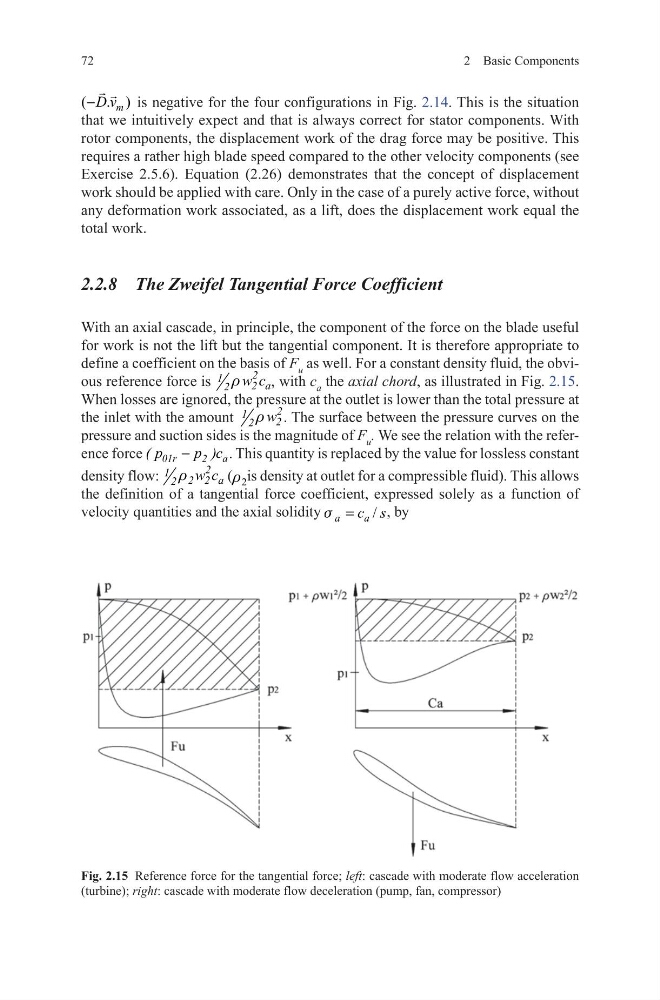
define a coefficient on the basis of F u as well. For a constant density fluid, the obvious reference force is
2
1
2 a
2 w c
r
, with c a the axial chord, as illustrated in Fig. 2.15.
When losses are ignored, the pressure at the outlet is lower than the total pressure at
the inlet with the amount
2
1
2
2 w
r . The surface between the pressure curves on the
pressure and suction sides is the magnitude of F u . We see the relation with the reference force 01r
2 a
( p
p )c
−
. This quantity is replaced by the value for lossless constant
density flow:
2
1
2 2 a
2
w c
r
( 2
r is density at outlet for a compressible fluid). This allows
the definition of a tangential force coefficient, expressed solely as a function of
velocity quantities and the axial solidity
/
a
a
c s
s =
, by
Fig. 2.15 Reference force for the tangential force; left: cascade with moderate flow acceleration
(turbine); right: cascade with moderate flow deceleration (pump, fan, compressor)
2 Basic Components
( . )
m
D v
−
is negative for the four configurations in Fig. 2.14. This is the situation
that we intuitively expect and that is always correct for stator components. With
rotor components, the displacement work of the drag force may be positive. This
requires a rather high blade speed compared to the other velocity components (see
Exercise 2.5.6). Equation (2.26) demonstrates that the concept of displacement
work should be applied with care. Only in the case of a purely active force, without
any deformation work associated, as a lift, does the displacement work equal the
total work.
2.2.8 The Zweifel Tangential Force Coefficient
With an axial cascade, in principle, the component of the force on the blade useful
for work is not the lift but the tangential component. It is therefore appropriate to
define a coefficient on the basis of F u as well. For a constant density fluid, the obvious reference force is
2
1
2 a
2 w c
r
, with c a the axial chord, as illustrated in Fig. 2.15.
When losses are ignored, the pressure at the outlet is lower than the total pressure at
the inlet with the amount
2
1
2
2 w
r . The surface between the pressure curves on the
pressure and suction sides is the magnitude of F u . We see the relation with the reference force 01r
2 a
( p
p )c
−
. This quantity is replaced by the value for lossless constant
density flow:
2
1
2 2 a
2
w c
r
( 2
r is density at outlet for a compressible fluid). This allows
the definition of a tangential force coefficient, expressed solely as a function of
velocity quantities and the axial solidity
/
a
a
c s
s =
, by
Fig. 2.15 Reference force for the tangential force; left: cascade with moderate flow acceleration
(turbine); right: cascade with moderate flow deceleration (pump, fan, compressor)