

71
2.2 Linear Cascades
cascade, this means that drag contributes to the work. The work by the drag
force on the fluid is
.
D u
−
. Analogously to the lift, we can verify the meaning
of
. m
D v
−
.
It follows that
.
.
. ,
m
m
D u
D v
D w
−
= −
+
with
(2.25)
So:
(2.26)
Equation (2.26) again demonstrates that the total work is the sum of displacement
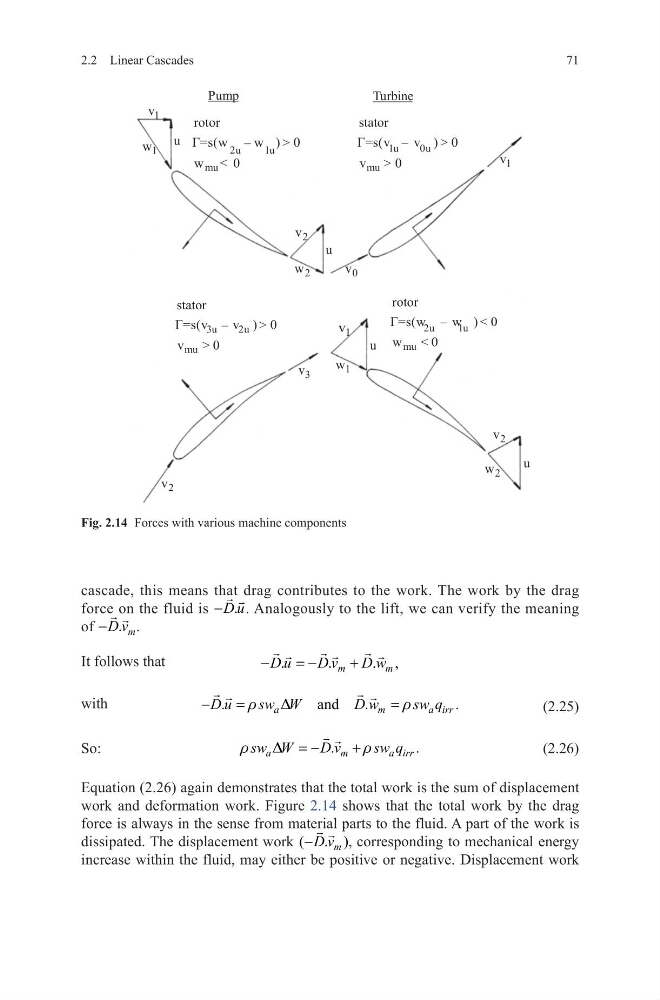
work and deformation work. Figure 2.14 shows that the total work by the drag
force is always in the sense from material parts to the fluid. A part of the work is
dissipated. The displacement work ( . )
m
D v
−
, corresponding to mechanical energy
increase within the fluid, may either be positive or negative. Displacement work
and
a
m
a irr
D.u
sw W
D.w
sw q .
r
D
r
−
=
=
a
m
a irr
sw W
D.v
sw q .
r
D
r
= −
+
3XPS
7XUELQH
PX
URWRU
Z
PX
VWDWRU
Y
Y
Y
Y
X
Z
Y
X
X
X
Ƚ VZ
Z
±
!
X
X
Ƚ VY
Y
±
!
!
!
Z
Y
X
Z
PX
VWDWRU
±
!
X
X
Ƚ VY
Y
Y
PX
URWRU
±
X
X
Ƚ VZ
Z
Z
Y
Y
Y
X
Z
Fig. 2.14 Forces with various machine components
2.2 Linear Cascades
cascade, this means that drag contributes to the work. The work by the drag
force on the fluid is
.
D u
−
. Analogously to the lift, we can verify the meaning
of
. m
D v
−
.
It follows that
.
.
. ,
m
m
D u
D v
D w
−
= −
+
with
(2.25)
So:
(2.26)
Equation (2.26) again demonstrates that the total work is the sum of displacement
work and deformation work. Figure 2.14 shows that the total work by the drag
force is always in the sense from material parts to the fluid. A part of the work is
dissipated. The displacement work ( . )
m
D v
−
, corresponding to mechanical energy
increase within the fluid, may either be positive or negative. Displacement work
and
a
m
a irr
D.u
sw W
D.w
sw q .
r
D
r
−
=
=
a
m
a irr
sw W
D.v
sw q .
r
D
r
= −
+
3XPS
7XUELQH
PX
URWRU
Z
PX
VWDWRU
Y
Y
Y
Y
X
Z
Y
X
X
X
Ƚ VZ
Z
±
!
X
X
Ƚ VY
Y
±
!
!
!
Z
Y
X
Z
PX
VWDWRU
±
!
X
X
Ƚ VY
Y
Y
PX
URWRU
±
X
X
Ƚ VZ
Z
Z
Y
Y
Y
X
Z
Fig. 2.14 Forces with various machine components