

70
2 Basic Components
This relation implies that the lift coefficient does not depend solely on the cascade
solidity and the flow angles, but on the drag coefficient as well.
With the above formulae it should be taken into account that the β-angles are
negative with the cascade considered in Fig. 2.12. This means that lift decreases
due to losses. When deriving the relations, sign conventions have been applied consistently. The expressions for F u and F a have general validity, also for a turbine
cascade
1
2
u
a
( tg
tg
0, F
0, F
0 )
b
b
−
>
>
>
. The expression for drag remains the
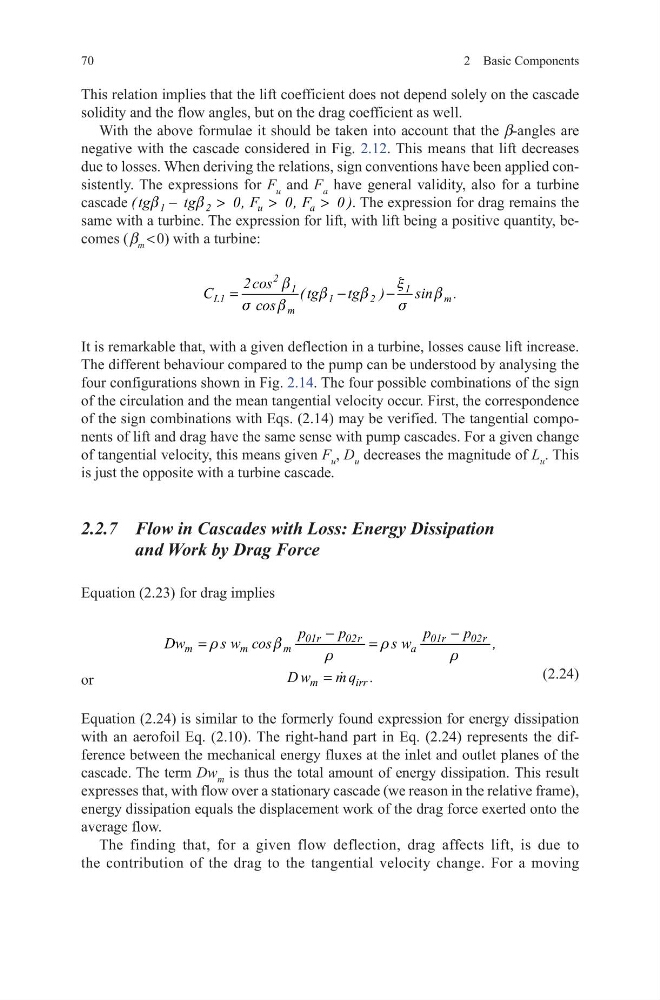
same with a turbine. The expression for lift, with lift being a positive quantity, becomes ( β m < 0) with a turbine:
It is remarkable that, with a given deflection in a turbine, losses cause lift increase.
The different behaviour compared to the pump can be understood by analysing the
four configurations shown in Fig. 2.14. The four possible combinations of the sign
of the circulation and the mean tangential velocity occur. First, the correspondence
of the sign combinations with Eqs. (2.14) may be verified. The tangential components of lift and drag have the same sense with pump cascades. For a given change
of tangential velocity, this means given F u , D u decreases the magnitude of L u . This
is just the opposite with a turbine cascade.
2.2.7 Flow in Cascades with Loss: Energy Dissipation
and Work by Drag Force
Equation (2.23) for drag implies
or
(2.24)
Equation (2.24) is similar to the formerly found expression for energy dissipation
with an aerofoil Eq. (2.10). The right-hand part in Eq. (2.24) represents the difference between the mechanical energy fluxes at the inlet and outlet planes of the
cascade. The term Dw m is thus the total amount of energy dissipation. This result
expresses that, with flow over a stationary cascade (we reason in the relative frame),
energy dissipation equals the displacement work of the drag force exerted onto the
average flow.
The finding that, for a given flow deflection, drag affects lift, is due to
the contribution of the drag to the tangential velocity change. For a moving
2 1
1
L1
1
2
m
m
2 cos
C
( tg
tg )
sin .
cos
b
x
b
b
b
s
b
s
=
−
−
01r
02r
01r
02r
m
m
m
a
m
irr
p
p
p
p
Dw
s w cos
s w
,
D w
m q .
r
b
r
r
r
−
−
=
=
=
2 Basic Components
This relation implies that the lift coefficient does not depend solely on the cascade
solidity and the flow angles, but on the drag coefficient as well.
With the above formulae it should be taken into account that the β-angles are
negative with the cascade considered in Fig. 2.12. This means that lift decreases
due to losses. When deriving the relations, sign conventions have been applied consistently. The expressions for F u and F a have general validity, also for a turbine
cascade
1
2
u
a
( tg
tg
0, F
0, F
0 )
b
b
−
>
>
>
. The expression for drag remains the
same with a turbine. The expression for lift, with lift being a positive quantity, becomes ( β m < 0) with a turbine:
It is remarkable that, with a given deflection in a turbine, losses cause lift increase.
The different behaviour compared to the pump can be understood by analysing the
four configurations shown in Fig. 2.14. The four possible combinations of the sign
of the circulation and the mean tangential velocity occur. First, the correspondence
of the sign combinations with Eqs. (2.14) may be verified. The tangential components of lift and drag have the same sense with pump cascades. For a given change
of tangential velocity, this means given F u , D u decreases the magnitude of L u . This
is just the opposite with a turbine cascade.
2.2.7 Flow in Cascades with Loss: Energy Dissipation
and Work by Drag Force
Equation (2.23) for drag implies
or
(2.24)
Equation (2.24) is similar to the formerly found expression for energy dissipation
with an aerofoil Eq. (2.10). The right-hand part in Eq. (2.24) represents the difference between the mechanical energy fluxes at the inlet and outlet planes of the
cascade. The term Dw m is thus the total amount of energy dissipation. This result
expresses that, with flow over a stationary cascade (we reason in the relative frame),
energy dissipation equals the displacement work of the drag force exerted onto the
average flow.
The finding that, for a given flow deflection, drag affects lift, is due to
the contribution of the drag to the tangential velocity change. For a moving
2 1
1
L1
1
2
m
m
2 cos
C
( tg
tg )
sin .
cos
b
x
b
b
b
s
b
s
=
−
−
01r
02r
01r
02r
m
m
m
a
m
irr
p
p
p
p
Dw
s w cos
s w
,
D w
m q .
r
b
r
r
r
−
−
=
=
=