

73
2.2 Linear Cascades
(2.27)
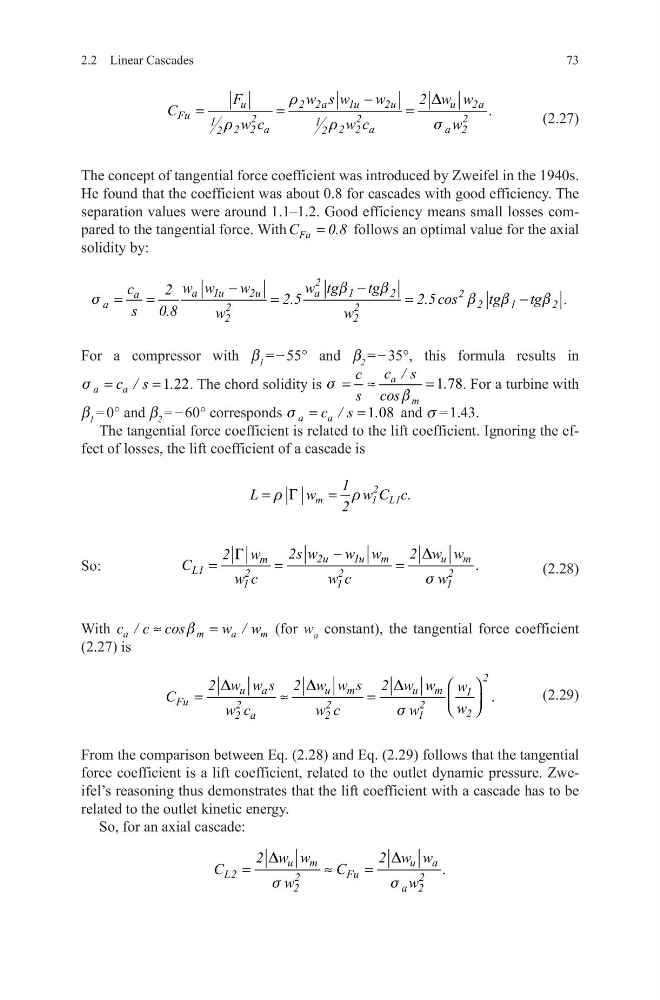
The concept of tangential force coefficient was introduced by Zweifel in the 1940s.
He found that the coefficient was about 0.8 for cascades with good efficiency. The
separation values were around 1.1–1.2. Good efficiency means small losses compared to the tangential force. With Fu
C
0.8
=
follows an optimal value for the axial
solidity by:
For a compressor with β 1 = − 55° and β 2 = − 35°, this formula results in
1 22
a
a
c / s .
s =
=
. The chord solidity is
1 78
a
m
c / s
c
.
s cos
s
b
= ≈
=
. For a turbine with
β 1 = 0° and β 2 = − 60° corresponds
1 08
a
a
c / s .
s =
=
and s = 1.43.
The tangential force coefficient is related to the lift coefficient. Ignoring the effect of losses, the lift coefficient of a cascade is
So:
(2.28)
With a
m
a
m
c / c cos
w / w
b
≈
=
(for w a constant), the tangential force coefficient
(2.27) is
(2.29)
From the comparison between Eq. (2.28) and Eq. (2.29) follows that the tangential
force coefficient is a lift coefficient, related to the outlet dynamic pressure. Zweifel’s reasoning thus demonstrates that the lift coefficient with a cascade has to be
related to the outlet kinetic energy.
So, for an axial cascade:
u
2 2a
1u
2u
u 2a
Fu
2
2
2
1
1
2 2 a
2 2 a
a 2
2
2
F
w s w
w
2 w w
C
.
w c
w c
w
r
D
r
r
s
−
=
=
=
2
a 1u
2u
a
1
2
2
a
a
2
1
2
2
2
2
2
w w
w
w tg
tg
c
2
2.5
2.5 cos
tg
tg .
s 0.8
w
w
b
b
s
b
b
b
−
−
=
=
=
=
−
2
m
1 L1
1
L
w
w C c.
2
r G
r
=
=
.
2u
1u m
u m
m
L1
2
2
2
1
1
1
2s w
w w
2 w w
2 w
C
w c
w c
w
D
G
s
−
=
=
=
.
2
u a
u m
u m
1
Fu
2
2
2
2
2 a
2
1
2 w w s 2 w w s 2 w w w
C
w
w c
w c
w
D
D
D
s
=
≈
=
.
u m
u a
L2
Fu
2
2
2
a 2
2 w w
2 w w
C
C
w
w
D
D
s
s
=
≈
=
2.2 Linear Cascades
(2.27)
The concept of tangential force coefficient was introduced by Zweifel in the 1940s.
He found that the coefficient was about 0.8 for cascades with good efficiency. The
separation values were around 1.1–1.2. Good efficiency means small losses compared to the tangential force. With Fu
C
0.8
=
follows an optimal value for the axial
solidity by:
For a compressor with β 1 = − 55° and β 2 = − 35°, this formula results in
1 22
a
a
c / s .
s =
=
. The chord solidity is
1 78
a
m
c / s
c
.
s cos
s
b
= ≈
=
. For a turbine with
β 1 = 0° and β 2 = − 60° corresponds
1 08
a
a
c / s .
s =
=
and s = 1.43.
The tangential force coefficient is related to the lift coefficient. Ignoring the effect of losses, the lift coefficient of a cascade is
So:
(2.28)
With a
m
a
m
c / c cos
w / w
b
≈
=
(for w a constant), the tangential force coefficient
(2.27) is
(2.29)
From the comparison between Eq. (2.28) and Eq. (2.29) follows that the tangential
force coefficient is a lift coefficient, related to the outlet dynamic pressure. Zweifel’s reasoning thus demonstrates that the lift coefficient with a cascade has to be
related to the outlet kinetic energy.
So, for an axial cascade:
u
2 2a
1u
2u
u 2a
Fu
2
2
2
1
1
2 2 a
2 2 a
a 2
2
2
F
w s w
w
2 w w
C
.
w c
w c
w
r
D
r
r
s
−
=
=
=
2
a 1u
2u
a
1
2
2
a
a
2
1
2
2
2
2
2
w w
w
w tg
tg
c
2
2.5
2.5 cos
tg
tg .
s 0.8
w
w
b
b
s
b
b
b
−
−
=
=
=
=
−
2
m
1 L1
1
L
w
w C c.
2
r G
r
=
=
.
2u
1u m
u m
m
L1
2
2
2
1
1
1
2s w
w w
2 w w
2 w
C
w c
w c
w
D
G
s
−
=
=
=
.
2
u a
u m
u m
1
Fu
2
2
2
2
2 a
2
1
2 w w s 2 w w s 2 w w w
C
w
w c
w c
w
D
D
D
s
=
≈
=
.
u m
u a
L2
Fu
2
2
2
a 2
2 w w
2 w w
C
C
w
w
D
D
s
s
=
≈
=