

56
2 Basic Components
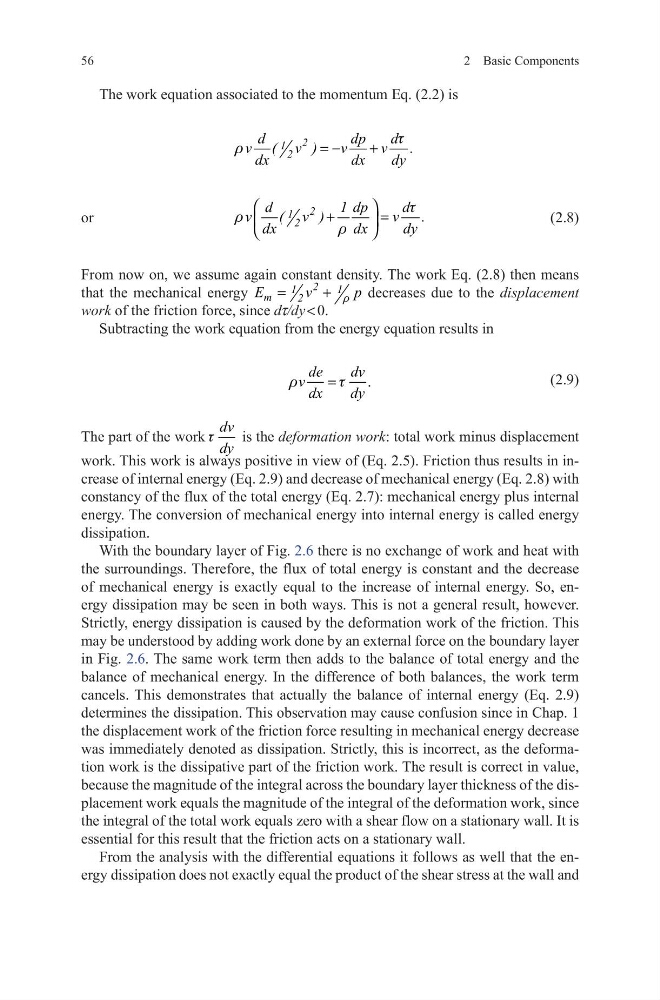
The work equation associated to the momentum Eq. (2.2) is
or
(2.8)
From now on, we assume again constant density. The work Eq. (2.8) then means
that the mechanical energy
2
1
1
m
2
E
v
p
r
=
+
decreases due to the displacement
work of the friction force, since dτ/dy < 0.
Subtracting the work equation from the energy equation results in
(2.9)
The part of the work
dv
dy
t
is the deformation work: total work minus displacement
work. This work is always positive in view of (Eq. 2.5). Friction thus results in increase of internal energy (Eq. 2.9) and decrease of mechanical energy (Eq. 2.8) with
constancy of the flux of the total energy (Eq. 2.7): mechanical energy plus internal
energy. The conversion of mechanical energy into internal energy is called energy
dissipation.
With the boundary layer of Fig. 2.6 there is no exchange of work and heat with
the surroundings. Therefore, the flux of total energy is constant and the decrease
of mechanical energy is exactly equal to the increase of internal energy. So, energy dissipation may be seen in both ways. This is not a general result, however.
Strictly, energy dissipation is caused by the deformation work of the friction. This
may be understood by adding work done by an external force on the boundary layer
in Fig. 2.6. The same work term then adds to the balance of total energy and the
balance of mechanical energy. In the difference of both balances, the work term
cancels. This demonstrates that actually the balance of internal energy (Eq. 2.9)
determines the dissipation. This observation may cause confusion since in Chap. 1
the displacement work of the friction force resulting in mechanical energy decrease
was immediately denoted as dissipation. Strictly, this is incorrect, as the deformation work is the dissipative part of the friction work. The result is correct in value,
because the magnitude of the integral across the boundary layer thickness of the displacement work equals the magnitude of the integral of the deformation work, since
the integral of the total work equals zero with a shear flow on a stationary wall. It is
essential for this result that the friction acts on a stationary wall.
From the analysis with the differential equations it follows as well that the energy dissipation does not exactly equal the product of the shear stress at the wall and
2
1 2
2
1 2
d
dp
d
v ( v )
v
v
.
dx
dx
dy
d
1 dp
d
v
( v )
v
.
dx
dx
dy
t
r
t
r
r
= −
+
+
=
.
de
dv
v dx
dy
r
t
=
2 Basic Components
The work equation associated to the momentum Eq. (2.2) is
or
(2.8)
From now on, we assume again constant density. The work Eq. (2.8) then means
that the mechanical energy
2
1
1
m
2
E
v
p
r
=
+
decreases due to the displacement
work of the friction force, since dτ/dy < 0.
Subtracting the work equation from the energy equation results in
(2.9)
The part of the work
dv
dy
t
is the deformation work: total work minus displacement
work. This work is always positive in view of (Eq. 2.5). Friction thus results in increase of internal energy (Eq. 2.9) and decrease of mechanical energy (Eq. 2.8) with
constancy of the flux of the total energy (Eq. 2.7): mechanical energy plus internal
energy. The conversion of mechanical energy into internal energy is called energy
dissipation.
With the boundary layer of Fig. 2.6 there is no exchange of work and heat with
the surroundings. Therefore, the flux of total energy is constant and the decrease
of mechanical energy is exactly equal to the increase of internal energy. So, energy dissipation may be seen in both ways. This is not a general result, however.
Strictly, energy dissipation is caused by the deformation work of the friction. This
may be understood by adding work done by an external force on the boundary layer
in Fig. 2.6. The same work term then adds to the balance of total energy and the
balance of mechanical energy. In the difference of both balances, the work term
cancels. This demonstrates that actually the balance of internal energy (Eq. 2.9)
determines the dissipation. This observation may cause confusion since in Chap. 1
the displacement work of the friction force resulting in mechanical energy decrease
was immediately denoted as dissipation. Strictly, this is incorrect, as the deformation work is the dissipative part of the friction work. The result is correct in value,
because the magnitude of the integral across the boundary layer thickness of the displacement work equals the magnitude of the integral of the deformation work, since
the integral of the total work equals zero with a shear flow on a stationary wall. It is
essential for this result that the friction acts on a stationary wall.
From the analysis with the differential equations it follows as well that the energy dissipation does not exactly equal the product of the shear stress at the wall and
2
1 2
2
1 2
d
dp
d
v ( v )
v
v
.
dx
dx
dy
d
1 dp
d
v
( v )
v
.
dx
dx
dy
t
r
t
r
r
= −
+
+
=
.
de
dv
v dx
dy
r
t
=