

36
1 Working Principles
1.8 Performance Characteristics
By a performance characteristic is meant a relationship between two operation
quantities, such as flow rate, manometric head, power, etc., with constant other
quantities. In principle, many such relations can be defined. In practice however,
only a few are relevant.
With a hydraulic turbine, normally, the head is constant. The same applies to
rotational speed, as the turbine typically drives a generator with a fixed rotational
speed. With a constant geometry, this machine does not have any variable operation
quantities. At a fixed head and rotational speed, the flow rate and power can only
be varied by changing the rotor blade pitch angle (the angle of the blade chord with
respect to the meridional plane) of an axial turbine (see Fig. 1.1). A characteristic
may thus be: the power as a function of the rotor blade pitch angle at a constant
rotational speed and a constant head.
With a pump, the rotational speed is set by the driving motor. The load is typically a piping system filling a reservoir under pressure (see Fig. 1.16). The pressure
within the reservoir is variable, for instance due to the presence of an air-filled bag.
With an installation for household use, it is normal to vary the reservoir pressure
between 1.5 and 3 bar. A pressure sensor starts the pump when the pressure falls
under the set minimum (1.5 bar) and stops the pump when pressure exceeds the
maximum (3 bar). The pump thus functions at a variable manometric head. The
change of manometric head affects the flow rate. The characteristic of a pump is
thus normally understood to mean the relation between manometric head and flow
rate at a constant rotational speed.
The form of this relation may easily be derived from the rotor work. As an
example, we take the centrifugal pump in Fig. 1.14. Assume that the velocity
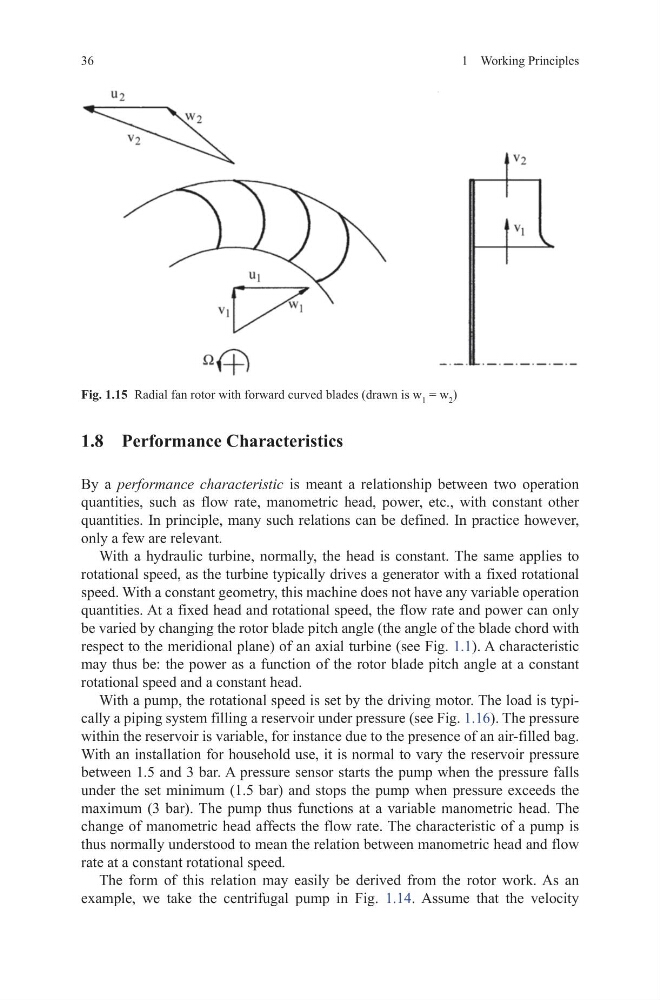
Fig. 1.15 Radial fan rotor with forward curved blades (drawn is w 1 = w 2 )
1 Working Principles
1.8 Performance Characteristics
By a performance characteristic is meant a relationship between two operation
quantities, such as flow rate, manometric head, power, etc., with constant other
quantities. In principle, many such relations can be defined. In practice however,
only a few are relevant.
With a hydraulic turbine, normally, the head is constant. The same applies to
rotational speed, as the turbine typically drives a generator with a fixed rotational
speed. With a constant geometry, this machine does not have any variable operation
quantities. At a fixed head and rotational speed, the flow rate and power can only
be varied by changing the rotor blade pitch angle (the angle of the blade chord with
respect to the meridional plane) of an axial turbine (see Fig. 1.1). A characteristic
may thus be: the power as a function of the rotor blade pitch angle at a constant
rotational speed and a constant head.
With a pump, the rotational speed is set by the driving motor. The load is typically a piping system filling a reservoir under pressure (see Fig. 1.16). The pressure
within the reservoir is variable, for instance due to the presence of an air-filled bag.
With an installation for household use, it is normal to vary the reservoir pressure
between 1.5 and 3 bar. A pressure sensor starts the pump when the pressure falls
under the set minimum (1.5 bar) and stops the pump when pressure exceeds the
maximum (3 bar). The pump thus functions at a variable manometric head. The
change of manometric head affects the flow rate. The characteristic of a pump is
thus normally understood to mean the relation between manometric head and flow
rate at a constant rotational speed.
The form of this relation may easily be derived from the rotor work. As an
example, we take the centrifugal pump in Fig. 1.14. Assume that the velocity
Fig. 1.15 Radial fan rotor with forward curved blades (drawn is w 1 = w 2 )