

528
14 Radial Compressors
The divergence angle of the channels formed by the vanes must be limited to about
10–12° in order to avoid separation. So, strong velocity reduction requires a large
radius ratio, which makes channel diffusers more efficient. They mostly start from
a square throat section, with an increasing width within the orthogonal plane and
constant axial width. The blades are called vane islands or blades with blunt trailing
edge. With a given divergence angle and radius ratio, these diffusers attain a higher
velocity reduction, as the tangential velocity component decreases more strongly.
The sudden widening at the outlet generates a dump diffusion loss. This dump loss
is not very significant, as it only affects the radial velocity component. The cascade diffuser is the most efficient one with a weaker velocity reduction within the
diffuser. The channel diffuser is better for a stronger velocity reduction. Some designs come in between, being cascade diffusers with blades with finite trailing edge
thickness or curved channel diffusers. The pipe diffuser is a variant of the channel
diffuser. Pipe diffusers feature a cylindrical throat and a conical divergent. They are
seldom used, as their construction is more complicated and they feature no advantages compared to channel diffusers. Separation occurs under off-design conditions
with reduced flow rate. The separation may be rotating or pulsating. Flow rate increase generates choking when the sonic speed is attained in the entrance region of
a vane channel.
14.6 Performance Characteristics
14.6.1 Flow Instability
Reduced flow rate compared to the design flow rate, at constant rotational speed,
may generate rotating stall within the inducer or within a vaned diffuser. Rotating flow reversal may occur within a vaneless diffuser. These phenomena generate
losses, causing a decrease of the pressure ratio of the compressor, which generates
a maximum in the characteristic for pressure ratio as a function of mass flow rate.
There is also a maximum in the characteristic with radial end blades or with small
backward sweep, without these phenomena. This implies that surge then may occur
without rotating stall or rotating flow reversal (partial separation).
14.6.2 Choking
The choking conditions in rotor and stator are the same as with axial compressors.
So, expressions (13.19) and (13.21) describe approximately the choking mass flow
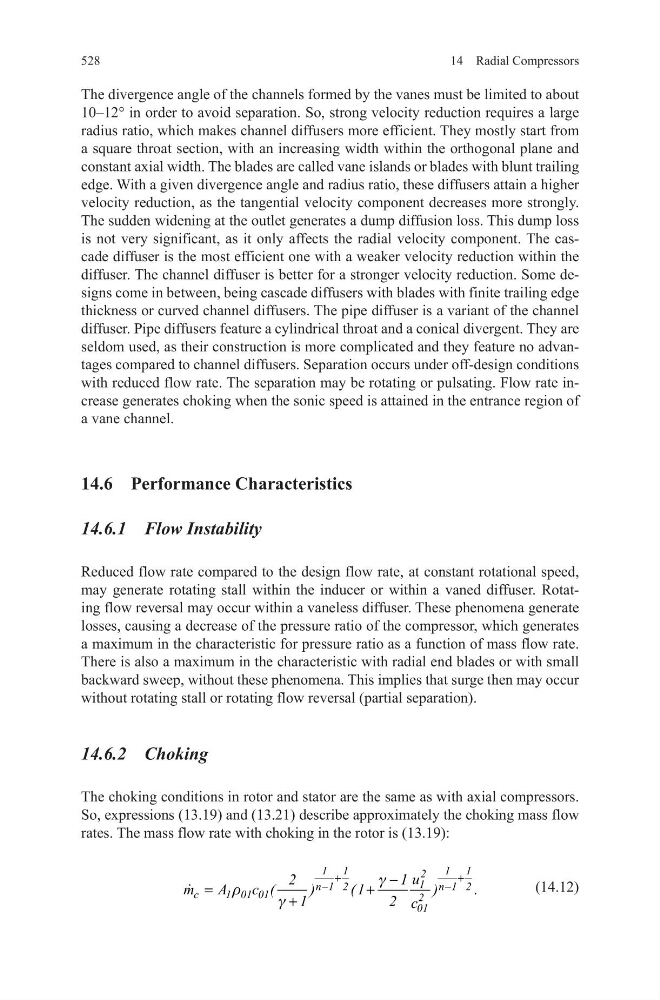
rates. The mass flow rate with choking in the rotor is (13.19):
(14.12)
g
r
g
+
+
−
−
−
=
+
+
1 1
1 1
2
1
n 1 2
n 1 2
c
1 01 01
2
01
u
2
1
m
A
c (
)
( 1
)
.
1
2 c
14 Radial Compressors
The divergence angle of the channels formed by the vanes must be limited to about
10–12° in order to avoid separation. So, strong velocity reduction requires a large
radius ratio, which makes channel diffusers more efficient. They mostly start from
a square throat section, with an increasing width within the orthogonal plane and
constant axial width. The blades are called vane islands or blades with blunt trailing
edge. With a given divergence angle and radius ratio, these diffusers attain a higher
velocity reduction, as the tangential velocity component decreases more strongly.
The sudden widening at the outlet generates a dump diffusion loss. This dump loss
is not very significant, as it only affects the radial velocity component. The cascade diffuser is the most efficient one with a weaker velocity reduction within the
diffuser. The channel diffuser is better for a stronger velocity reduction. Some designs come in between, being cascade diffusers with blades with finite trailing edge
thickness or curved channel diffusers. The pipe diffuser is a variant of the channel
diffuser. Pipe diffusers feature a cylindrical throat and a conical divergent. They are
seldom used, as their construction is more complicated and they feature no advantages compared to channel diffusers. Separation occurs under off-design conditions
with reduced flow rate. The separation may be rotating or pulsating. Flow rate increase generates choking when the sonic speed is attained in the entrance region of
a vane channel.
14.6 Performance Characteristics
14.6.1 Flow Instability
Reduced flow rate compared to the design flow rate, at constant rotational speed,
may generate rotating stall within the inducer or within a vaned diffuser. Rotating flow reversal may occur within a vaneless diffuser. These phenomena generate
losses, causing a decrease of the pressure ratio of the compressor, which generates
a maximum in the characteristic for pressure ratio as a function of mass flow rate.
There is also a maximum in the characteristic with radial end blades or with small
backward sweep, without these phenomena. This implies that surge then may occur
without rotating stall or rotating flow reversal (partial separation).
14.6.2 Choking
The choking conditions in rotor and stator are the same as with axial compressors.
So, expressions (13.19) and (13.21) describe approximately the choking mass flow
rates. The mass flow rate with choking in the rotor is (13.19):
(14.12)
g
r
g
+
+
−
−
−
=
+
+
1 1
1 1
2
1
n 1 2
n 1 2
c
1 01 01
2
01
u
2
1
m
A
c (
)
( 1
)
.
1
2 c