

496
13 Axial Compressors
13.4.3 Supersonic Cascades and Transonic Cascades with High
Inlet Mach Number
In compressor terminology a cascade is supersonic when both inlet and outlet Mach
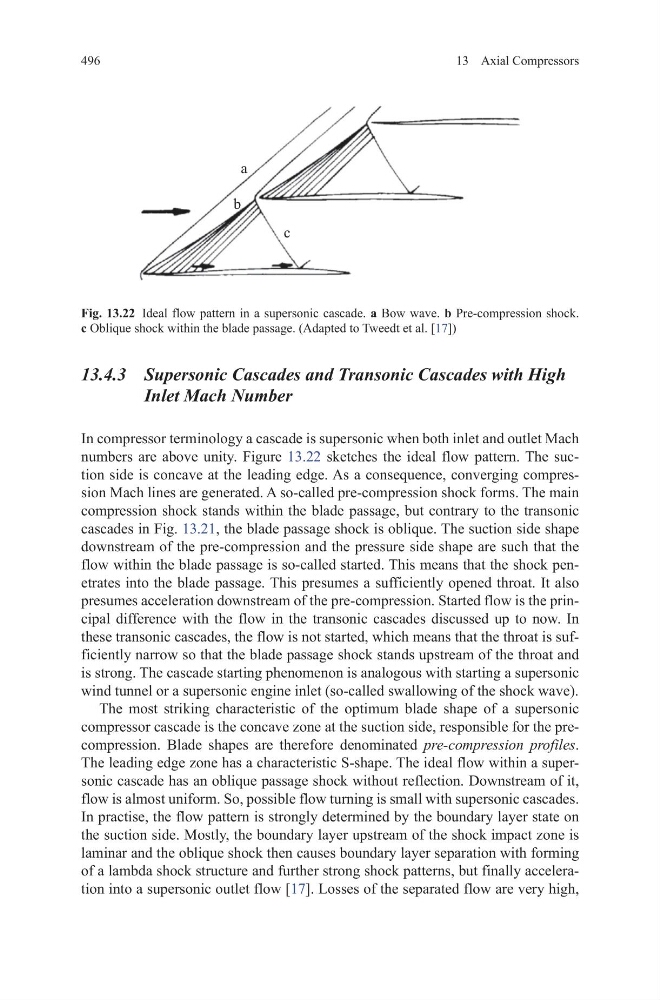
numbers are above unity. Figure 13.22 sketches the ideal flow pattern. The suction side is concave at the leading edge. As a consequence, converging compression Mach lines are generated. A so-called pre-compression shock forms. The main
compression shock stands within the blade passage, but contrary to the transonic
cascades in Fig. 13.21, the blade passage shock is oblique. The suction side shape
downstream of the pre-compression and the pressure side shape are such that the
flow within the blade passage is so-called started. This means that the shock penetrates into the blade passage. This presumes a sufficiently opened throat. It also
presumes acceleration downstream of the pre-compression. Started flow is the principal difference with the flow in the transonic cascades discussed up to now. In
these transonic cascades, the flow is not started, which means that the throat is sufficiently narrow so that the blade passage shock stands upstream of the throat and
is strong. The cascade starting phenomenon is analogous with starting a supersonic
wind tunnel or a supersonic engine inlet (so-called swallowing of the shock wave).
The most striking characteristic of the optimum blade shape of a supersonic
compressor cascade is the concave zone at the suction side, responsible for the precompression. Blade shapes are therefore denominated pre-compression profiles.
The leading edge zone has a characteristic S-shape. The ideal flow within a supersonic cascade has an oblique passage shock without reflection. Downstream of it,
flow is almost uniform. So, possible flow turning is small with supersonic cascades.
In practise, the flow pattern is strongly determined by the boundary layer state on
the suction side. Mostly, the boundary layer upstream of the shock impact zone is
laminar and the oblique shock then causes boundary layer separation with forming
of a lambda shock structure and further strong shock patterns, but finally acceleration into a supersonic outlet flow [17]. Losses of the separated flow are very high,
E
F
D
Fig. 13.22 Ideal flow pattern in a supersonic cascade. a Bow wave. b Pre-compression shock.
c Oblique shock within the blade passage. (Adapted to Tweedt et al. [17])
13 Axial Compressors
13.4.3 Supersonic Cascades and Transonic Cascades with High
Inlet Mach Number
In compressor terminology a cascade is supersonic when both inlet and outlet Mach
numbers are above unity. Figure 13.22 sketches the ideal flow pattern. The suction side is concave at the leading edge. As a consequence, converging compression Mach lines are generated. A so-called pre-compression shock forms. The main
compression shock stands within the blade passage, but contrary to the transonic
cascades in Fig. 13.21, the blade passage shock is oblique. The suction side shape
downstream of the pre-compression and the pressure side shape are such that the
flow within the blade passage is so-called started. This means that the shock penetrates into the blade passage. This presumes a sufficiently opened throat. It also
presumes acceleration downstream of the pre-compression. Started flow is the principal difference with the flow in the transonic cascades discussed up to now. In
these transonic cascades, the flow is not started, which means that the throat is sufficiently narrow so that the blade passage shock stands upstream of the throat and
is strong. The cascade starting phenomenon is analogous with starting a supersonic
wind tunnel or a supersonic engine inlet (so-called swallowing of the shock wave).
The most striking characteristic of the optimum blade shape of a supersonic
compressor cascade is the concave zone at the suction side, responsible for the precompression. Blade shapes are therefore denominated pre-compression profiles.
The leading edge zone has a characteristic S-shape. The ideal flow within a supersonic cascade has an oblique passage shock without reflection. Downstream of it,
flow is almost uniform. So, possible flow turning is small with supersonic cascades.
In practise, the flow pattern is strongly determined by the boundary layer state on
the suction side. Mostly, the boundary layer upstream of the shock impact zone is
laminar and the oblique shock then causes boundary layer separation with forming
of a lambda shock structure and further strong shock patterns, but finally acceleration into a supersonic outlet flow [17]. Losses of the separated flow are very high,
E
F
D
Fig. 13.22 Ideal flow pattern in a supersonic cascade. a Bow wave. b Pre-compression shock.
c Oblique shock within the blade passage. (Adapted to Tweedt et al. [17])