

489
13.3 Radial Flow Variation
dimensional flow simulations, and optimisation of the stacking is quite complex.
The main objectives of the shifts can be understood from fundamental arguments,
however, as discussed hereafter.
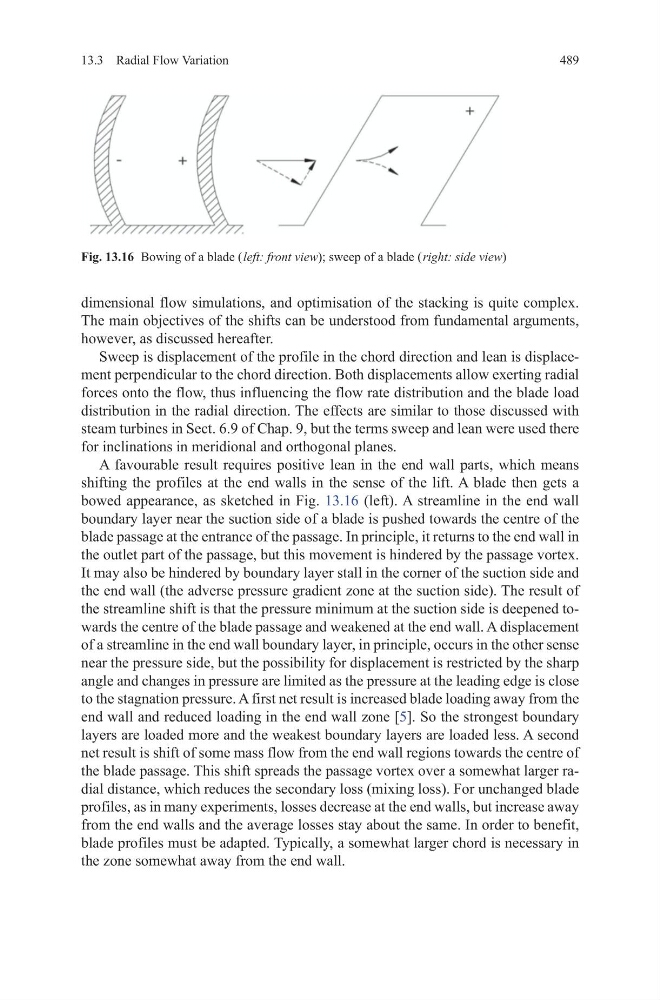
Sweep is displacement of the profile in the chord direction and lean is displacement perpendicular to the chord direction. Both displacements allow exerting radial
forces onto the flow, thus influencing the flow rate distribution and the blade load
distribution in the radial direction. The effects are similar to those discussed with
steam turbines in Sect. 6.9 of Chap. 9, but the terms sweep and lean were used there
for inclinations in meridional and orthogonal planes.
A favourable result requires positive lean in the end wall parts, which means
shifting the profiles at the end walls in the sense of the lift. A blade then gets a
bowed appearance, as sketched in Fig. 13.16 (left). A streamline in the end wall
boundary layer near the suction side of a blade is pushed towards the centre of the
blade passage at the entrance of the passage. In principle, it returns to the end wall in
the outlet part of the passage, but this movement is hindered by the passage vortex.
It may also be hindered by boundary layer stall in the corner of the suction side and
the end wall (the adverse pressure gradient zone at the suction side). The result of
the streamline shift is that the pressure minimum at the suction side is deepened towards the centre of the blade passage and weakened at the end wall. A displacement
of a streamline in the end wall boundary layer, in principle, occurs in the other sense
near the pressure side, but the possibility for displacement is restricted by the sharp
angle and changes in pressure are limited as the pressure at the leading edge is close
to the stagnation pressure. A first net result is increased blade loading away from the
end wall and reduced loading in the end wall zone [5]. So the strongest boundary
layers are loaded more and the weakest boundary layers are loaded less. A second
net result is shift of some mass flow from the end wall regions towards the centre of
the blade passage. This shift spreads the passage vortex over a somewhat larger radial distance, which reduces the secondary loss (mixing loss). For unchanged blade
profiles, as in many experiments, losses decrease at the end walls, but increase away
from the end walls and the average losses stay about the same. In order to benefit,
blade profiles must be adapted. Typically, a somewhat larger chord is necessary in
the zone somewhat away from the end wall.
Fig. 13.16 Bowing of a blade ( left: front view); sweep of a blade ( right: side view)
13.3 Radial Flow Variation
dimensional flow simulations, and optimisation of the stacking is quite complex.
The main objectives of the shifts can be understood from fundamental arguments,
however, as discussed hereafter.
Sweep is displacement of the profile in the chord direction and lean is displacement perpendicular to the chord direction. Both displacements allow exerting radial
forces onto the flow, thus influencing the flow rate distribution and the blade load
distribution in the radial direction. The effects are similar to those discussed with
steam turbines in Sect. 6.9 of Chap. 9, but the terms sweep and lean were used there
for inclinations in meridional and orthogonal planes.
A favourable result requires positive lean in the end wall parts, which means
shifting the profiles at the end walls in the sense of the lift. A blade then gets a
bowed appearance, as sketched in Fig. 13.16 (left). A streamline in the end wall
boundary layer near the suction side of a blade is pushed towards the centre of the
blade passage at the entrance of the passage. In principle, it returns to the end wall in
the outlet part of the passage, but this movement is hindered by the passage vortex.
It may also be hindered by boundary layer stall in the corner of the suction side and
the end wall (the adverse pressure gradient zone at the suction side). The result of
the streamline shift is that the pressure minimum at the suction side is deepened towards the centre of the blade passage and weakened at the end wall. A displacement
of a streamline in the end wall boundary layer, in principle, occurs in the other sense
near the pressure side, but the possibility for displacement is restricted by the sharp
angle and changes in pressure are limited as the pressure at the leading edge is close
to the stagnation pressure. A first net result is increased blade loading away from the
end wall and reduced loading in the end wall zone [5]. So the strongest boundary
layers are loaded more and the weakest boundary layers are loaded less. A second
net result is shift of some mass flow from the end wall regions towards the centre of
the blade passage. This shift spreads the passage vortex over a somewhat larger radial distance, which reduces the secondary loss (mixing loss). For unchanged blade
profiles, as in many experiments, losses decrease at the end walls, but increase away
from the end walls and the average losses stay about the same. In order to benefit,
blade profiles must be adapted. Typically, a somewhat larger chord is necessary in
the zone somewhat away from the end wall.
Fig. 13.16 Bowing of a blade ( left: front view); sweep of a blade ( right: side view)