

488
13 Axial Compressors
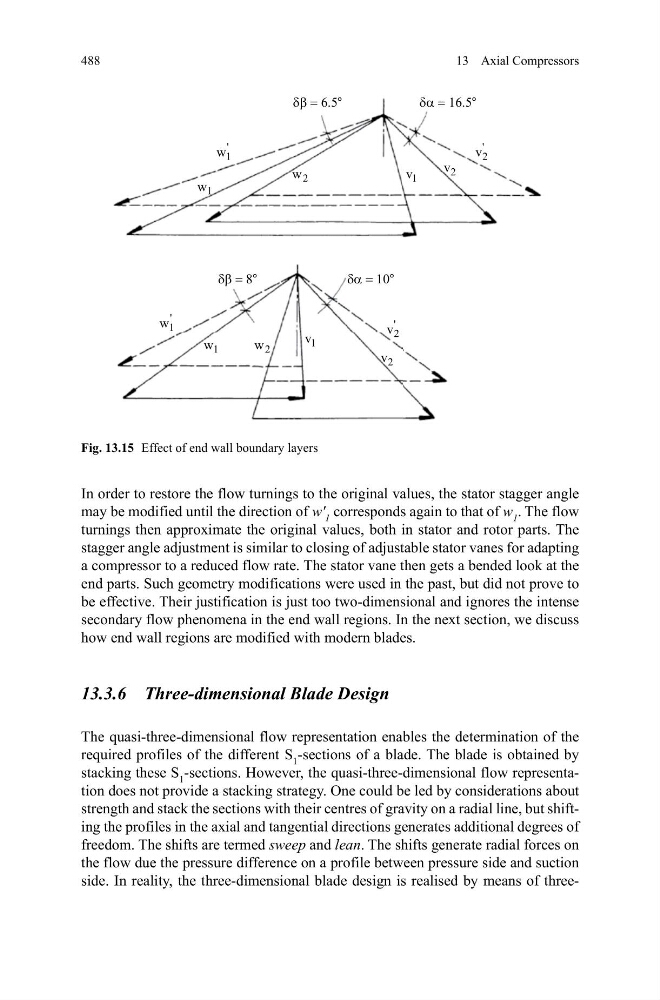
In order to restore the flow turnings to the original values, the stator stagger angle
may be modified until the direction of w' 1 corresponds again to that of w 1 . The flow
turnings then approximate the original values, both in stator and rotor parts. The
stagger angle adjustment is similar to closing of adjustable stator vanes for adapting
a compressor to a reduced flow rate. The stator vane then gets a bended look at the
end parts. Such geometry modifications were used in the past, but did not prove to
be effective. Their justification is just too two-dimensional and ignores the intense
secondary flow phenomena in the end wall regions. In the next section, we discuss
how end wall regions are modified with modern blades.
13.3.6 Three-dimensional Blade Design
The quasi-three-dimensional flow representation enables the determination of the
required profiles of the different S 1 -sections of a blade. The blade is obtained by
stacking these S 1 -sections. However, the quasi-three-dimensional flow representation does not provide a stacking strategy. One could be led by considerations about
strength and stack the sections with their centres of gravity on a radial line, but shifting the profiles in the axial and tangential directions generates additional degrees of
freedom. The shifts are termed sweep and lean. The shifts generate radial forces on
the flow due the pressure difference on a profile between pressure side and suction
side. In reality, the three-dimensional blade design is realised by means of threeZ
Z
Z
Y
Y
Y
Z
Z
Z
Y
Y
Y
GE °
GD °
GD °
GE °
Fig. 13.15 Effect of end wall boundary layers
13 Axial Compressors
In order to restore the flow turnings to the original values, the stator stagger angle
may be modified until the direction of w' 1 corresponds again to that of w 1 . The flow
turnings then approximate the original values, both in stator and rotor parts. The
stagger angle adjustment is similar to closing of adjustable stator vanes for adapting
a compressor to a reduced flow rate. The stator vane then gets a bended look at the
end parts. Such geometry modifications were used in the past, but did not prove to
be effective. Their justification is just too two-dimensional and ignores the intense
secondary flow phenomena in the end wall regions. In the next section, we discuss
how end wall regions are modified with modern blades.
13.3.6 Three-dimensional Blade Design
The quasi-three-dimensional flow representation enables the determination of the
required profiles of the different S 1 -sections of a blade. The blade is obtained by
stacking these S 1 -sections. However, the quasi-three-dimensional flow representation does not provide a stacking strategy. One could be led by considerations about
strength and stack the sections with their centres of gravity on a radial line, but shifting the profiles in the axial and tangential directions generates additional degrees of
freedom. The shifts are termed sweep and lean. The shifts generate radial forces on
the flow due the pressure difference on a profile between pressure side and suction
side. In reality, the three-dimensional blade design is realised by means of threeZ
Z
Z
Y
Y
Y
Z
Z
Z
Y
Y
Y
GE °
GD °
GD °
GE °
Fig. 13.15 Effect of end wall boundary layers