

475
13.1 Mean Line Analysis
Because of both effects, a degree of reaction on the average radius above R = 0.5
is better. Typical values at optimum are (see Sect. 13.3):
Average radius
R = 0.7, ψ = 0.4, ϕ = 0.5
Casing
R = 0.8, ψ = 0.3, ϕ = 0.4
Hub
R = 0.5, ψ = 0.7, ϕ = 0.65
Figure 13.9 sketches the corresponding dimensionless velocity triangles for constant axial velocity (see the later Table 13.2). Due to the deceleration ratio limitation
of 2 1
/
0.70
w w ≈
and 1 2
/
0.70
v v ≈
at the hub, limiting the possible flow turning,
ψ on the average radius cannot be higher than about 0.4. The value of ϕ should be
chosen as large as possible in order to allow the greatest possible flow rate through
the compressor. But ~
V
u
f and
2
∆ =
W
u
y . With regard to stage work it is more
advantageous to choose the blade speed u as high as possible and to choose ϕ rather
low, taking into account that the Mach number of w 1 should be limited at the casing.
With an aero-engine compressor, the average radius blade speed typically amounts
to about 360 m/s, being about the speed of sound, so that the Mach number corresponding to w 1 at the casing is about 1.25 (Fig. 13.9). This can hardly be increased
without generating great losses by shock waves. These considerations explain the
typical values of degree of reaction, work coefficient and flow coefficient, given
above. These values are not universal however. The exact optimum depends very
much on the boundary layer status on the end walls, determined strongly by losses
in previous stages, and the relative importance of secondary losses and end wall
boundary losses, determined strongly by the aspect ratio of the blades (height to
chord ratio). The cited values are typical for stages with important secondary losses
(aspect ratio around two and not front stages), but still high ratio of casing radius
to hub radius, as the second and third stages of the low-pressure compressor of an
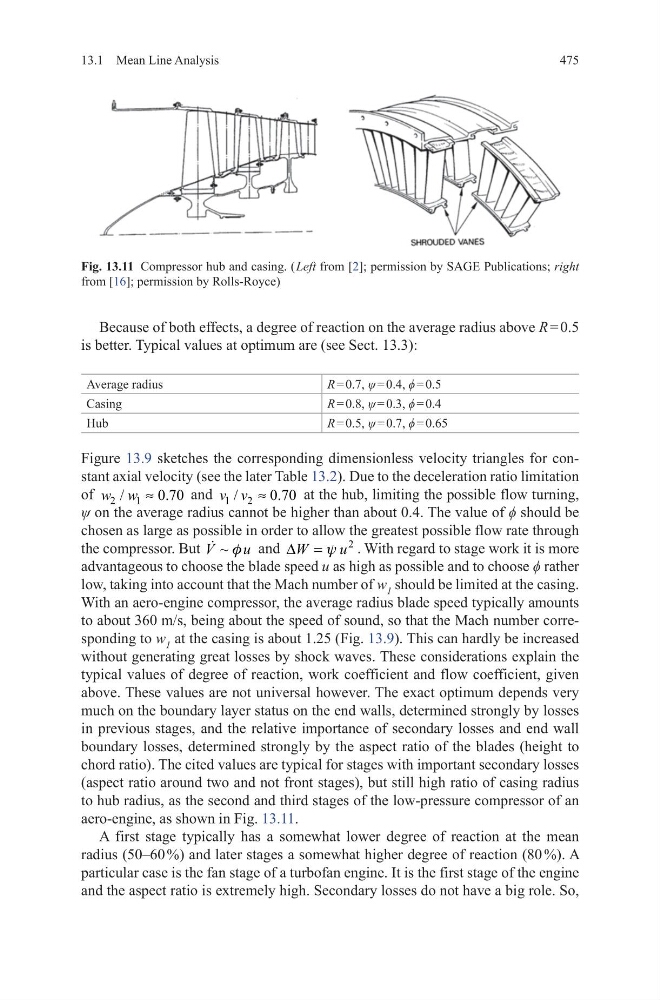
aero-engine, as shown in Fig. 13.11.
A first stage typically has a somewhat lower degree of reaction at the mean
radius (50–60 %) and later stages a somewhat higher degree of reaction (80 %). A
particular case is the fan stage of a turbofan engine. It is the first stage of the engine
and the aspect ratio is extremely high. Secondary losses do not have a big role. So,
Fig. 13.11 Compressor hub and casing. ( Left from [2]; permission by SAGE Publications; right
from [16]; permission by Rolls-Royce)
13.1 Mean Line Analysis
Because of both effects, a degree of reaction on the average radius above R = 0.5
is better. Typical values at optimum are (see Sect. 13.3):
Average radius
R = 0.7, ψ = 0.4, ϕ = 0.5
Casing
R = 0.8, ψ = 0.3, ϕ = 0.4
Hub
R = 0.5, ψ = 0.7, ϕ = 0.65
Figure 13.9 sketches the corresponding dimensionless velocity triangles for constant axial velocity (see the later Table 13.2). Due to the deceleration ratio limitation
of 2 1
/
0.70
w w ≈
and 1 2
/
0.70
v v ≈
at the hub, limiting the possible flow turning,
ψ on the average radius cannot be higher than about 0.4. The value of ϕ should be
chosen as large as possible in order to allow the greatest possible flow rate through
the compressor. But ~
V
u
f and
2
∆ =
W
u
y . With regard to stage work it is more
advantageous to choose the blade speed u as high as possible and to choose ϕ rather
low, taking into account that the Mach number of w 1 should be limited at the casing.
With an aero-engine compressor, the average radius blade speed typically amounts
to about 360 m/s, being about the speed of sound, so that the Mach number corresponding to w 1 at the casing is about 1.25 (Fig. 13.9). This can hardly be increased
without generating great losses by shock waves. These considerations explain the
typical values of degree of reaction, work coefficient and flow coefficient, given
above. These values are not universal however. The exact optimum depends very
much on the boundary layer status on the end walls, determined strongly by losses
in previous stages, and the relative importance of secondary losses and end wall
boundary losses, determined strongly by the aspect ratio of the blades (height to
chord ratio). The cited values are typical for stages with important secondary losses
(aspect ratio around two and not front stages), but still high ratio of casing radius
to hub radius, as the second and third stages of the low-pressure compressor of an
aero-engine, as shown in Fig. 13.11.
A first stage typically has a somewhat lower degree of reaction at the mean
radius (50–60 %) and later stages a somewhat higher degree of reaction (80 %). A
particular case is the fan stage of a turbofan engine. It is the first stage of the engine
and the aspect ratio is extremely high. Secondary losses do not have a big role. So,
Fig. 13.11 Compressor hub and casing. ( Left from [2]; permission by SAGE Publications; right
from [16]; permission by Rolls-Royce)