

473
13.1 Mean Line Analysis
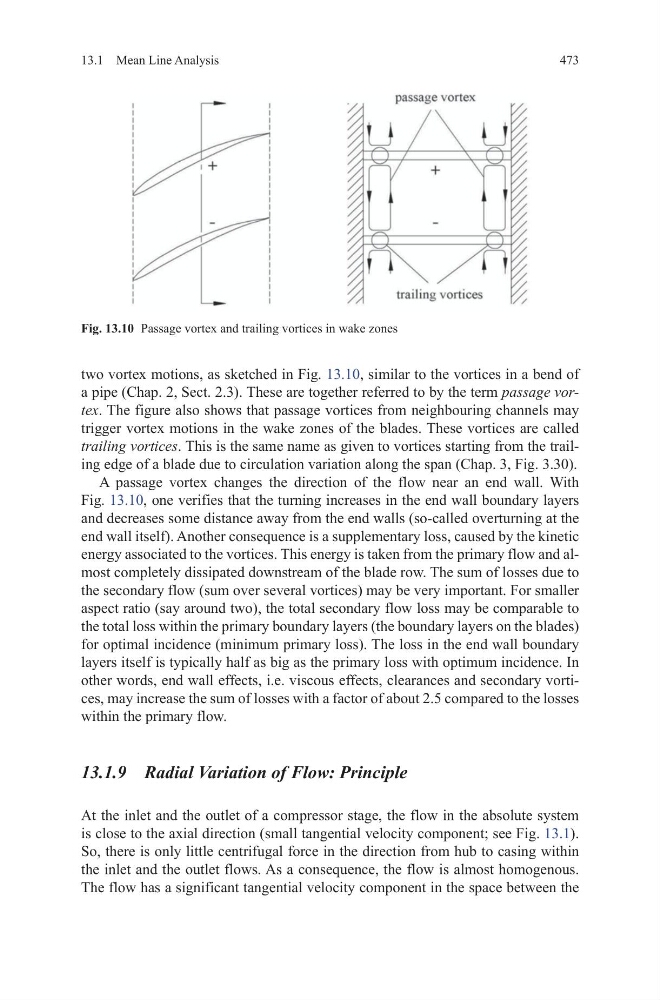
two vortex motions, as sketched in Fig. 13.10, similar to the vortices in a bend of
a pipe (Chap. 2, Sect. 2.3). These are together referred to by the term passage vortex. The figure also shows that passage vortices from neighbouring channels may
trigger vortex motions in the wake zones of the blades. These vortices are called
trailing vortices. This is the same name as given to vortices starting from the trailing edge of a blade due to circulation variation along the span (Chap. 3, Fig. 3.30).
A passage vortex changes the direction of the flow near an end wall. With
Fig. 13.10, one verifies that the turning increases in the end wall boundary layers
and decreases some distance away from the end walls (so-called overturning at the
end wall itself). Another consequence is a supplementary loss, caused by the kinetic
energy associated to the vortices. This energy is taken from the primary flow and almost completely dissipated downstream of the blade row. The sum of losses due to
the secondary flow (sum over several vortices) may be very important. For smaller
aspect ratio (say around two), the total secondary flow loss may be comparable to
the total loss within the primary boundary layers (the boundary layers on the blades)
for optimal incidence (minimum primary loss). The loss in the end wall boundary
layers itself is typically half as big as the primary loss with optimum incidence. In
other words, end wall effects, i.e. viscous effects, clearances and secondary vortices, may increase the sum of losses with a factor of about 2.5 compared to the losses
within the primary flow.
13.1.9 Radial Variation of Flow: Principle
At the inlet and the outlet of a compressor stage, the flow in the absolute system
is close to the axial direction (small tangential velocity component; see Fig. 13.1).
So, there is only little centrifugal force in the direction from hub to casing within
the inlet and the outlet flows. As a consequence, the flow is almost homogenous.
The flow has a significant tangential velocity component in the space between the
Fig. 13.10 Passage vortex and trailing vortices in wake zones
13.1 Mean Line Analysis
two vortex motions, as sketched in Fig. 13.10, similar to the vortices in a bend of
a pipe (Chap. 2, Sect. 2.3). These are together referred to by the term passage vortex. The figure also shows that passage vortices from neighbouring channels may
trigger vortex motions in the wake zones of the blades. These vortices are called
trailing vortices. This is the same name as given to vortices starting from the trailing edge of a blade due to circulation variation along the span (Chap. 3, Fig. 3.30).
A passage vortex changes the direction of the flow near an end wall. With
Fig. 13.10, one verifies that the turning increases in the end wall boundary layers
and decreases some distance away from the end walls (so-called overturning at the
end wall itself). Another consequence is a supplementary loss, caused by the kinetic
energy associated to the vortices. This energy is taken from the primary flow and almost completely dissipated downstream of the blade row. The sum of losses due to
the secondary flow (sum over several vortices) may be very important. For smaller
aspect ratio (say around two), the total secondary flow loss may be comparable to
the total loss within the primary boundary layers (the boundary layers on the blades)
for optimal incidence (minimum primary loss). The loss in the end wall boundary
layers itself is typically half as big as the primary loss with optimum incidence. In
other words, end wall effects, i.e. viscous effects, clearances and secondary vortices, may increase the sum of losses with a factor of about 2.5 compared to the losses
within the primary flow.
13.1.9 Radial Variation of Flow: Principle
At the inlet and the outlet of a compressor stage, the flow in the absolute system
is close to the axial direction (small tangential velocity component; see Fig. 13.1).
So, there is only little centrifugal force in the direction from hub to casing within
the inlet and the outlet flows. As a consequence, the flow is almost homogenous.
The flow has a significant tangential velocity component in the space between the
Fig. 13.10 Passage vortex and trailing vortices in wake zones