

472
13 Axial Compressors
clearances. The primary flow is sometimes defined more restrictively as the flow
on the average radius, which means that the radial variation of the primary flow is
then ignored. The latter simplification is not necessary for a good understanding,
as will emerge from the discussion in Sect. 13.1.10 about flow optimisation. Some
basics of secondary flow and of radial flow variation are required to understand this
optimisation. A detailed discussion of these subjects follows later. Here, we briefly
discuss secondary flow. The next section deals with a brief discussion of radial
variation.
The end wall boundary layers react with the core flow or primary flow. This
generates a series of flow patterns, all of them with a vortex character. We therefore
refer to these as secondary vortices. The dominant vortex is the passage vortex,
which is the result of the turning within the primary flow. A centrifugal force that
is balanced by the pressure difference between the pressure and the suction sides of
the blades corresponds with this turning. But the velocity is lower in the end wall
boundary layers than in the core flow. For the same turning, the centrifugal force
and the pressure difference are weaker there. The consequence is the generation of
U
U
U
Y
Z
Z
Y
Y
Z
Z
Y
Y
Y
Z
Z
§
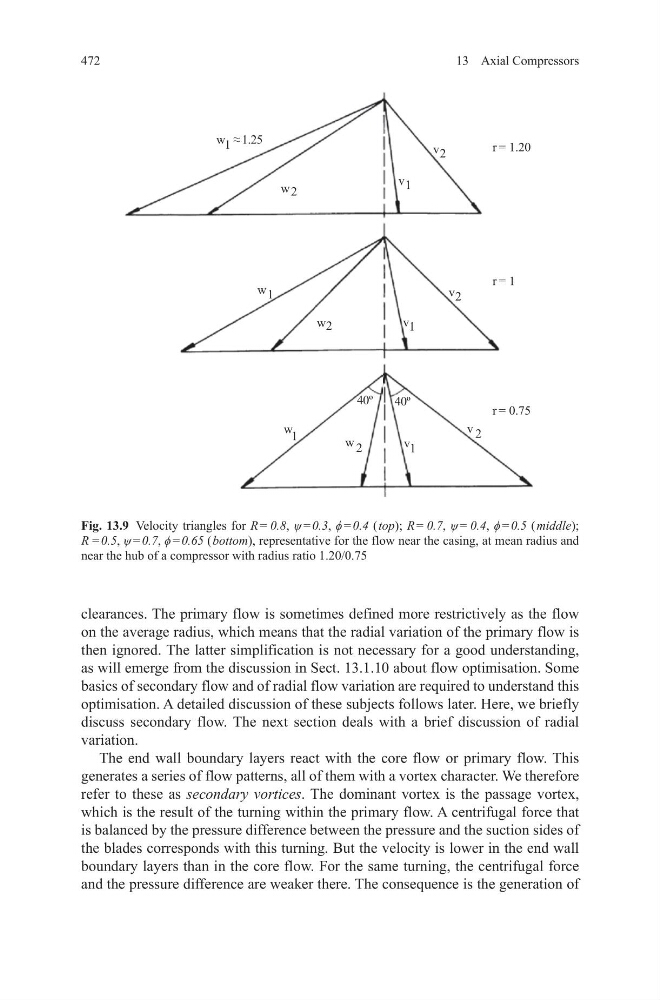
Fig. 13.9 Velocity triangles for R = 0.8, ψ = 0.3, ϕ = 0.4 ( top); R = 0.7, ψ = 0.4, ϕ = 0.5 ( middle);
R = 0.5, ψ = 0.7, ϕ = 0.65 ( bottom), representative for the flow near the casing, at mean radius and
near the hub of a compressor with radius ratio 1.20/0.75
13 Axial Compressors
clearances. The primary flow is sometimes defined more restrictively as the flow
on the average radius, which means that the radial variation of the primary flow is
then ignored. The latter simplification is not necessary for a good understanding,
as will emerge from the discussion in Sect. 13.1.10 about flow optimisation. Some
basics of secondary flow and of radial flow variation are required to understand this
optimisation. A detailed discussion of these subjects follows later. Here, we briefly
discuss secondary flow. The next section deals with a brief discussion of radial
variation.
The end wall boundary layers react with the core flow or primary flow. This
generates a series of flow patterns, all of them with a vortex character. We therefore
refer to these as secondary vortices. The dominant vortex is the passage vortex,
which is the result of the turning within the primary flow. A centrifugal force that
is balanced by the pressure difference between the pressure and the suction sides of
the blades corresponds with this turning. But the velocity is lower in the end wall
boundary layers than in the core flow. For the same turning, the centrifugal force
and the pressure difference are weaker there. The consequence is the generation of
U
U
U
Y
Z
Z
Y
Y
Z
Z
Y
Y
Y
Z
Z
§
Fig. 13.9 Velocity triangles for R = 0.8, ψ = 0.3, ϕ = 0.4 ( top); R = 0.7, ψ = 0.4, ϕ = 0.5 ( middle);
R = 0.5, ψ = 0.7, ϕ = 0.65 ( bottom), representative for the flow near the casing, at mean radius and
near the hub of a compressor with radius ratio 1.20/0.75