

470
13 Axial Compressors
and the diffusion factor. The strong correlation was proven by Lieblein [11]. Figure 13.7 renders the result. The line shown is an average of very many experimental
results, with a small spreading around the line. The loss coefficient rises sharply
from DF = 0.6. This value may be considered as the value above which stall occurs.
DF ≈ 0.45 is mostly accepted as the optimum. It corresponds to the best ratio of the
loss coefficient according to (13.13) to the diffusion factor. Henceforth we apply
this value to determine the optimum solidity. At present, many compressor cascades
have a larger design diffusion factor, namely DF = 0.50 in stator cascades and up to
DF = 0.60 in rotor cascades. Rotor cascades allow a greater diffusion factor as the
boundary layers are reinforced by the centrifugal force (the data of Lieblein are for
stationary cascades). The values DF = 0.50 and DF = 0.60 refer to cascades with
a very high load. The very good correlation shown in Fig. 13.7, together with the
sharp rise of the diffusion factor, proves the robustness of the diffusion factor as a
measure for the cascade loading. To conclude, we remark that the loss coefficient
has a rather good correlation with D loc as well, with a value for strong loss increase
around 0.50 [10, 11].
13.1.7 Kinematic Parameters
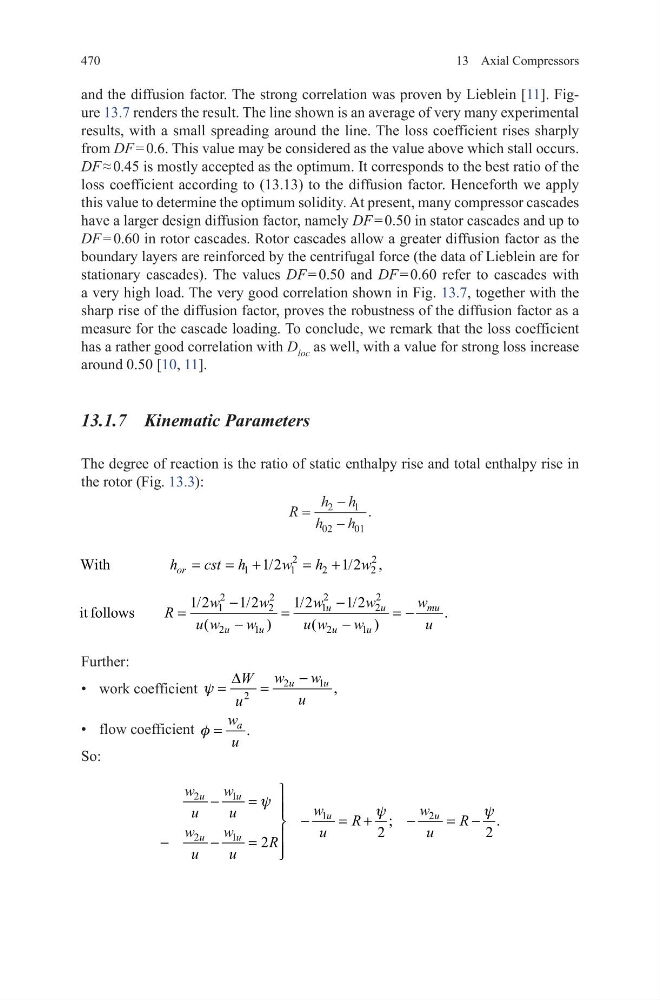
The degree of reaction is the ratio of static enthalpy rise and total enthalpy rise in
the rotor (Fig. 13.3):
Further:
• work coefficient
2
1
2
,
u
u
w
w
W
u
u
−
∆
=
=
y
• flow coefficient
.
a
w
u
=
f
So:
R
h h
h
h
=
−
−
2
1
02
01
.
2
2
1
1
2
2
With
1/2
1/2 ,
or
h
cst h
w
h
w
=
= +
= +
2
2
2
2
1
2
1
2
2
1
2
1
1/2
1/2
1/2
1/2
it follows
.
(
)
(
)
u
u
mu
u
u
u
u
w
w
w
w
w
R u w
w
u w
w
u
−
−
=
=
= −
−
−
2
1
1
2
2
1
;
.
2
2
2
u
u
u
u
u
u
w
w
w
w
u
u
R
R
w
w
u
u
R
u
u
−
= −
= +
−
= −
−
−
=
y
y
y
13 Axial Compressors
and the diffusion factor. The strong correlation was proven by Lieblein [11]. Figure 13.7 renders the result. The line shown is an average of very many experimental
results, with a small spreading around the line. The loss coefficient rises sharply
from DF = 0.6. This value may be considered as the value above which stall occurs.
DF ≈ 0.45 is mostly accepted as the optimum. It corresponds to the best ratio of the
loss coefficient according to (13.13) to the diffusion factor. Henceforth we apply
this value to determine the optimum solidity. At present, many compressor cascades
have a larger design diffusion factor, namely DF = 0.50 in stator cascades and up to
DF = 0.60 in rotor cascades. Rotor cascades allow a greater diffusion factor as the
boundary layers are reinforced by the centrifugal force (the data of Lieblein are for
stationary cascades). The values DF = 0.50 and DF = 0.60 refer to cascades with
a very high load. The very good correlation shown in Fig. 13.7, together with the
sharp rise of the diffusion factor, proves the robustness of the diffusion factor as a
measure for the cascade loading. To conclude, we remark that the loss coefficient
has a rather good correlation with D loc as well, with a value for strong loss increase
around 0.50 [10, 11].
13.1.7 Kinematic Parameters
The degree of reaction is the ratio of static enthalpy rise and total enthalpy rise in
the rotor (Fig. 13.3):
Further:
• work coefficient
2
1
2
,
u
u
w
w
W
u
u
−
∆
=
=
y
• flow coefficient
.
a
w
u
=
f
So:
R
h h
h
h
=
−
−
2
1
02
01
.
2
2
1
1
2
2
With
1/2
1/2 ,
or
h
cst h
w
h
w
=
= +
= +
2
2
2
2
1
2
1
2
2
1
2
1
1/2
1/2
1/2
1/2
it follows
.
(
)
(
)
u
u
mu
u
u
u
u
w
w
w
w
w
R u w
w
u w
w
u
−
−
=
=
= −
−
−
2
1
1
2
2
1
;
.
2
2
2
u
u
u
u
u
u
w
w
w
w
u
u
R
R
w
w
u
u
R
u
u
−
= −
= +
−
= −
−
−
=
y
y
y