

469
13.1 Mean Line Analysis
momentum loss flow rate (defect of momentum flux due to presence of boundary
layers) at the trailing edge of a blade may be expressed according to
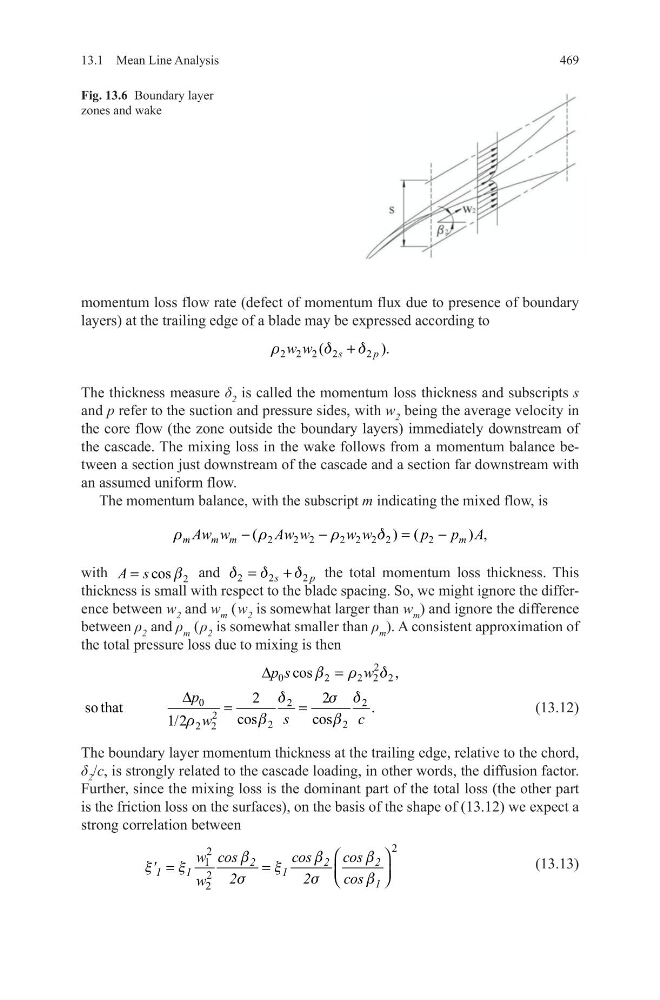
The thickness measure δ 2 is called the momentum loss thickness and subscripts s
and p refer to the suction and pressure sides, with w 2 being the average velocity in
the core flow (the zone outside the boundary layers) immediately downstream of
the cascade. The mixing loss in the wake follows from a momentum balance between a section just downstream of the cascade and a section far downstream with
an assumed uniform flow.
The momentum balance, with the subscript m indicating the mixed flow, is
with
2
cos
A s
=
b and 2
2
2
s
p
=
+
d
d
d the total momentum loss thickness. This
thickness is small with respect to the blade spacing. So, we might ignore the difference between w 2 and w m ( w 2 is somewhat larger than w m ) and ignore the difference
between ρ 2 and ρ m ( ρ 2 is somewhat smaller than ρ m ). A consistent approximation of
the total pressure loss due to mixing is then
(13.12)
The boundary layer momentum thickness at the trailing edge, relative to the chord,
δ 2 /c, is strongly related to the cascade loading, in other words, the diffusion factor.
Further, since the mixing loss is the dominant part of the total loss (the other part
is the friction loss on the surfaces), on the basis of the shape of (13.12) we expect a
strong correlation between
(13.13)
2 2 2 2
2
(
).
s
p
w w
+
r
d
d
2
2 2
2 2 2 2
2
(
) (
) ,
m
m m
m
Aw w
Aw w
w w
p
p A
−
−
=
−
r
r
r
d
2
0
2
2 2 2
cos
,
p s
w
∆
=
b
r
d
0
2
2
2
2
2
2 2
2
2
so that
.
cos
cos
1/2
p
s
c
w
d
d
s
b
b
r
∆
=
=
2
2
1
2
2
=
=
2
2
2
1
1
1
1
w cos
cos
cos
'
2
2
cos
w
b
b
b
x
x
x
s
s
b
Fig. 13.6 Boundary layer
zones and wake
13.1 Mean Line Analysis
momentum loss flow rate (defect of momentum flux due to presence of boundary
layers) at the trailing edge of a blade may be expressed according to
The thickness measure δ 2 is called the momentum loss thickness and subscripts s
and p refer to the suction and pressure sides, with w 2 being the average velocity in
the core flow (the zone outside the boundary layers) immediately downstream of
the cascade. The mixing loss in the wake follows from a momentum balance between a section just downstream of the cascade and a section far downstream with
an assumed uniform flow.
The momentum balance, with the subscript m indicating the mixed flow, is
with
2
cos
A s
=
b and 2
2
2
s
p
=
+
d
d
d the total momentum loss thickness. This
thickness is small with respect to the blade spacing. So, we might ignore the difference between w 2 and w m ( w 2 is somewhat larger than w m ) and ignore the difference
between ρ 2 and ρ m ( ρ 2 is somewhat smaller than ρ m ). A consistent approximation of
the total pressure loss due to mixing is then
(13.12)
The boundary layer momentum thickness at the trailing edge, relative to the chord,
δ 2 /c, is strongly related to the cascade loading, in other words, the diffusion factor.
Further, since the mixing loss is the dominant part of the total loss (the other part
is the friction loss on the surfaces), on the basis of the shape of (13.12) we expect a
strong correlation between
(13.13)
2 2 2 2
2
(
).
s
p
w w
+
r
d
d
2
2 2
2 2 2 2
2
(
) (
) ,
m
m m
m
Aw w
Aw w
w w
p
p A
−
−
=
−
r
r
r
d
2
0
2
2 2 2
cos
,
p s
w
∆
=
b
r
d
0
2
2
2
2
2
2 2
2
2
so that
.
cos
cos
1/2
p
s
c
w
d
d
s
b
b
r
∆
=
=
2
2
1
2
2
=
=
2
2
2
1
1
1
1
w cos
cos
cos
'
2
2
cos
w
b
b
b
x
x
x
s
s
b
Fig. 13.6 Boundary layer
zones and wake