

466
13 Axial Compressors
This result is identical with the one attained in Chap. 2 with the analysis of constant
density fluid flow through blade cascades. For a compressible fluid, lift coefficient
and drag coefficient may be defined in exactly the same way. The only difference is
the need to apply the average density.
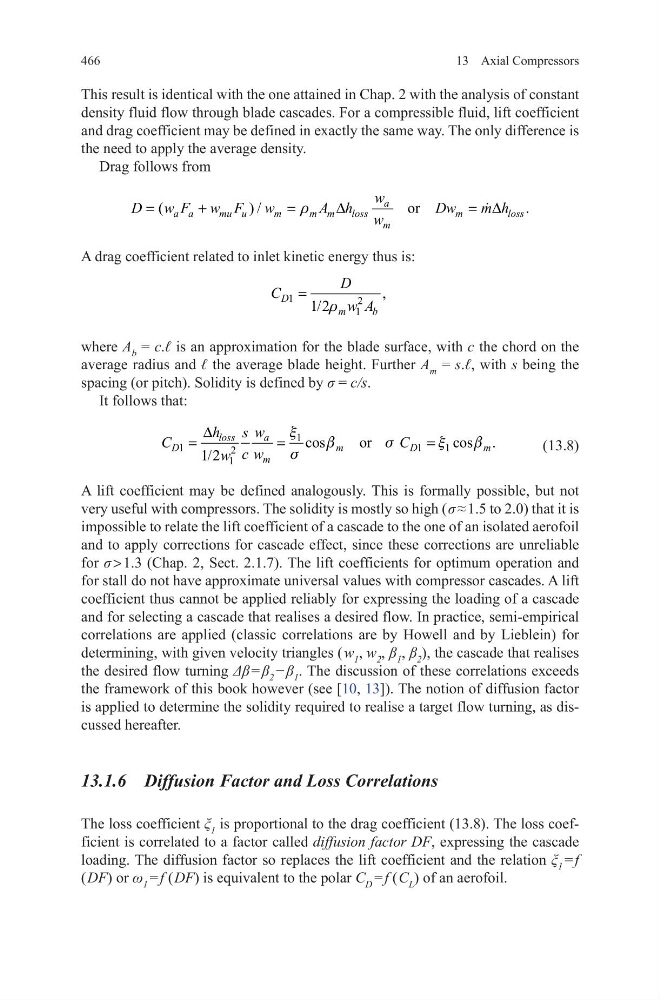
Drag follows from
A drag coefficient related to inlet kinetic energy thus is:
where A b = c.ℓ is an approximation for the blade surface, with c the chord on the
average radius and ℓ the average blade height. Further A m = s.ℓ, with s being the
spacing (or pitch). Solidity is defined by σ = c/s.
It follows that:
(13.8)
A lift coefficient may be defined analogously. This is formally possible, but not
very useful with compressors. The solidity is mostly so high ( σ ≈ 1.5 to 2.0) that it is
impossible to relate the lift coefficient of a cascade to the one of an isolated aerofoil
and to apply corrections for cascade effect, since these corrections are unreliable
for σ > 1.3 (Chap. 2, Sect. 2.1.7). The lift coefficients for optimum operation and
for stall do not have approximate universal values with compressor cascades. A lift
coefficient thus cannot be applied reliably for expressing the loading of a cascade
and for selecting a cascade that realises a desired flow. In practice, semi-empirical
correlations are applied (classic correlations are by Howell and by Lieblein) for
determining, with given velocity triangles ( w 1 , w 2 , β 1 , β 2 ), the cascade that realises
the desired flow turning Δβ = β 2 − β 1 . The discussion of these correlations exceeds
the framework of this book however (see [10, 13]). The notion of diffusion factor
is applied to determine the solidity required to realise a target flow turning, as discussed hereafter.
13.1.6 Diffusion Factor and Loss Correlations
The loss coefficient ξ 1 is proportional to the drag coefficient (13.8). The loss coefficient is correlated to a factor called diffusion factor DF, expressing the cascade
loading. The diffusion factor so replaces the lift coefficient and the relation ξ 1 = f
( DF) or ω 1 = f ( DF) is equivalent to the polar C D = f ( C L ) of an aerofoil.
(
) /
or
.
=
+
=
∆
= ∆
a
a a
mu u
m
m m
loss
m
loss
m
w
D w F w F w
A h
Dw
m h
w
r
1
2
1
,
1/2
D
m
b
D
C
w A
r
=
1
1
1
1
2
1
cos
or
cos .
1/2
loss
a
D
m
D
m
m
h
w
s
C
C
c w
w
x
b
s
x
b
s
∆
=
=
=
13 Axial Compressors
This result is identical with the one attained in Chap. 2 with the analysis of constant
density fluid flow through blade cascades. For a compressible fluid, lift coefficient
and drag coefficient may be defined in exactly the same way. The only difference is
the need to apply the average density.
Drag follows from
A drag coefficient related to inlet kinetic energy thus is:
where A b = c.ℓ is an approximation for the blade surface, with c the chord on the
average radius and ℓ the average blade height. Further A m = s.ℓ, with s being the
spacing (or pitch). Solidity is defined by σ = c/s.
It follows that:
(13.8)
A lift coefficient may be defined analogously. This is formally possible, but not
very useful with compressors. The solidity is mostly so high ( σ ≈ 1.5 to 2.0) that it is
impossible to relate the lift coefficient of a cascade to the one of an isolated aerofoil
and to apply corrections for cascade effect, since these corrections are unreliable
for σ > 1.3 (Chap. 2, Sect. 2.1.7). The lift coefficients for optimum operation and
for stall do not have approximate universal values with compressor cascades. A lift
coefficient thus cannot be applied reliably for expressing the loading of a cascade
and for selecting a cascade that realises a desired flow. In practice, semi-empirical
correlations are applied (classic correlations are by Howell and by Lieblein) for
determining, with given velocity triangles ( w 1 , w 2 , β 1 , β 2 ), the cascade that realises
the desired flow turning Δβ = β 2 − β 1 . The discussion of these correlations exceeds
the framework of this book however (see [10, 13]). The notion of diffusion factor
is applied to determine the solidity required to realise a target flow turning, as discussed hereafter.
13.1.6 Diffusion Factor and Loss Correlations
The loss coefficient ξ 1 is proportional to the drag coefficient (13.8). The loss coefficient is correlated to a factor called diffusion factor DF, expressing the cascade
loading. The diffusion factor so replaces the lift coefficient and the relation ξ 1 = f
( DF) or ω 1 = f ( DF) is equivalent to the polar C D = f ( C L ) of an aerofoil.
(
) /
or
.
=
+
=
∆
= ∆
a
a a
mu u
m
m m
loss
m
loss
m
w
D w F w F w
A h
Dw
m h
w
r
1
2
1
,
1/2
D
m
b
D
C
w A
r
=
1
1
1
1
2
1
cos
or
cos .
1/2
loss
a
D
m
D
m
m
h
w
s
C
C
c w
w
x
b
s
x
b
s
∆
=
=
=