

465
13.1 Mean Line Analysis
13.1.4 Loss Coefficients
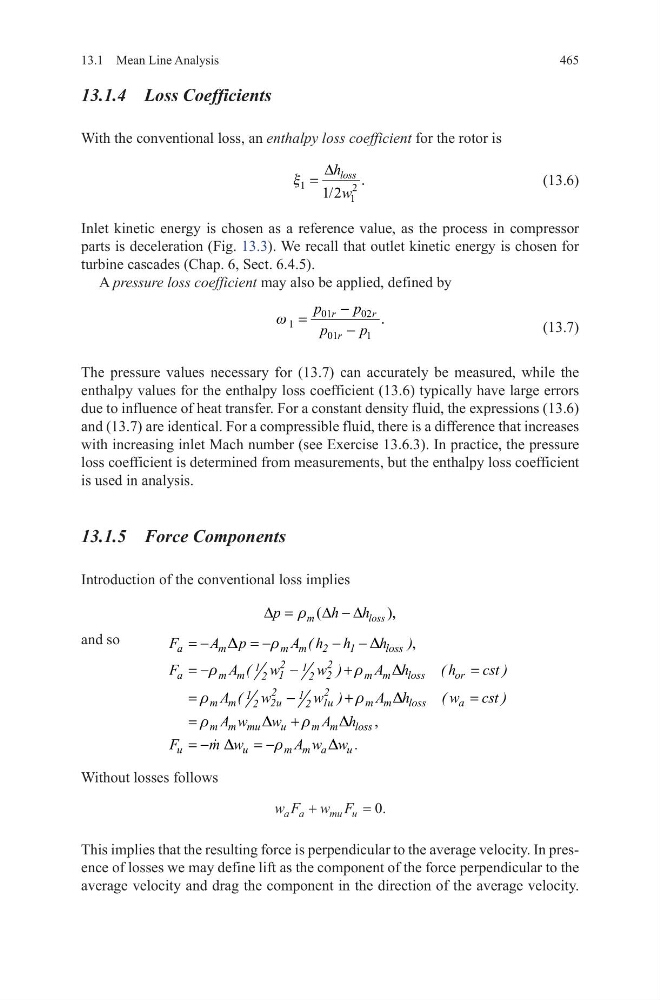
With the conventional loss, an enthalpy loss coefficient for the rotor is
(13.6)
Inlet kinetic energy is chosen as a reference value, as the process in compressor
parts is deceleration (Fig. 13.3). We recall that outlet kinetic energy is chosen for
turbine cascades (Chap. 6, Sect. 6.4.5).
A pressure loss coefficient may also be applied, defined by
(13.7)
The pressure values necessary for (13.7) can accurately be measured, while the
enthalpy values for the enthalpy loss coefficient (13.6) typically have large errors
due to influence of heat transfer. For a constant density fluid, the expressions (13.6)
and (13.7) are identical. For a compressible fluid, there is a difference that increases
with increasing inlet Mach number (see Exercise 13.6.3). In practice, the pressure
loss coefficient is determined from measurements, but the enthalpy loss coefficient
is used in analysis.
13.1.5 Force Components
Introduction of the conventional loss implies
and so
Without losses follows
This implies that the resulting force is perpendicular to the average velocity. In presence of losses we may define lift as the component of the force perpendicular to the
average velocity and drag the component in the direction of the average velocity.
1
2
1
.
1/2
loss
h
w
x
∆
=
01
02
1
01
1
.
−
=
−
r
r
r
p
p
p
p
w
(
),
m
loss
p
h
h
∆ =
∆ − ∆
r
,
,
D
r
D
r
r
D
r
r
D
r
D
r
D
D
r
D
= −
= −
− −
= −
−
+
=
=
−
+
=
=
+
= −
= −
a
m
m m 2
1
loss
2
2
1
1
a
m m
1
2
m m
loss
or
2
2
2
2
1
1
m m
2u
1u
m m
loss
a
2
2
m m mu
u
m m
loss
u
u
m m a
u
F
A p
A ( h h
h )
F
A ( w
w )
A h
( h
cst )
A ( w
w )
A h
( w cst )
A w
w
A h
F
m w
A w w .
w F w F
a a
mu u
+
=0.
13.1 Mean Line Analysis
13.1.4 Loss Coefficients
With the conventional loss, an enthalpy loss coefficient for the rotor is
(13.6)
Inlet kinetic energy is chosen as a reference value, as the process in compressor
parts is deceleration (Fig. 13.3). We recall that outlet kinetic energy is chosen for
turbine cascades (Chap. 6, Sect. 6.4.5).
A pressure loss coefficient may also be applied, defined by
(13.7)
The pressure values necessary for (13.7) can accurately be measured, while the
enthalpy values for the enthalpy loss coefficient (13.6) typically have large errors
due to influence of heat transfer. For a constant density fluid, the expressions (13.6)
and (13.7) are identical. For a compressible fluid, there is a difference that increases
with increasing inlet Mach number (see Exercise 13.6.3). In practice, the pressure
loss coefficient is determined from measurements, but the enthalpy loss coefficient
is used in analysis.
13.1.5 Force Components
Introduction of the conventional loss implies
and so
Without losses follows
This implies that the resulting force is perpendicular to the average velocity. In presence of losses we may define lift as the component of the force perpendicular to the
average velocity and drag the component in the direction of the average velocity.
1
2
1
.
1/2
loss
h
w
x
∆
=
01
02
1
01
1
.
−
=
−
r
r
r
p
p
p
p
w
(
),
m
loss
p
h
h
∆ =
∆ − ∆
r
,
,
D
r
D
r
r
D
r
r
D
r
D
r
D
D
r
D
= −
= −
− −
= −
−
+
=
=
−
+
=
=
+
= −
= −
a
m
m m 2
1
loss
2
2
1
1
a
m m
1
2
m m
loss
or
2
2
2
2
1
1
m m
2u
1u
m m
loss
a
2
2
m m mu
u
m m
loss
u
u
m m a
u
F
A p
A ( h h
h )
F
A ( w
w )
A h
( h
cst )
A ( w
w )
A h
( w cst )
A w
w
A h
F
m w
A w w .
w F w F
a a
mu u
+
=0.