

464
13 Axial Compressors
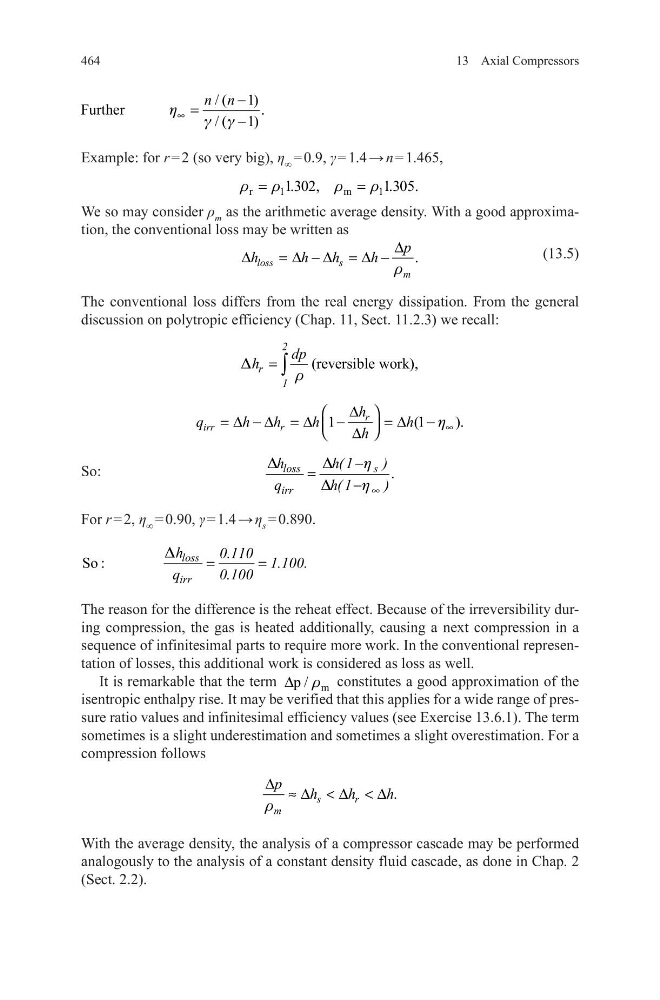
Example: for r = 2 (so very big), η ∞ = 0.9, γ = 1.4 → n = 1.465,
We so may consider ρ m as the arithmetic average density. With a good approximation, the conventional loss may be written as
(13.5)
The conventional loss differs from the real energy dissipation. From the general
discussion on polytropic efficiency (Chap. 11, Sect. 11.2.3) we recall:
So:
For r = 2, η ∞ = 0.90, γ = 1.4 → η s = 0.890.
The reason for the difference is the reheat effect. Because of the irreversibility during compression, the gas is heated additionally, causing a next compression in a
sequence of infinitesimal parts to require more work. In the conventional representation of losses, this additional work is considered as loss as well.
It is remarkable that the term
m
p /
∆ r constitutes a good approximation of the
isentropic enthalpy rise. It may be verified that this applies for a wide range of pressure ratio values and infinitesimal efficiency values (see Exercise 13.6.1). The term
sometimes is a slight underestimation and sometimes a slight overestimation. For a
compression follows
With the average density, the analysis of a compressor cascade may be performed
analogously to the analysis of a constant density fluid cascade, as done in Chap. 2
(Sect. 2.2).
/ ( 1)
Further
.
/ ( 1)
∞
−
=
−
n n
h
g g
r
1
m
1
1.302,
1.305.
=
=
r
r
r
r
.
loss
s
m
p
h
h
h
h
∆
∆
= ∆ − ∆ = ∆ − r
(reversible work),
= ∫
2
r
1
dp
h
D
r
1
(1
).
r
irr
r
h
q
h
h
h
h
h
∞
∆
= ∆ − ∆ = ∆
−
= ∆ −
∆
h
D
D
h
D
h ∞
−
=
−
loss
s
irr
h
h( 1
) .
q
h( 1
)
So :
=
=
loss
irr
h
0.110 1.100.
q
0.100
D
.
s
r
m
p
h
h
h
∆ ≈ ∆ < ∆ < ∆
r
13 Axial Compressors
Example: for r = 2 (so very big), η ∞ = 0.9, γ = 1.4 → n = 1.465,
We so may consider ρ m as the arithmetic average density. With a good approximation, the conventional loss may be written as
(13.5)
The conventional loss differs from the real energy dissipation. From the general
discussion on polytropic efficiency (Chap. 11, Sect. 11.2.3) we recall:
So:
For r = 2, η ∞ = 0.90, γ = 1.4 → η s = 0.890.
The reason for the difference is the reheat effect. Because of the irreversibility during compression, the gas is heated additionally, causing a next compression in a
sequence of infinitesimal parts to require more work. In the conventional representation of losses, this additional work is considered as loss as well.
It is remarkable that the term
m
p /
∆ r constitutes a good approximation of the
isentropic enthalpy rise. It may be verified that this applies for a wide range of pressure ratio values and infinitesimal efficiency values (see Exercise 13.6.1). The term
sometimes is a slight underestimation and sometimes a slight overestimation. For a
compression follows
With the average density, the analysis of a compressor cascade may be performed
analogously to the analysis of a constant density fluid cascade, as done in Chap. 2
(Sect. 2.2).
/ ( 1)
Further
.
/ ( 1)
∞
−
=
−
n n
h
g g
r
1
m
1
1.302,
1.305.
=
=
r
r
r
r
.
loss
s
m
p
h
h
h
h
∆
∆
= ∆ − ∆ = ∆ − r
(reversible work),
= ∫
2
r
1
dp
h
D
r
1
(1
).
r
irr
r
h
q
h
h
h
h
h
∞
∆
= ∆ − ∆ = ∆
−
= ∆ −
∆
h
D
D
h
D
h ∞
−
=
−
loss
s
irr
h
h( 1
) .
q
h( 1
)
So :
=
=
loss
irr
h
0.110 1.100.
q
0.100
D
.
s
r
m
p
h
h
h
∆ ≈ ∆ < ∆ < ∆
r