

452
12 Thrust Gas Turbines
not used in stator vanes. Convection cooling, impingement cooling and film cooling
are combined. Figure 12.15 sketches examples of cooling schemes of nozzle vanes
and blades. In the vane example, cooling air is fed to two internal channels (convection cooling), which both deliver air for film cooling on the pressure surface. The
second channel delivers air through holes in an internal wall, forming impinging
jets on the inner side of the suction surface. This air leaves through a trailing edge
slot passing over so-called pedestals, which are staggered cylinders creating a high
level of turbulence. The rotor blade has three cooling channels. In the middle one,
air passes three times.
12.6.3 Combustion Chamber
Common modern combustion chambers are of annular type with several injectors. Compared to the can-annular type frequently used earlier, the main advantages are a smaller length and a smaller frontal area, which are vital properties
for an aero-engine. The smaller wall area results in lower pressure drop and
lower cooling air flow rate. The disadvantage of the annular type is that it is
more difficult to manufacture and that it is more difficult to reach perfectly
stable combustion resulting in a homogeneous exit temperature. Figure 12.16
is a sketch of a longitudinal section through the liner of a combustion chamber
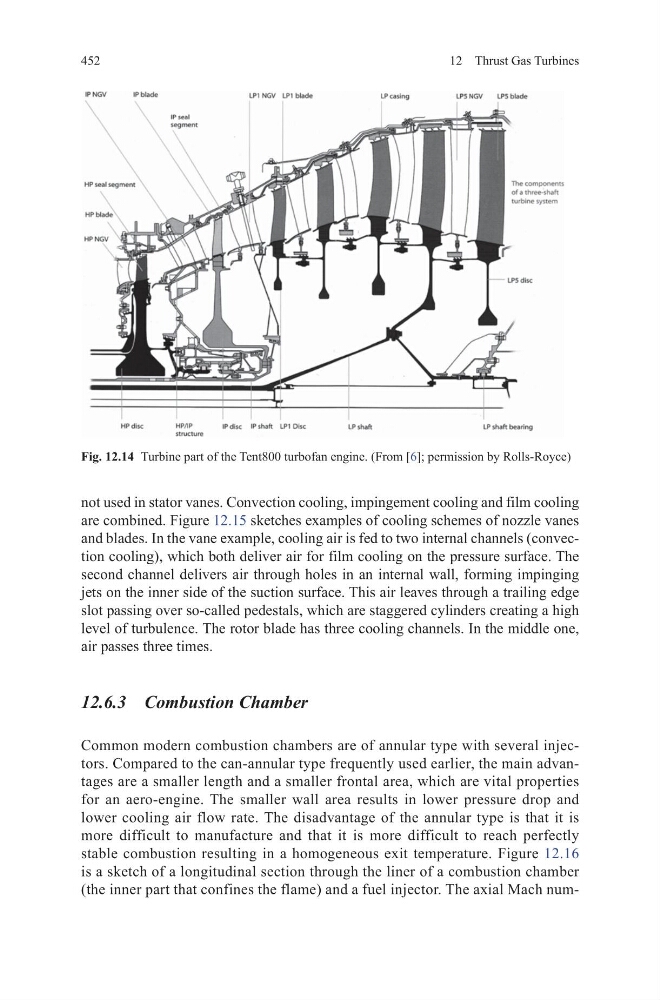
(the inner part that confines the flame) and a fuel injector. The axial Mach numFig. 12.14 Turbine part of the Tent800 turbofan engine. (From [6]; permission by Rolls-Royce)
12 Thrust Gas Turbines
not used in stator vanes. Convection cooling, impingement cooling and film cooling
are combined. Figure 12.15 sketches examples of cooling schemes of nozzle vanes
and blades. In the vane example, cooling air is fed to two internal channels (convection cooling), which both deliver air for film cooling on the pressure surface. The
second channel delivers air through holes in an internal wall, forming impinging
jets on the inner side of the suction surface. This air leaves through a trailing edge
slot passing over so-called pedestals, which are staggered cylinders creating a high
level of turbulence. The rotor blade has three cooling channels. In the middle one,
air passes three times.
12.6.3 Combustion Chamber
Common modern combustion chambers are of annular type with several injectors. Compared to the can-annular type frequently used earlier, the main advantages are a smaller length and a smaller frontal area, which are vital properties
for an aero-engine. The smaller wall area results in lower pressure drop and
lower cooling air flow rate. The disadvantage of the annular type is that it is
more difficult to manufacture and that it is more difficult to reach perfectly
stable combustion resulting in a homogeneous exit temperature. Figure 12.16
is a sketch of a longitudinal section through the liner of a combustion chamber
(the inner part that confines the flame) and a fuel injector. The axial Mach numFig. 12.14 Turbine part of the Tent800 turbofan engine. (From [6]; permission by Rolls-Royce)