

446
12 Thrust Gas Turbines
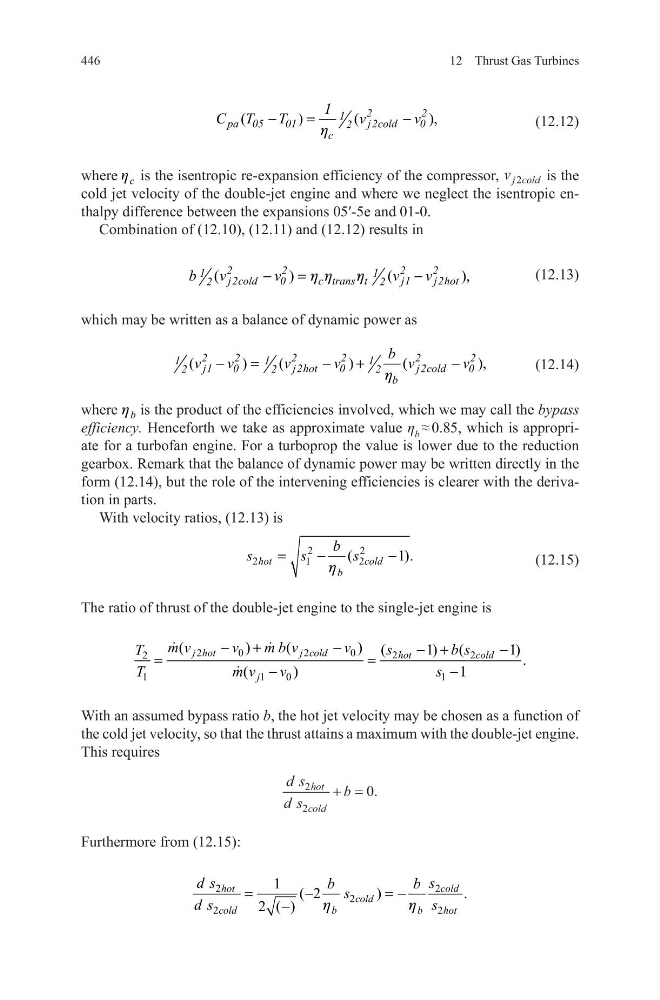
(12.12)
where c
h is the isentropic re-expansion efficiency of the compressor, v j cold
2
is the
cold jet velocity of the double-jet engine and where we neglect the isentropic enthalpy difference between the expansions 05ʹ-5e and 01-0.
Combination of (12.10), (12.11) and (12.12) results in
(12.13)
which may be written as a balance of dynamic power as
(12.14)
where b
h is the product of the efficiencies involved, which we may call the bypass
efficiency. Henceforth we take as approximate value η b ≈ 0.85, which is appropriate for a turbofan engine. For a turboprop the value is lower due to the reduction
gearbox. Remark that the balance of dynamic power may be written directly in the
form (12.14), but the role of the intervening efficiencies is clearer with the derivation in parts.
With velocity ratios, (12.13) is
(12.15)
The ratio of thrust of the double-jet engine to the single-jet engine is
With an assumed bypass ratio b, the hot jet velocity may be chosen as a function of
the cold jet velocity, so that the thrust attains a maximum with the double-jet engine.
This requires
Furthermore from (12.15):
(
)
(
),
−
=
−
2
2
1
pa 05
01
j2cold
0
2
c
1
C T
T
v
v
h
(
)
(
),
−
=
−
2
2
2
2
1
1
j2cold
0
c trans t
j1
j2hot
2
2
b
v
v
v
v
h h
h
(
)
(
)
(
),
−
=
−
+
−
2
2
2
2
2
2
1
1
1
j1
0
j2hot
0
j2cold
0
2
2
2 b
b
v
v
v
v
v
v
h
2
2
2
1
2
(
1).
hot
cold
b
b
s
s
s
h
=
−
−
2
0
2
0
2
2
2
1
1
0
1
(
)
(
) (
1) (
1) .
(
)
1
j hot
j cold
hot
cold
j
m v
v
m b v
v
s
b s
T
T
m v
v
s
−
+
−
− +
−
=
=
−
−
d s
d s
b
hot
cold
2
2
0
+ = .
2
2
2
2
2
1 ( 2
)
.
2 ( )
hot
cold
cold
cold
b
b
hot
d s
s
b
b
s
d s
s
h
h
=
−
= −
−
12 Thrust Gas Turbines
(12.12)
where c
h is the isentropic re-expansion efficiency of the compressor, v j cold
2
is the
cold jet velocity of the double-jet engine and where we neglect the isentropic enthalpy difference between the expansions 05ʹ-5e and 01-0.
Combination of (12.10), (12.11) and (12.12) results in
(12.13)
which may be written as a balance of dynamic power as
(12.14)
where b
h is the product of the efficiencies involved, which we may call the bypass
efficiency. Henceforth we take as approximate value η b ≈ 0.85, which is appropriate for a turbofan engine. For a turboprop the value is lower due to the reduction
gearbox. Remark that the balance of dynamic power may be written directly in the
form (12.14), but the role of the intervening efficiencies is clearer with the derivation in parts.
With velocity ratios, (12.13) is
(12.15)
The ratio of thrust of the double-jet engine to the single-jet engine is
With an assumed bypass ratio b, the hot jet velocity may be chosen as a function of
the cold jet velocity, so that the thrust attains a maximum with the double-jet engine.
This requires
Furthermore from (12.15):
(
)
(
),
−
=
−
2
2
1
pa 05
01
j2cold
0
2
c
1
C T
T
v
v
h
(
)
(
),
−
=
−
2
2
2
2
1
1
j2cold
0
c trans t
j1
j2hot
2
2
b
v
v
v
v
h h
h
(
)
(
)
(
),
−
=
−
+
−
2
2
2
2
2
2
1
1
1
j1
0
j2hot
0
j2cold
0
2
2
2 b
b
v
v
v
v
v
v
h
2
2
2
1
2
(
1).
hot
cold
b
b
s
s
s
h
=
−
−
2
0
2
0
2
2
2
1
1
0
1
(
)
(
) (
1) (
1) .
(
)
1
j hot
j cold
hot
cold
j
m v
v
m b v
v
s
b s
T
T
m v
v
s
−
+
−
− +
−
=
=
−
−
d s
d s
b
hot
cold
2
2
0
+ = .
2
2
2
2
2
1 ( 2
)
.
2 ( )
hot
cold
cold
cold
b
b
hot
d s
s
b
b
s
d s
s
h
h
=
−
= −
−