

444
12 Thrust Gas Turbines
12.5 Performance of Double-Flow Engines
A double-flow engine consists of a gas generator with an added turbine that drives
the cold air flow compressor, fan or propeller. As already discussed, it is often impossible to distinguish physically the gas generator and jet generator parts in a double-flow engine. The distinction is made here thermodynamically, enabling us to
study the effect of the second flow. Additional parameters are the bypass ratio b and
the pressure ratio of the cold air flow. Furthermore, there is a difference between
engines with both air flows mixed before a common nozzle (bypass engine) and
engines with separate nozzles (turbofan).
We assume a given gas generator and a given flight velocity. Engine optimisation
implies then obtaining the highest possible thrust per unit of mass flow rate in the
hot flow. In the following derivations, the small mass flow increase by adding fuel
is not taken into account.
12.5.1 Unmixed Flows (Double-Jet Engine: Turbofan,
Turboprop)
A single jet engine has dynamic power
Neglecting nozzle loss, this power also equals the gas power:
where the symbol s denotes a speed ratio.
Thrust is T m v
v
m v s
j
1
1
0
0 1 1
=
−
=
−
(
)
(
).
(
)
=
−
2
2
1
dyn
j1
0
2
P
m v
v .
(
)
,
=
−
=
j1
2 2
1
gas
0 1
1
2
0
v
P
m v s 1 , s
v
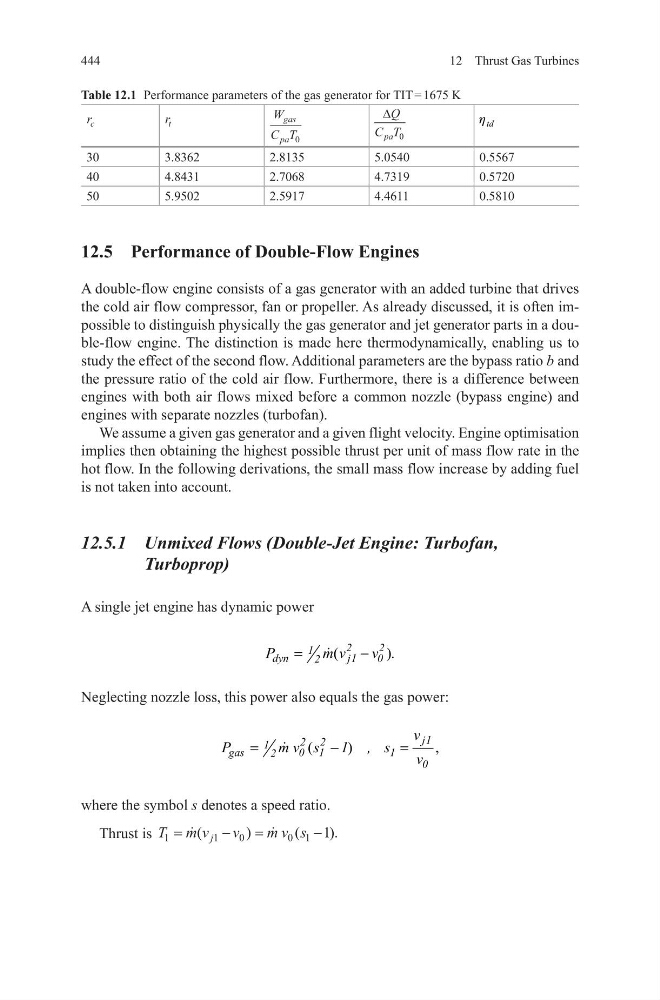
Table 12.1 Performance parameters of the gas generator for TIT = 1675 K
r c
r t
W
C T
gas
pa 0
∆Q
C T
pa 0
td
h
30
3.8362
2.8135
5.0540
0.5567
40
4.8431
2.7068
4.7319
0.5720
50
5.9502
2.5917
4.4611
0.5810
12 Thrust Gas Turbines
12.5 Performance of Double-Flow Engines
A double-flow engine consists of a gas generator with an added turbine that drives
the cold air flow compressor, fan or propeller. As already discussed, it is often impossible to distinguish physically the gas generator and jet generator parts in a double-flow engine. The distinction is made here thermodynamically, enabling us to
study the effect of the second flow. Additional parameters are the bypass ratio b and
the pressure ratio of the cold air flow. Furthermore, there is a difference between
engines with both air flows mixed before a common nozzle (bypass engine) and
engines with separate nozzles (turbofan).
We assume a given gas generator and a given flight velocity. Engine optimisation
implies then obtaining the highest possible thrust per unit of mass flow rate in the
hot flow. In the following derivations, the small mass flow increase by adding fuel
is not taken into account.
12.5.1 Unmixed Flows (Double-Jet Engine: Turbofan,
Turboprop)
A single jet engine has dynamic power
Neglecting nozzle loss, this power also equals the gas power:
where the symbol s denotes a speed ratio.
Thrust is T m v
v
m v s
j
1
1
0
0 1 1
=
−
=
−
(
)
(
).
(
)
=
−
2
2
1
dyn
j1
0
2
P
m v
v .
(
)
,
=
−
=
j1
2 2
1
gas
0 1
1
2
0
v
P
m v s 1 , s
v
Table 12.1 Performance parameters of the gas generator for TIT = 1675 K
r c
r t
W
C T
gas
pa 0
∆Q
C T
pa 0
td
h
30
3.8362
2.8135
5.0540
0.5567
40
4.8431
2.7068
4.7319
0.5720
50
5.9502
2.5917
4.4611
0.5810