

443
12.4 Performance of the Gas Generator and the Single-Jet Engine
b. Turbine
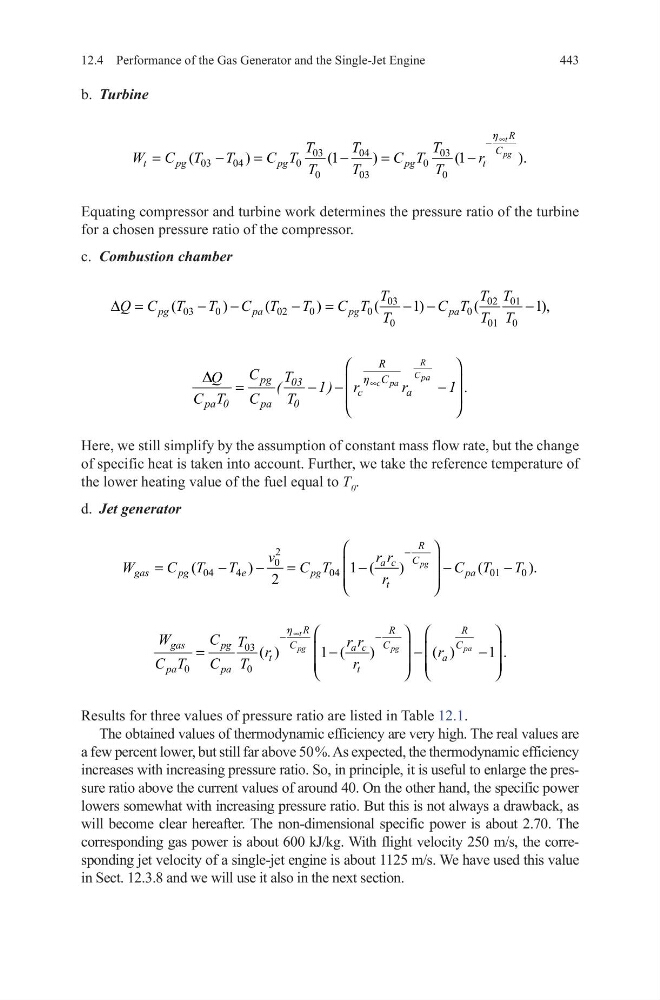
Equating compressor and turbine work determines the pressure ratio of the turbine
for a chosen pressure ratio of the compressor.
c. Combustion chamber
Here, we still simplify by the assumption of constant mass flow rate, but the change
of specific heat is taken into account. Further, we take the reference temperature of
the lower heating value of the fuel equal to T 0 .
d. Jet generator
Results for three values of pressure ratio are listed in Table 12.1.
The obtained values of thermodynamic efficiency are very high. The real values are
a few percent lower, but still far above 50 %. As expected, the thermodynamic efficiency
increases with increasing pressure ratio. So, in principle, it is useful to enlarge the pressure ratio above the current values of around 40. On the other hand, the specific power
lowers somewhat with increasing pressure ratio. But this is not always a drawback, as
will become clear hereafter. The non-dimensional specific power is about 2.70. The
corresponding gas power is about 600 kJ/kg. With flight velocity 250 m/s, the corresponding jet velocity of a single-jet engine is about 1125 m/s. We have used this value
in Sect. 12.3.8 and we will use it also in the next section.
03
04
03
03
04
0
0
0
03
0
(
)
(1
)
(1
).
t
pg
R
C
t
pg
pg
pg
t
T
T
T
W C T
T
C T
C T
r
T
T
T
h ∞
−
=
−
=
−
=
−
03
02 01
03
0
02
0
0
0
0
01 0
(
)
(
)
(
1)
(
1),
pg
pa
pg
pa
T
T T
Q C T
T
C T
T
C T
C T
T
T T
∆ =
−
−
−
=
− −
−
R
C pa
c pa
R
C
pg
03
c
a
pa 0
pa
0
C
T
Q
(
1) r
r
1 .
C T
C
T
h
D
∞
=
− −
−
2
0
04
4
04
01
0
(
)
1 (
)
(
).
2
pg
R
C
a c
gas
pg
e
pg
pa
t
v
r r
W
C T
T
C T
C T
T
r
−
=
−
−
=
−
−
−
03
0
0
( )
1 (
)
( )
1 .
t
pg
pg
pa
R
R
R
C
C
C
gas
pg
a c
t
a
pa
pa
t
W
C T
r r
r
r
C T
C T
r
h ∞
−
−
=
−
−
−
12.4 Performance of the Gas Generator and the Single-Jet Engine
b. Turbine
Equating compressor and turbine work determines the pressure ratio of the turbine
for a chosen pressure ratio of the compressor.
c. Combustion chamber
Here, we still simplify by the assumption of constant mass flow rate, but the change
of specific heat is taken into account. Further, we take the reference temperature of
the lower heating value of the fuel equal to T 0 .
d. Jet generator
Results for three values of pressure ratio are listed in Table 12.1.
The obtained values of thermodynamic efficiency are very high. The real values are
a few percent lower, but still far above 50 %. As expected, the thermodynamic efficiency
increases with increasing pressure ratio. So, in principle, it is useful to enlarge the pressure ratio above the current values of around 40. On the other hand, the specific power
lowers somewhat with increasing pressure ratio. But this is not always a drawback, as
will become clear hereafter. The non-dimensional specific power is about 2.70. The
corresponding gas power is about 600 kJ/kg. With flight velocity 250 m/s, the corresponding jet velocity of a single-jet engine is about 1125 m/s. We have used this value
in Sect. 12.3.8 and we will use it also in the next section.
03
04
03
03
04
0
0
0
03
0
(
)
(1
)
(1
).
t
pg
R
C
t
pg
pg
pg
t
T
T
T
W C T
T
C T
C T
r
T
T
T
h ∞
−
=
−
=
−
=
−
03
02 01
03
0
02
0
0
0
0
01 0
(
)
(
)
(
1)
(
1),
pg
pa
pg
pa
T
T T
Q C T
T
C T
T
C T
C T
T
T T
∆ =
−
−
−
=
− −
−
R
C pa
c pa
R
C
pg
03
c
a
pa 0
pa
0
C
T
Q
(
1) r
r
1 .
C T
C
T
h
D
∞
=
− −
−
2
0
04
4
04
01
0
(
)
1 (
)
(
).
2
pg
R
C
a c
gas
pg
e
pg
pa
t
v
r r
W
C T
T
C T
C T
T
r
−
=
−
−
=
−
−
−
03
0
0
( )
1 (
)
( )
1 .
t
pg
pg
pa
R
R
R
C
C
C
gas
pg
a c
t
a
pa
pa
t
W
C T
r r
r
r
C T
C T
r
h ∞
−
−
=
−
−
−