

429
12.2 Overview of Aircraft Gas Turbine Engines
turbofan rather vague. Fundamentally, there is indeed not much difference. Both
are jet engines with two internal flows. The variants are that the flows feed separate
nozzles or that the flows partially or fully mix at the entrance of a common nozzle.
We will analyse in Sect. 12.5 that mixing of the flows principally is beneficial for
efficiency, but efficient mixing is only possible for lower values of the bypass ratio.
Figure 12.9 renders a modern turbofan engine: a Tent800 from Rolls-Royce. It
is a three-shaft engine. The internal shaft bears the fan and the low-pressure turbine
(5 stages). The fan diameter is 2.80 m. There are eight stages in the intermediatepressure compressor and six stages in the high-pressure compressor. The inlet guide
vanes and the vanes of the first two stages of the IP compressor are adjustable. The
HP turbine and IP turbine have one stage. Sea level thrust is 330–420 kN, depending
on the version. The bypass ratio is 5.7–6.2. Similar engines exist with two shafts. In
these engines, there is a small IP compressor part, called a booster, running together
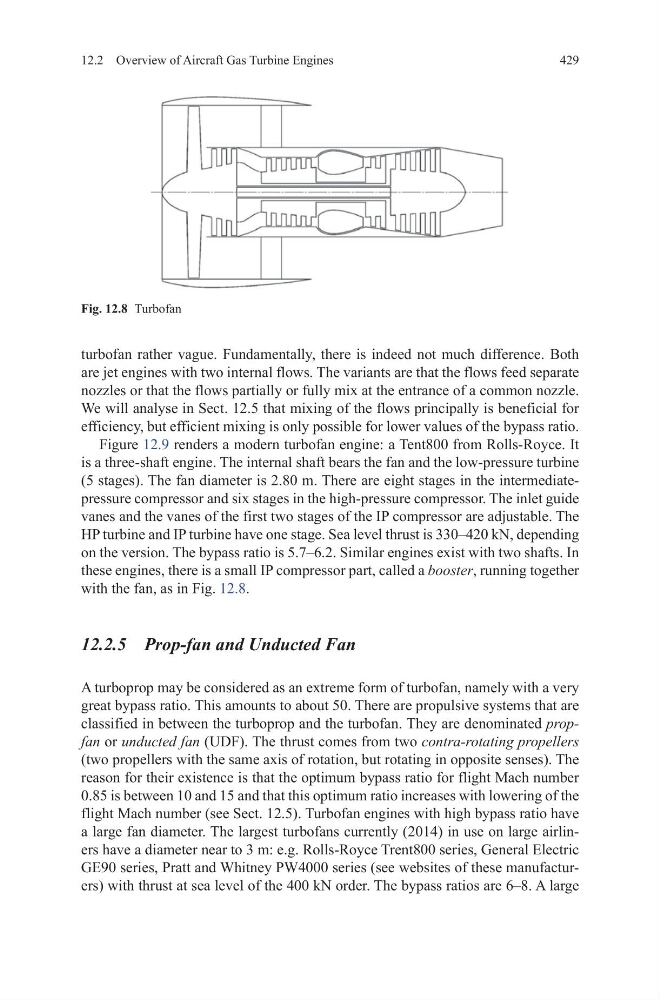
with the fan, as in Fig. 12.8.
12.2.5 Prop-fan and Unducted Fan
A turboprop may be considered as an extreme form of turbofan, namely with a very
great bypass ratio. This amounts to about 50. There are propulsive systems that are
classified in between the turboprop and the turbofan. They are denominated propfan or unducted fan (UDF). The thrust comes from two contra-rotating propellers
(two propellers with the same axis of rotation, but rotating in opposite senses). The
reason for their existence is that the optimum bypass ratio for flight Mach number
0.85 is between 10 and 15 and that this optimum ratio increases with lowering of the
flight Mach number (see Sect. 12.5). Turbofan engines with high bypass ratio have
a large fan diameter. The largest turbofans currently (2014) in use on large airliners have a diameter near to 3 m: e.g. Rolls-Royce Trent800 series, General Electric
GE90 series, Pratt and Whitney PW4000 series (see websites of these manufacturers) with thrust at sea level of the 400 kN order. The bypass ratios are 6–8. A large
Fig. 12.8 Turbofan
12.2 Overview of Aircraft Gas Turbine Engines
turbofan rather vague. Fundamentally, there is indeed not much difference. Both
are jet engines with two internal flows. The variants are that the flows feed separate
nozzles or that the flows partially or fully mix at the entrance of a common nozzle.
We will analyse in Sect. 12.5 that mixing of the flows principally is beneficial for
efficiency, but efficient mixing is only possible for lower values of the bypass ratio.
Figure 12.9 renders a modern turbofan engine: a Tent800 from Rolls-Royce. It
is a three-shaft engine. The internal shaft bears the fan and the low-pressure turbine
(5 stages). The fan diameter is 2.80 m. There are eight stages in the intermediatepressure compressor and six stages in the high-pressure compressor. The inlet guide
vanes and the vanes of the first two stages of the IP compressor are adjustable. The
HP turbine and IP turbine have one stage. Sea level thrust is 330–420 kN, depending
on the version. The bypass ratio is 5.7–6.2. Similar engines exist with two shafts. In
these engines, there is a small IP compressor part, called a booster, running together
with the fan, as in Fig. 12.8.
12.2.5 Prop-fan and Unducted Fan
A turboprop may be considered as an extreme form of turbofan, namely with a very
great bypass ratio. This amounts to about 50. There are propulsive systems that are
classified in between the turboprop and the turbofan. They are denominated propfan or unducted fan (UDF). The thrust comes from two contra-rotating propellers
(two propellers with the same axis of rotation, but rotating in opposite senses). The
reason for their existence is that the optimum bypass ratio for flight Mach number
0.85 is between 10 and 15 and that this optimum ratio increases with lowering of the
flight Mach number (see Sect. 12.5). Turbofan engines with high bypass ratio have
a large fan diameter. The largest turbofans currently (2014) in use on large airliners have a diameter near to 3 m: e.g. Rolls-Royce Trent800 series, General Electric
GE90 series, Pratt and Whitney PW4000 series (see websites of these manufacturers) with thrust at sea level of the 400 kN order. The bypass ratios are 6–8. A large
Fig. 12.8 Turbofan