

426
12 Thrust Gas Turbines
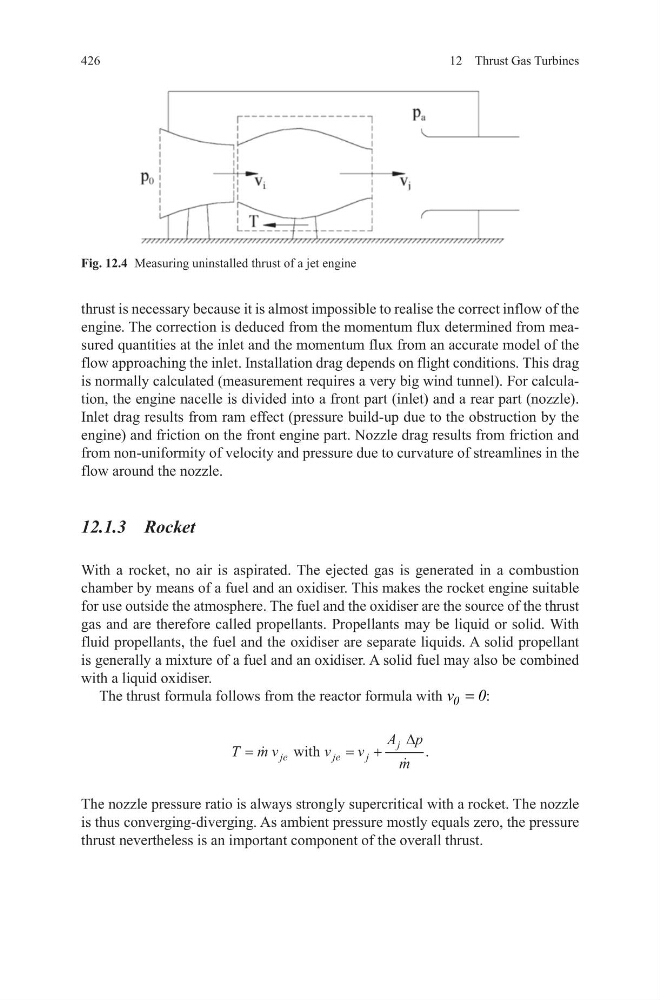
thrust is necessary because it is almost impossible to realise the correct inflow of the
engine. The correction is deduced from the momentum flux determined from measured quantities at the inlet and the momentum flux from an accurate model of the
flow approaching the inlet. Installation drag depends on flight conditions. This drag
is normally calculated (measurement requires a very big wind tunnel). For calculation, the engine nacelle is divided into a front part (inlet) and a rear part (nozzle).
Inlet drag results from ram effect (pressure build-up due to the obstruction by the
engine) and friction on the front engine part. Nozzle drag results from friction and
from non-uniformity of velocity and pressure due to curvature of streamlines in the
flow around the nozzle.
12.1.3 Rocket
With a rocket, no air is aspirated. The ejected gas is generated in a combustion
chamber by means of a fuel and an oxidiser. This makes the rocket engine suitable
for use outside the atmosphere. The fuel and the oxidiser are the source of the thrust
gas and are therefore called propellants. Propellants may be liquid or solid. With
fluid propellants, the fuel and the oxidiser are separate liquids. A solid propellant
is generally a mixture of a fuel and an oxidiser. A solid fuel may also be combined
with a liquid oxidiser.
The thrust formula follows from the reactor formula with 0
v 0
= :
The nozzle pressure ratio is always strongly supercritical with a rocket. The nozzle
is thus converging-diverging. As ambient pressure mostly equals zero, the pressure
thrust nevertheless is an important component of the overall thrust.
T m v
v
v
A p
m
je
je
j
j
=
= +
with
∆ .
Fig. 12.4 Measuring uninstalled thrust of a jet engine
12 Thrust Gas Turbines
thrust is necessary because it is almost impossible to realise the correct inflow of the
engine. The correction is deduced from the momentum flux determined from measured quantities at the inlet and the momentum flux from an accurate model of the
flow approaching the inlet. Installation drag depends on flight conditions. This drag
is normally calculated (measurement requires a very big wind tunnel). For calculation, the engine nacelle is divided into a front part (inlet) and a rear part (nozzle).
Inlet drag results from ram effect (pressure build-up due to the obstruction by the
engine) and friction on the front engine part. Nozzle drag results from friction and
from non-uniformity of velocity and pressure due to curvature of streamlines in the
flow around the nozzle.
12.1.3 Rocket
With a rocket, no air is aspirated. The ejected gas is generated in a combustion
chamber by means of a fuel and an oxidiser. This makes the rocket engine suitable
for use outside the atmosphere. The fuel and the oxidiser are the source of the thrust
gas and are therefore called propellants. Propellants may be liquid or solid. With
fluid propellants, the fuel and the oxidiser are separate liquids. A solid propellant
is generally a mixture of a fuel and an oxidiser. A solid fuel may also be combined
with a liquid oxidiser.
The thrust formula follows from the reactor formula with 0
v 0
= :
The nozzle pressure ratio is always strongly supercritical with a rocket. The nozzle
is thus converging-diverging. As ambient pressure mostly equals zero, the pressure
thrust nevertheless is an important component of the overall thrust.
T m v
v
v
A p
m
je
je
j
j
=
= +
with
∆ .
Fig. 12.4 Measuring uninstalled thrust of a jet engine