

425
12.1 Thrust Generation
with
/ .
j
p p
e = ∆
Thus:
1
2
2 1
1
[1 (1 ) ].
1
e
j
j
v v
M
g
g
e
g
−
=
+
− −
−
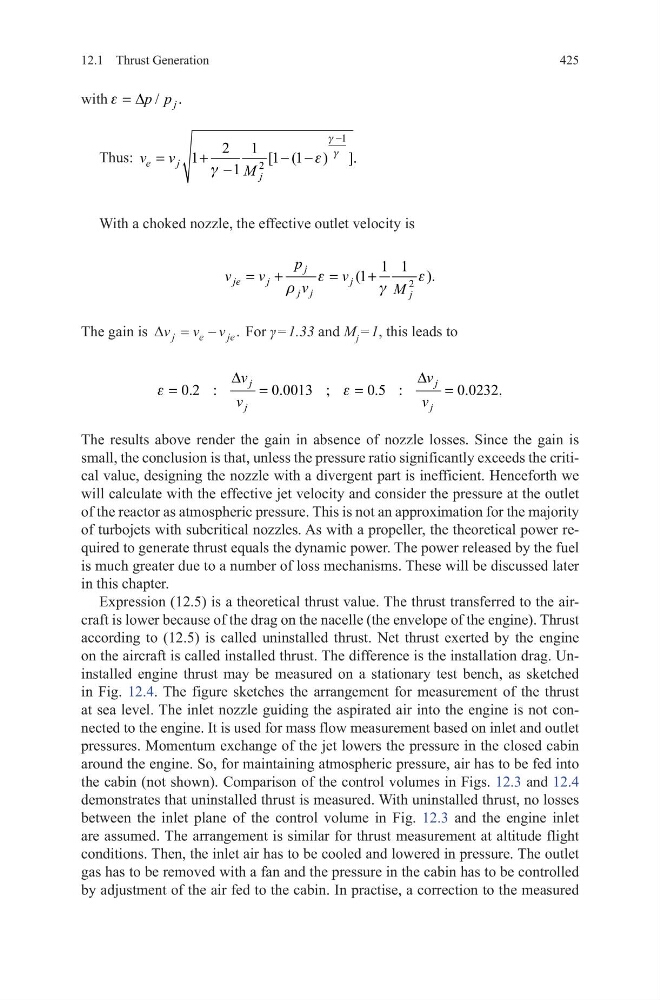
With a choked nozzle, the effective outlet velocity is
The gain is ∆v v v
j
e
je
= − . For γ = 1.33 and M j = 1, this leads to
The results above render the gain in absence of nozzle losses. Since the gain is
small, the conclusion is that, unless the pressure ratio significantly exceeds the critical value, designing the nozzle with a divergent part is inefficient. Henceforth we
will calculate with the effective jet velocity and consider the pressure at the outlet
of the reactor as atmospheric pressure. This is not an approximation for the majority
of turbojets with subcritical nozzles. As with a propeller, the theoretical power required to generate thrust equals the dynamic power. The power released by the fuel
is much greater due to a number of loss mechanisms. These will be discussed later
in this chapter.
Expression (12.5) is a theoretical thrust value. The thrust transferred to the aircraft is lower because of the drag on the nacelle (the envelope of the engine). Thrust
according to (12.5) is called uninstalled thrust. Net thrust exerted by the engine
on the aircraft is called installed thrust. The difference is the installation drag. Uninstalled engine thrust may be measured on a stationary test bench, as sketched
in Fig. 12.4. The figure sketches the arrangement for measurement of the thrust
at sea level. The inlet nozzle guiding the aspirated air into the engine is not connected to the engine. It is used for mass flow measurement based on inlet and outlet
pressures. Momentum exchange of the jet lowers the pressure in the closed cabin
around the engine. So, for maintaining atmospheric pressure, air has to be fed into
the cabin (not shown). Comparison of the control volumes in Figs. 12.3 and 12.4
demonstrates that uninstalled thrust is measured. With uninstalled thrust, no losses
between the inlet plane of the control volume in Fig. 12.3 and the engine inlet
are assumed. The arrangement is similar for thrust measurement at altitude flight
conditions. Then, the inlet air has to be cooled and lowered in pressure. The outlet
gas has to be removed with a fan and the pressure in the cabin has to be controlled
by adjustment of the air fed to the cabin. In practise, a correction to the measured
2
1 1
(1
).
j
je
j
j
j j
j
p
v
v
v
v
M
e
e
r
g
= +
=
+
0.2 :
0.0013 ;
0.5 :
0.0232.
j
j
j
j
v
v
v
v
e
e
∆
∆
=
=
=
=
12.1 Thrust Generation
with
/ .
j
p p
e = ∆
Thus:
1
2
2 1
1
[1 (1 ) ].
1
e
j
j
v v
M
g
g
e
g
−
=
+
− −
−
With a choked nozzle, the effective outlet velocity is
The gain is ∆v v v
j
e
je
= − . For γ = 1.33 and M j = 1, this leads to
The results above render the gain in absence of nozzle losses. Since the gain is
small, the conclusion is that, unless the pressure ratio significantly exceeds the critical value, designing the nozzle with a divergent part is inefficient. Henceforth we
will calculate with the effective jet velocity and consider the pressure at the outlet
of the reactor as atmospheric pressure. This is not an approximation for the majority
of turbojets with subcritical nozzles. As with a propeller, the theoretical power required to generate thrust equals the dynamic power. The power released by the fuel
is much greater due to a number of loss mechanisms. These will be discussed later
in this chapter.
Expression (12.5) is a theoretical thrust value. The thrust transferred to the aircraft is lower because of the drag on the nacelle (the envelope of the engine). Thrust
according to (12.5) is called uninstalled thrust. Net thrust exerted by the engine
on the aircraft is called installed thrust. The difference is the installation drag. Uninstalled engine thrust may be measured on a stationary test bench, as sketched
in Fig. 12.4. The figure sketches the arrangement for measurement of the thrust
at sea level. The inlet nozzle guiding the aspirated air into the engine is not connected to the engine. It is used for mass flow measurement based on inlet and outlet
pressures. Momentum exchange of the jet lowers the pressure in the closed cabin
around the engine. So, for maintaining atmospheric pressure, air has to be fed into
the cabin (not shown). Comparison of the control volumes in Figs. 12.3 and 12.4
demonstrates that uninstalled thrust is measured. With uninstalled thrust, no losses
between the inlet plane of the control volume in Fig. 12.3 and the engine inlet
are assumed. The arrangement is similar for thrust measurement at altitude flight
conditions. Then, the inlet air has to be cooled and lowered in pressure. The outlet
gas has to be removed with a fan and the pressure in the cabin has to be controlled
by adjustment of the air fed to the cabin. In practise, a correction to the measured
2
1 1
(1
).
j
je
j
j
j j
j
p
v
v
v
v
M
e
e
r
g
= +
=
+
0.2 :
0.0013 ;
0.5 :
0.0232.
j
j
j
j
v
v
v
v
e
e
∆
∆
=
=
=
=