

424
12 Thrust Gas Turbines
atmospheric pressure in the inlet and outlet planes of the outer streamtube. No energy is added to the flow that does not pass through the reactor. In the outlet plane
of the outer streamtube, pressure is atmospheric and velocity thus equals inflow
velocity ( v 0 ).
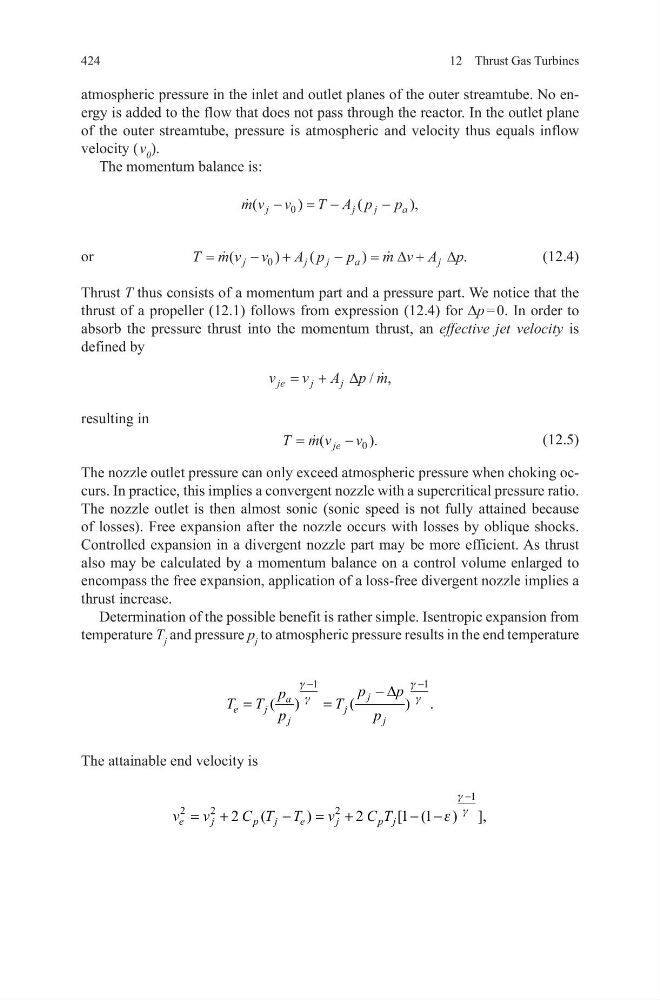
The momentum balance is:
or
(12.4)
Thrust T thus consists of a momentum part and a pressure part. We notice that the
thrust of a propeller (12.1) follows from expression (12.4) for Dp = 0. In order to
absorb the pressure thrust into the momentum thrust, an effective jet velocity is
defined by
resulting in
(12.5)
The nozzle outlet pressure can only exceed atmospheric pressure when choking occurs. In practice, this implies a convergent nozzle with a supercritical pressure ratio.
The nozzle outlet is then almost sonic (sonic speed is not fully attained because
of losses). Free expansion after the nozzle occurs with losses by oblique shocks.
Controlled expansion in a divergent nozzle part may be more efficient. As thrust
also may be calculated by a momentum balance on a control volume enlarged to
encompass the free expansion, application of a loss-free divergent nozzle implies a
thrust increase.
Determination of the possible benefit is rather simple. Isentropic expansion from
temperature T j and pressure p j to atmospheric pressure results in the end temperature
The attainable end velocity is
m v v
T A p p
j
j
j
a
(
)
(
) ,
−
= −
−
0
T m v v
A p p
m v A p
j
j
j
a
j
=
−
+
−
=
+
(
)
(
)
.
0
∆
∆
v
v A p m
je
j
j
= +
∆ / ,
T m v
v
je
=
−
(
) .
0
1
1
( )
(
) .
j
a
e
j
j
j
j
p
p
p
T T
T
p
p
g
g
g
g
−
−
− ∆
=
=
1
2
2
2
2 (
)
2
[1 (1 ) ],
e
j
p
j
e
j
p j
v
v
C T T
v
C T
g
g
e
−
= +
−
= +
− −
12 Thrust Gas Turbines
atmospheric pressure in the inlet and outlet planes of the outer streamtube. No energy is added to the flow that does not pass through the reactor. In the outlet plane
of the outer streamtube, pressure is atmospheric and velocity thus equals inflow
velocity ( v 0 ).
The momentum balance is:
or
(12.4)
Thrust T thus consists of a momentum part and a pressure part. We notice that the
thrust of a propeller (12.1) follows from expression (12.4) for Dp = 0. In order to
absorb the pressure thrust into the momentum thrust, an effective jet velocity is
defined by
resulting in
(12.5)
The nozzle outlet pressure can only exceed atmospheric pressure when choking occurs. In practice, this implies a convergent nozzle with a supercritical pressure ratio.
The nozzle outlet is then almost sonic (sonic speed is not fully attained because
of losses). Free expansion after the nozzle occurs with losses by oblique shocks.
Controlled expansion in a divergent nozzle part may be more efficient. As thrust
also may be calculated by a momentum balance on a control volume enlarged to
encompass the free expansion, application of a loss-free divergent nozzle implies a
thrust increase.
Determination of the possible benefit is rather simple. Isentropic expansion from
temperature T j and pressure p j to atmospheric pressure results in the end temperature
The attainable end velocity is
m v v
T A p p
j
j
j
a
(
)
(
) ,
−
= −
−
0
T m v v
A p p
m v A p
j
j
j
a
j
=
−
+
−
=
+
(
)
(
)
.
0
∆
∆
v
v A p m
je
j
j
= +
∆ / ,
T m v
v
je
=
−
(
) .
0
1
1
( )
(
) .
j
a
e
j
j
j
j
p
p
p
T T
T
p
p
g
g
g
g
−
−
− ∆
=
=
1
2
2
2
2 (
)
2
[1 (1 ) ],
e
j
p
j
e
j
p j
v
v
C T T
v
C T
g
g
e
−
= +
−
= +
− −