

422
12 Thrust Gas Turbines
there is no change of momentum flux in this streamtube. The resulting force on the
entire surface of the second streamtube thus must equal zero. This demonstrates
that the resulting force on the envelope of the streamtube through the propeller in
Fig. 12.2, in the absence of losses, equals zero.
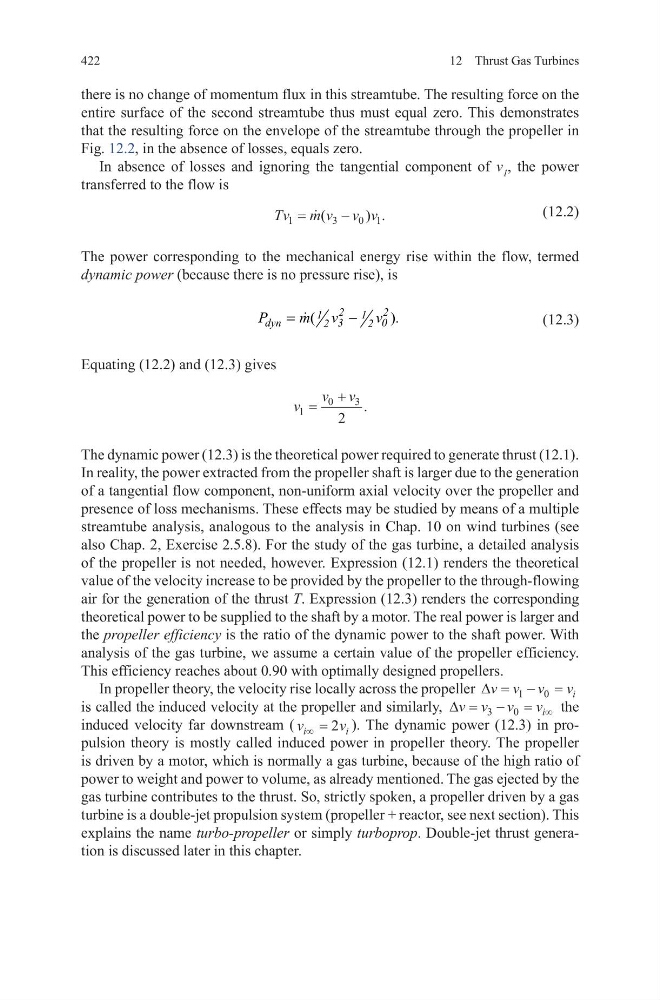
In absence of losses and ignoring the tangential component of v 1 , the power
transferred to the flow is
(12.2)
The power corresponding to the mechanical energy rise within the flow, termed
dynamic power (because there is no pressure rise), is
(12.3)
Equating (12.2) and (12.3) gives
The dynamic power (12.3) is the theoretical power required to generate thrust (12.1).
In reality, the power extracted from the propeller shaft is larger due to the generation
of a tangential flow component, non-uniform axial velocity over the propeller and
presence of loss mechanisms. These effects may be studied by means of a multiple
streamtube analysis, analogous to the analysis in Chap. 10 on wind turbines (see
also Chap. 2, Exercise 2.5.8). For the study of the gas turbine, a detailed analysis
of the propeller is not needed, however. Expression (12.1) renders the theoretical
value of the velocity increase to be provided by the propeller to the through-flowing
air for the generation of the thrust T. Expression (12.3) renders the corresponding
theoretical power to be supplied to the shaft by a motor. The real power is larger and
the propeller efficiency is the ratio of the dynamic power to the shaft power. With
analysis of the gas turbine, we assume a certain value of the propeller efficiency.
This efficiency reaches about 0.90 with optimally designed propellers.
In propeller theory, the velocity rise locally across the propeller ∆v v v v i
= − =
1
0
is called the induced velocity at the propeller and similarly, ∆v v v v i
= − = ∞
3
0
the
induced velocity far downstream ( v
v
i
i
∞ = 2 ). The dynamic power (12.3) in propulsion theory is mostly called induced power in propeller theory. The propeller
is driven by a motor, which is normally a gas turbine, because of the high ratio of
power to weight and power to volume, as already mentioned. The gas ejected by the
gas turbine contributes to the thrust. So, strictly spoken, a propeller driven by a gas
turbine is a double-jet propulsion system (propeller + reactor, see next section). This
explains the name turbo-propeller or simply turboprop. Double-jet thrust generation is discussed later in this chapter.
Tv m v v v
1
3
0 1
=
−
(
) .
(
)
=
−
2
2
1
1
dyn
3
0
2
2
P
m v
v .
v
v v
1
0
3
2
=
+ .
12 Thrust Gas Turbines
there is no change of momentum flux in this streamtube. The resulting force on the
entire surface of the second streamtube thus must equal zero. This demonstrates
that the resulting force on the envelope of the streamtube through the propeller in
Fig. 12.2, in the absence of losses, equals zero.
In absence of losses and ignoring the tangential component of v 1 , the power
transferred to the flow is
(12.2)
The power corresponding to the mechanical energy rise within the flow, termed
dynamic power (because there is no pressure rise), is
(12.3)
Equating (12.2) and (12.3) gives
The dynamic power (12.3) is the theoretical power required to generate thrust (12.1).
In reality, the power extracted from the propeller shaft is larger due to the generation
of a tangential flow component, non-uniform axial velocity over the propeller and
presence of loss mechanisms. These effects may be studied by means of a multiple
streamtube analysis, analogous to the analysis in Chap. 10 on wind turbines (see
also Chap. 2, Exercise 2.5.8). For the study of the gas turbine, a detailed analysis
of the propeller is not needed, however. Expression (12.1) renders the theoretical
value of the velocity increase to be provided by the propeller to the through-flowing
air for the generation of the thrust T. Expression (12.3) renders the corresponding
theoretical power to be supplied to the shaft by a motor. The real power is larger and
the propeller efficiency is the ratio of the dynamic power to the shaft power. With
analysis of the gas turbine, we assume a certain value of the propeller efficiency.
This efficiency reaches about 0.90 with optimally designed propellers.
In propeller theory, the velocity rise locally across the propeller ∆v v v v i
= − =
1
0
is called the induced velocity at the propeller and similarly, ∆v v v v i
= − = ∞
3
0
the
induced velocity far downstream ( v
v
i
i
∞ = 2 ). The dynamic power (12.3) in propulsion theory is mostly called induced power in propeller theory. The propeller
is driven by a motor, which is normally a gas turbine, because of the high ratio of
power to weight and power to volume, as already mentioned. The gas ejected by the
gas turbine contributes to the thrust. So, strictly spoken, a propeller driven by a gas
turbine is a double-jet propulsion system (propeller + reactor, see next section). This
explains the name turbo-propeller or simply turboprop. Double-jet thrust generation is discussed later in this chapter.
Tv m v v v
1
3
0 1
=
−
(
) .
(
)
=
−
2
2
1
1
dyn
3
0
2
2
P
m v
v .
v
v v
1
0
3
2
=
+ .