

395
11.2 Thermodynamic Modelling
The subscripts a, f and g refer to air, fuel and combustion gas. H L is the lower
heating value of the fuel, determined at the reference temperature T r , which often
is T r = 288 K, the standard temperature at sea level (sometimes 25 °C is used). The
lower heating value of a liquid fuel is around H L = 42,000 kJ/kg. The temperatures
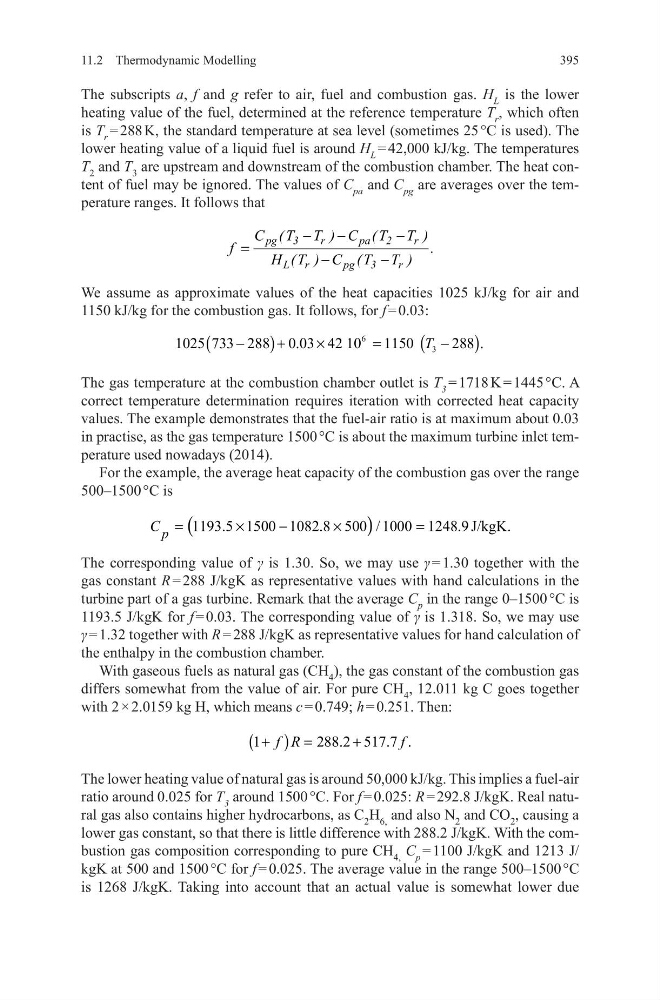
T 2 and T 3 are upstream and downstream of the combustion chamber. The heat content of fuel may be ignored. The values of C pa and C pg are averages over the temperature ranges. It follows that
We assume as approximate values of the heat capacities 1025 kJ/kg for air and
1150 kJ/kg for the combustion gas. It follows, for f = 0.03:
The gas temperature at the combustion chamber outlet is T 3 = 1718 K = 1445 °C. A
correct temperature determination requires iteration with corrected heat capacity
values. The example demonstrates that the fuel-air ratio is at maximum about 0.03
in practise, as the gas temperature 1500 °C is about the maximum turbine inlet temperature used nowadays (2014).
For the example, the average heat capacity of the combustion gas over the range
500–1500 °C is
The corresponding value of γ is 1.30. So, we may use γ = 1.30 together with the
gas constant R = 288 J/kgK as representative values with hand calculations in the
turbine part of a gas turbine. Remark that the average C p in the range 0–1500 °C is
1193.5 J/kgK for f = 0.03. The corresponding value of γ is 1.318. So, we may use
γ = 1.32 together with R = 288 J/kgK as representative values for hand calculation of
the enthalpy in the combustion chamber.
With gaseous fuels as natural gas (CH 4 ), the gas constant of the combustion gas
differs somewhat from the value of air. For pure CH 4 , 12.011 kg C goes together
with 2 × 2.0159 kg H, which means c = 0.749; h = 0.251. Then:
The lower heating value of natural gas is around 50,000 kJ/kg. This implies a fuel-air
ratio around 0.025 for T 3 around 1500 °C. For f = 0.025: R = 292.8 J/kgK. Real natural gas also contains higher hydrocarbons, as C 2 H 6, and also N 2 and CO 2 , causing a
lower gas constant, so that there is little difference with 288.2 J/kgK. With the combustion gas composition corresponding to pure CH 4, C p = 1100 J/kgK and 1213 J/
kgK at 500 and 1500 °C for f = 0.025. The average value in the range 500–1500 °C
is 1268 J/kgK. Taking into account that an actual value is somewhat lower due
pg 3
r
pa 2
r
L r
pg 3
r
C (T T ) C (T T )
f
.
H (T ) C (T T )
−
−
−
=
−
−
(
)
(
)
6
3
1025 733 288 0.03 42 10
1150
288 .
T
−
+
×
=
−
(
)
1193.5 1500 1082.8 500 / 1000 1248.9 J/kgK.
p
C =
×
−
×
=
( )
1
288.2 517.7 .
f R
f
+
=
+
11.2 Thermodynamic Modelling
The subscripts a, f and g refer to air, fuel and combustion gas. H L is the lower
heating value of the fuel, determined at the reference temperature T r , which often
is T r = 288 K, the standard temperature at sea level (sometimes 25 °C is used). The
lower heating value of a liquid fuel is around H L = 42,000 kJ/kg. The temperatures
T 2 and T 3 are upstream and downstream of the combustion chamber. The heat content of fuel may be ignored. The values of C pa and C pg are averages over the temperature ranges. It follows that
We assume as approximate values of the heat capacities 1025 kJ/kg for air and
1150 kJ/kg for the combustion gas. It follows, for f = 0.03:
The gas temperature at the combustion chamber outlet is T 3 = 1718 K = 1445 °C. A
correct temperature determination requires iteration with corrected heat capacity
values. The example demonstrates that the fuel-air ratio is at maximum about 0.03
in practise, as the gas temperature 1500 °C is about the maximum turbine inlet temperature used nowadays (2014).
For the example, the average heat capacity of the combustion gas over the range
500–1500 °C is
The corresponding value of γ is 1.30. So, we may use γ = 1.30 together with the
gas constant R = 288 J/kgK as representative values with hand calculations in the
turbine part of a gas turbine. Remark that the average C p in the range 0–1500 °C is
1193.5 J/kgK for f = 0.03. The corresponding value of γ is 1.318. So, we may use
γ = 1.32 together with R = 288 J/kgK as representative values for hand calculation of
the enthalpy in the combustion chamber.
With gaseous fuels as natural gas (CH 4 ), the gas constant of the combustion gas
differs somewhat from the value of air. For pure CH 4 , 12.011 kg C goes together
with 2 × 2.0159 kg H, which means c = 0.749; h = 0.251. Then:
The lower heating value of natural gas is around 50,000 kJ/kg. This implies a fuel-air
ratio around 0.025 for T 3 around 1500 °C. For f = 0.025: R = 292.8 J/kgK. Real natural gas also contains higher hydrocarbons, as C 2 H 6, and also N 2 and CO 2 , causing a
lower gas constant, so that there is little difference with 288.2 J/kgK. With the combustion gas composition corresponding to pure CH 4, C p = 1100 J/kgK and 1213 J/
kgK at 500 and 1500 °C for f = 0.025. The average value in the range 500–1500 °C
is 1268 J/kgK. Taking into account that an actual value is somewhat lower due
pg 3
r
pa 2
r
L r
pg 3
r
C (T T ) C (T T )
f
.
H (T ) C (T T )
−
−
−
=
−
−
(
)
(
)
6
3
1025 733 288 0.03 42 10
1150
288 .
T
−
+
×
=
−
(
)
1193.5 1500 1082.8 500 / 1000 1248.9 J/kgK.
p
C =
×
−
×
=
( )
1
288.2 517.7 .
f R
f
+
=
+