

396
11 Power Gas Turbines
to presence of N 2 and CO 2 components, we still may use R = 288 J/kgK together
with γ = 1.30 for hand calculations of the expansion in the turbine and together with
γ = 1.32 for determination of the fuel-air ratio in the combustion chamber.
11.2.5 Heat Capacity Representation
The integral heat capacity of a gas as a function of temperature may be expressed,
with good accuracy, by a polynomial, according to
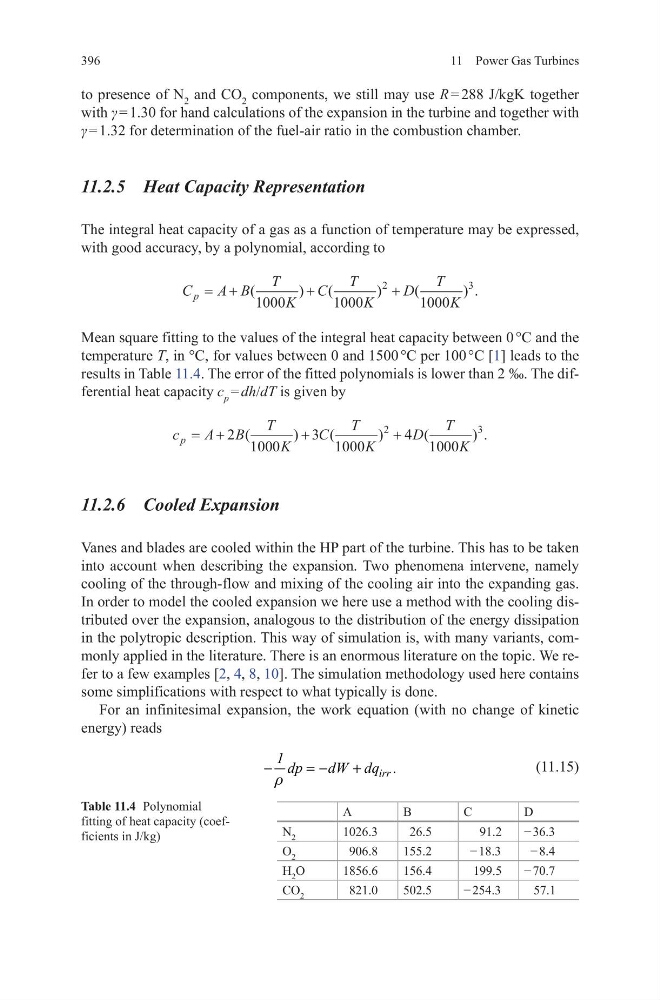
Mean square fitting to the values of the integral heat capacity between 0 °C and the
temperature T, in °C, for values between 0 and 1500 °C per 100 °C [1] leads to the
results in Table 11.4. The error of the fitted polynomials is lower than 2 ‰. The differential heat capacity c p = dh/dT is given by
11.2.6 Cooled Expansion
Vanes and blades are cooled within the HP part of the turbine. This has to be taken
into account when describing the expansion. Two phenomena intervene, namely
cooling of the through-flow and mixing of the cooling air into the expanding gas.
In order to model the cooled expansion we here use a method with the cooling distributed over the expansion, analogous to the distribution of the energy dissipation
in the polytropic description. This way of simulation is, with many variants, commonly applied in the literature. There is an enormous literature on the topic. We refer to a few examples [2, 4, 8, 10]. The simulation methodology used here contains
some simplifications with respect to what typically is done.
For an infinitesimal expansion, the work equation (with no change of kinetic
energy) reads
(11.15)
C
A B
T
K
C
T
K
D
T
K
p = +
+
+
(
)
(
)
(
) .
1000
1000
1000
2
3
c
A B
T
K
C
T
K
D
T
K
p = +
+
+
2 1000
3 1000
4 1000
2
3
(
)
(
)
(
) .
irr
1 dp
dW dq .
r
−
= −
+
A
B
C
D
N 2
1026.3
26.5
91.2
− 36.3
O 2
906.8
155.2
− 18.3
− 8.4
H 2 O
1856.6
156.4
199.5
− 70.7
CO 2
821.0
502.5
− 254.3
57.1
Table 11.4 Polynomial
fitting of heat capacity (coefficients in J/kg)
11 Power Gas Turbines
to presence of N 2 and CO 2 components, we still may use R = 288 J/kgK together
with γ = 1.30 for hand calculations of the expansion in the turbine and together with
γ = 1.32 for determination of the fuel-air ratio in the combustion chamber.
11.2.5 Heat Capacity Representation
The integral heat capacity of a gas as a function of temperature may be expressed,
with good accuracy, by a polynomial, according to
Mean square fitting to the values of the integral heat capacity between 0 °C and the
temperature T, in °C, for values between 0 and 1500 °C per 100 °C [1] leads to the
results in Table 11.4. The error of the fitted polynomials is lower than 2 ‰. The differential heat capacity c p = dh/dT is given by
11.2.6 Cooled Expansion
Vanes and blades are cooled within the HP part of the turbine. This has to be taken
into account when describing the expansion. Two phenomena intervene, namely
cooling of the through-flow and mixing of the cooling air into the expanding gas.
In order to model the cooled expansion we here use a method with the cooling distributed over the expansion, analogous to the distribution of the energy dissipation
in the polytropic description. This way of simulation is, with many variants, commonly applied in the literature. There is an enormous literature on the topic. We refer to a few examples [2, 4, 8, 10]. The simulation methodology used here contains
some simplifications with respect to what typically is done.
For an infinitesimal expansion, the work equation (with no change of kinetic
energy) reads
(11.15)
C
A B
T
K
C
T
K
D
T
K
p = +
+
+
(
)
(
)
(
) .
1000
1000
1000
2
3
c
A B
T
K
C
T
K
D
T
K
p = +
+
+
2 1000
3 1000
4 1000
2
3
(
)
(
)
(
) .
irr
1 dp
dW dq .
r
−
= −
+
A
B
C
D
N 2
1026.3
26.5
91.2
− 36.3
O 2
906.8
155.2
− 18.3
− 8.4
H 2 O
1856.6
156.4
199.5
− 70.7
CO 2
821.0
502.5
− 254.3
57.1
Table 11.4 Polynomial
fitting of heat capacity (coefficients in J/kg)