

394
11 Power Gas Turbines
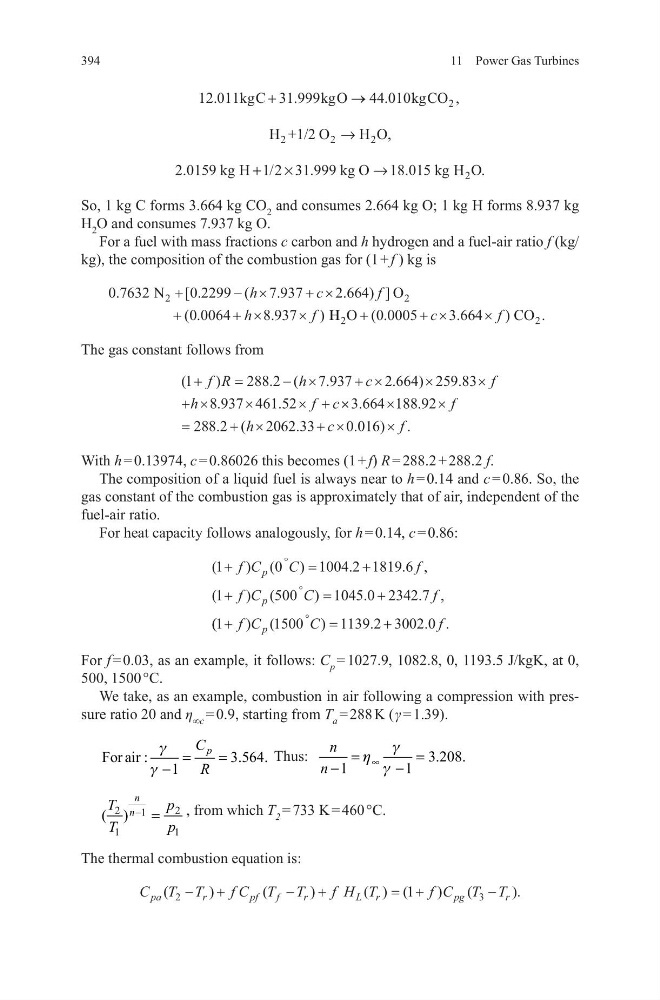
So, 1 kg C forms 3.664 kg CO 2 and consumes 2.664 kg O; 1 kg H forms 8.937 kg
H 2 O and consumes 7.937 kg O.
For a fuel with mass fractions c carbon and h hydrogen and a fuel-air ratio f (kg/
kg), the composition of the combustion gas for (1 + f ) kg is
The gas constant follows from
With h = 0.13974, c = 0.86026 this becomes (1 + f) R = 288.2 + 288.2 f.
The composition of a liquid fuel is always near to h = 0.14 and c = 0.86. So, the
gas constant of the combustion gas is approximately that of air, independent of the
fuel-air ratio.
For heat capacity follows analogously, for h = 0.14, c = 0.86:
For f = 0.03, as an example, it follows: C p = 1027.9, 1082.8, 0, 1193.5 J/kgK, at 0,
500, 1500 °C.
We take, as an example, combustion in air following a compression with pressure ratio 20 and η ∞c = 0.9, starting from T a = 288 K ( γ = 1.39).
For air :
3.564.
1
p
C
R
g
g
=
=
−
Thus:
3.208.
1
1
n
n
g
h g
∞
=
=
−
−
2
2
1
1
1
( )
n
n
T
p
T
p
− =
, from which T 2 = 733 K = 460 °C.
The thermal combustion equation is:
12.011kgC 31.999kgO 44.010kgCO 2
+
→
,
H +1/2 O
H O,
2
2
2
→
2.0159 kg H / 31.999 kg O 18.015 kg H O
2
+
×
→
1 2
.
0 7632
0 2299
7 937
2 664
0 0064
8 937
.
[.
(
.
. ) ]
( .
.
)
N
O
2
2
+
− ×
+ ×
+
+ ×
×
h
c
f
h
f H H O
CO
2
2
+
+ ×
×
( .
.
)
.
0 0005
3 664
c
f
(
)
. (
.
. )
.
.
.
1
288 2
7937
2 664 259 83
8 937 461 52
+
=
− ×
+ ×
×
×
+ ×
×
× +
f R
h
c
f
h
f c × ×
×
×
=
+ ×
+ ×
×
3 664 188 92
288 2
2062 33
0 016
.
.
. (
.
.
) .
f
h
c
f
(
) (
)
.
. ,
(
) (
)
.
. ,
1
0
1004 2 1819 6
1
500
1045 0 2342 7
+
=
+
+
=
+
°
°
f C
C
f
f C
C
f
p
p
( (
) (
)
.
. .
1
1500
1139 2 3002 0
+
=
+
°
f C
C
f
p
C T T
fC T T
f H T
f C T T
pa
r
p f
f
r
L r
p g
r
(
)
(
)
( ) (
)
(
).
2
3
1
−
+
−
+
= +
−
11 Power Gas Turbines
So, 1 kg C forms 3.664 kg CO 2 and consumes 2.664 kg O; 1 kg H forms 8.937 kg
H 2 O and consumes 7.937 kg O.
For a fuel with mass fractions c carbon and h hydrogen and a fuel-air ratio f (kg/
kg), the composition of the combustion gas for (1 + f ) kg is
The gas constant follows from
With h = 0.13974, c = 0.86026 this becomes (1 + f) R = 288.2 + 288.2 f.
The composition of a liquid fuel is always near to h = 0.14 and c = 0.86. So, the
gas constant of the combustion gas is approximately that of air, independent of the
fuel-air ratio.
For heat capacity follows analogously, for h = 0.14, c = 0.86:
For f = 0.03, as an example, it follows: C p = 1027.9, 1082.8, 0, 1193.5 J/kgK, at 0,
500, 1500 °C.
We take, as an example, combustion in air following a compression with pressure ratio 20 and η ∞c = 0.9, starting from T a = 288 K ( γ = 1.39).
For air :
3.564.
1
p
C
R
g
g
=
=
−
Thus:
3.208.
1
1
n
n
g
h g
∞
=
=
−
−
2
2
1
1
1
( )
n
n
T
p
T
p
− =
, from which T 2 = 733 K = 460 °C.
The thermal combustion equation is:
12.011kgC 31.999kgO 44.010kgCO 2
+
→
,
H +1/2 O
H O,
2
2
2
→
2.0159 kg H / 31.999 kg O 18.015 kg H O
2
+
×
→
1 2
.
0 7632
0 2299
7 937
2 664
0 0064
8 937
.
[.
(
.
. ) ]
( .
.
)
N
O
2
2
+
− ×
+ ×
+
+ ×
×
h
c
f
h
f H H O
CO
2
2
+
+ ×
×
( .
.
)
.
0 0005
3 664
c
f
(
)
. (
.
. )
.
.
.
1
288 2
7937
2 664 259 83
8 937 461 52
+
=
− ×
+ ×
×
×
+ ×
×
× +
f R
h
c
f
h
f c × ×
×
×
=
+ ×
+ ×
×
3 664 188 92
288 2
2062 33
0 016
.
.
. (
.
.
) .
f
h
c
f
(
) (
)
.
. ,
(
) (
)
.
. ,
1
0
1004 2 1819 6
1
500
1045 0 2342 7
+
=
+
+
=
+
°
°
f C
C
f
f C
C
f
p
p
( (
) (
)
.
. .
1
1500
1139 2 3002 0
+
=
+
°
f C
C
f
p
C T T
fC T T
f H T
f C T T
pa
r
p f
f
r
L r
p g
r
(
)
(
)
( ) (
)
(
).
2
3
1
−
+
−
+
= +
−