

11
1.4 Basic Laws for Stationary Duct Parts
So, the displacement work done against gravity is the total differential of the term
U. Work supplied for a displacement between two points is thus independent of the
path followed. This implies that no work is required for a displacement with coinciding initial and final points. Consequently, work stored in the fluid, done against
a conservative force, is entirely recoverable and may thus be considered as energy.
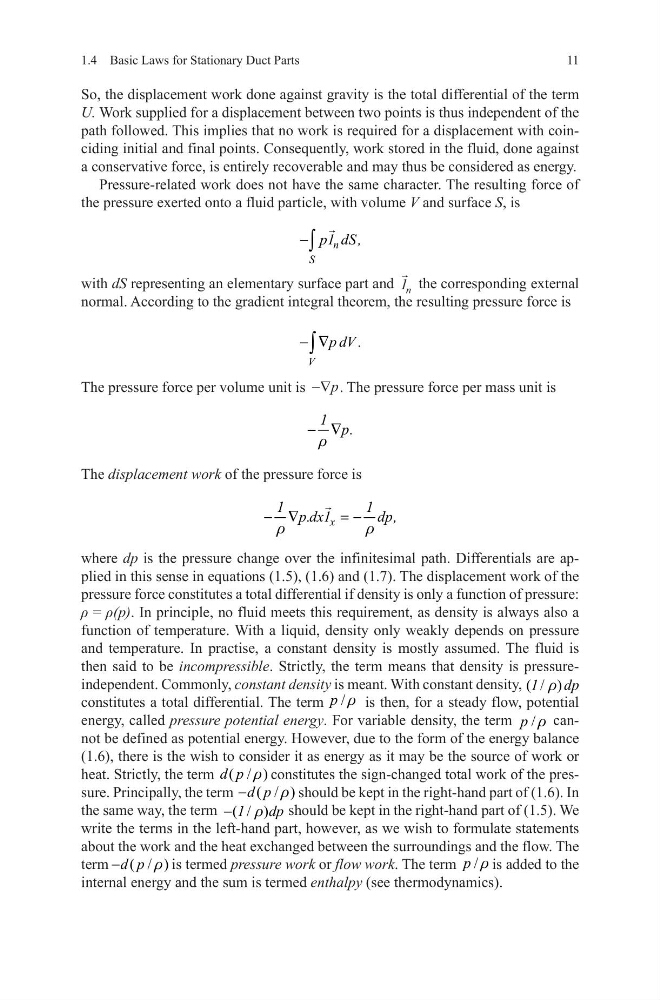
Pressure-related work does not have the same character. The resulting force of
the pressure exerted onto a fluid particle, with volume V and surface S, is
with dS representing an elementary surface part and
1 n the corresponding external
normal. According to the gradient integral theorem, the resulting pressure force is
The pressure force per volume unit is −∇p. The pressure force per mass unit is
The displacement work of the pressure force is
where dp is the pressure change over the infinitesimal path. Differentials are applied in this sense in equations (1.5), (1.6) and (1.7). The displacement work of the
pressure force constitutes a total differential if density is only a function of pressure:
ρ = ρ(p). In principle, no fluid meets this requirement, as density is always also a
function of temperature. With a liquid, density only weakly depends on pressure
and temperature. In practise, a constant density is mostly assumed. The fluid is
then said to be incompressible. Strictly, the term means that density is pressureindependent. Commonly, constant density is meant. With constant density, ( / )
1
dp
r
constitutes a total differential. The term /
p r is then, for a steady flow, potential
energy, called pressure potential energy. For variable density, the term /
p r cannot be defined as potential energy. However, due to the form of the energy balance
(1.6), there is the wish to consider it as energy as it may be the source of work or
heat. Strictly, the term ( / )
d p r constitutes the sign-changed total work of the pressure. Principally, the term
( / )
d p r
−
should be kept in the right-hand part of (1.6). In
the same way, the term ( / )
1
dp
r
−
should be kept in the right-hand part of (1.5). We
write the terms in the left-hand part, however, as we wish to formulate statements
about the work and the heat exchanged between the surroundings and the flow. The
term ( / )
d p r
−
is termed pressure work or flow work. The term /
p r is added to the
internal energy and the sum is termed enthalpy (see thermodynamics).
n
S
p1 dS ,
− ∫
V
p dV .
− ∇
∫
1 p.
r
− ∇
x
1
1
p.dx1
dp,
r
r
− ∇
= −
1.4 Basic Laws for Stationary Duct Parts
So, the displacement work done against gravity is the total differential of the term
U. Work supplied for a displacement between two points is thus independent of the
path followed. This implies that no work is required for a displacement with coinciding initial and final points. Consequently, work stored in the fluid, done against
a conservative force, is entirely recoverable and may thus be considered as energy.
Pressure-related work does not have the same character. The resulting force of
the pressure exerted onto a fluid particle, with volume V and surface S, is
with dS representing an elementary surface part and
1 n the corresponding external
normal. According to the gradient integral theorem, the resulting pressure force is
The pressure force per volume unit is −∇p. The pressure force per mass unit is
The displacement work of the pressure force is
where dp is the pressure change over the infinitesimal path. Differentials are applied in this sense in equations (1.5), (1.6) and (1.7). The displacement work of the
pressure force constitutes a total differential if density is only a function of pressure:
ρ = ρ(p). In principle, no fluid meets this requirement, as density is always also a
function of temperature. With a liquid, density only weakly depends on pressure
and temperature. In practise, a constant density is mostly assumed. The fluid is
then said to be incompressible. Strictly, the term means that density is pressureindependent. Commonly, constant density is meant. With constant density, ( / )
1
dp
r
constitutes a total differential. The term /
p r is then, for a steady flow, potential
energy, called pressure potential energy. For variable density, the term /
p r cannot be defined as potential energy. However, due to the form of the energy balance
(1.6), there is the wish to consider it as energy as it may be the source of work or
heat. Strictly, the term ( / )
d p r constitutes the sign-changed total work of the pressure. Principally, the term
( / )
d p r
−
should be kept in the right-hand part of (1.6). In
the same way, the term ( / )
1
dp
r
−
should be kept in the right-hand part of (1.5). We
write the terms in the left-hand part, however, as we wish to formulate statements
about the work and the heat exchanged between the surroundings and the flow. The
term ( / )
d p r
−
is termed pressure work or flow work. The term /
p r is added to the
internal energy and the sum is termed enthalpy (see thermodynamics).
n
S
p1 dS ,
− ∫
V
p dV .
− ∇
∫
1 p.
r
− ∇
x
1
1
p.dx1
dp,
r
r
− ∇
= −