

10
1 Working Principles
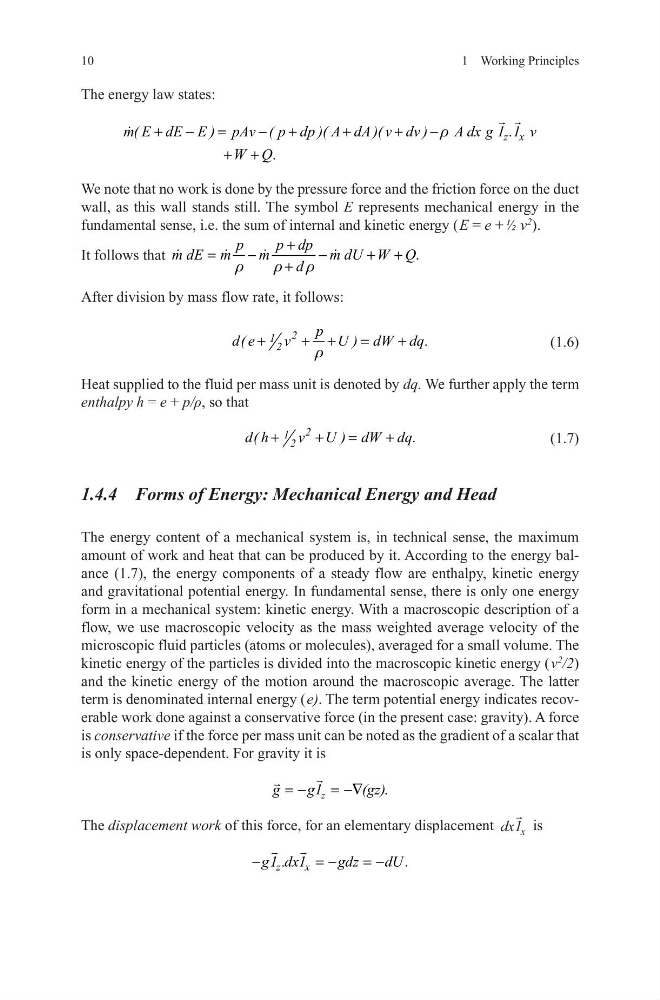
The energy law states:
We note that no work is done by the pressure force and the friction force on the duct
wall, as this wall stands still. The symbol E represents mechanical energy in the
fundamental sense, i.e. the sum of internal and kinetic energy ( E = e + ½ v
2
).
It follows that
.
p
p dp
m dE m
m
m dU W Q
d
r
r
r
+
=
−
−
+ +
+
After division by mass flow rate, it follows:
(1.6)
Heat supplied to the fluid per mass unit is denoted by dq. We further apply the term
enthalpy h = e + p/ρ, so that
(1.7)
1.4.4 Forms of Energy: Mechanical Energy and Head
The energy content of a mechanical system is, in technical sense, the maximum
amount of work and heat that can be produced by it. According to the energy balance (1.7), the energy components of a steady flow are enthalpy, kinetic energy
and gravitational potential energy. In fundamental sense, there is only one energy
form in a mechanical system: kinetic energy. With a macroscopic description of a
flow, we use macroscopic velocity as the mass weighted average velocity of the
microscopic fluid particles (atoms or molecules), averaged for a small volume. The
kinetic energy of the particles is divided into the macroscopic kinetic energy ( v
2
/2)
and the kinetic energy of the motion around the macroscopic average. The latter
term is denominated internal energy ( e). The term potential energy indicates recoverable work done against a conservative force (in the present case: gravity). A force
is conservative if the force per mass unit can be noted as the gradient of a scalar that
is only space-dependent. For gravity it is
The displacement work of this force, for an elementary displacement dx1 x
is
z x
m( E dE E ) pAv ( p dp )( A dA )( v dv )
A dx g 1 .1 v
W Q.
r
+
−
=
− +
+
+
−
+ +
2
1 2
p
d( e
v
U ) dW dq.
r
+
+ +
=
+
2
1 2
d( h
v U ) dW dq.
+
+
=
+
.
z
g
g1
(gz)
= −
= −∇
z
x
g1 .dx1
gdz
dU .
−
= −
= −
1 Working Principles
The energy law states:
We note that no work is done by the pressure force and the friction force on the duct
wall, as this wall stands still. The symbol E represents mechanical energy in the
fundamental sense, i.e. the sum of internal and kinetic energy ( E = e + ½ v
2
).
It follows that
.
p
p dp
m dE m
m
m dU W Q
d
r
r
r
+
=
−
−
+ +
+
After division by mass flow rate, it follows:
(1.6)
Heat supplied to the fluid per mass unit is denoted by dq. We further apply the term
enthalpy h = e + p/ρ, so that
(1.7)
1.4.4 Forms of Energy: Mechanical Energy and Head
The energy content of a mechanical system is, in technical sense, the maximum
amount of work and heat that can be produced by it. According to the energy balance (1.7), the energy components of a steady flow are enthalpy, kinetic energy
and gravitational potential energy. In fundamental sense, there is only one energy
form in a mechanical system: kinetic energy. With a macroscopic description of a
flow, we use macroscopic velocity as the mass weighted average velocity of the
microscopic fluid particles (atoms or molecules), averaged for a small volume. The
kinetic energy of the particles is divided into the macroscopic kinetic energy ( v
2
/2)
and the kinetic energy of the motion around the macroscopic average. The latter
term is denominated internal energy ( e). The term potential energy indicates recoverable work done against a conservative force (in the present case: gravity). A force
is conservative if the force per mass unit can be noted as the gradient of a scalar that
is only space-dependent. For gravity it is
The displacement work of this force, for an elementary displacement dx1 x
is
z x
m( E dE E ) pAv ( p dp )( A dA )( v dv )
A dx g 1 .1 v
W Q.
r
+
−
=
− +
+
+
−
+ +
2
1 2
p
d( e
v
U ) dW dq.
r
+
+ +
=
+
2
1 2
d( h
v U ) dW dq.
+
+
=
+
.
z
g
g1
(gz)
= −
= −∇
z
x
g1 .dx1
gdz
dU .
−
= −
= −