

9
1.4 Basic Laws for Stationary Duct Parts
with O being the circumference. This gives, after multiplication by velocity and
division by mass flow rate:
The first term may be considered as the work per time unit done on the moving
fluid by the friction force per unit of mass flow rate, or the work per unit of mass.
The second term is, similarly, the active force work per unit of mass. We denote the
additional terms by
In the notation we already take into account that the work of the friction force on
the moving fluid, with friction on a stationary material wall, is equal to the friction-generated heat; this is the energy dissipation (see Sect. 1.4.5 and see Chap. 2,
Sect. 2.1.5). The work of the active force is positive when work is done on the fluid
( dF v
. > 0 ).
Bernoulli’s equation (work equation) becomes
(1.5)
1.4.3 Conservation of Energy
The first law of thermodynamics states that, with a fixed mass system, energy increase equals the sum of work supplied and heat supplied. We denote the heat supplied to the elementary duct part per time unit by Q (J/s = W). We denote work
supplied per time unit by the active force by W:
O dx v dF v .
Av
Av
t
r
r
−
+
−
+
dq
dW J kg
irr
( / ).
2
1
irr
2
1
d v
dp dU dq
dW .
r
+
+
+
=
W dFv dWm
= =
.
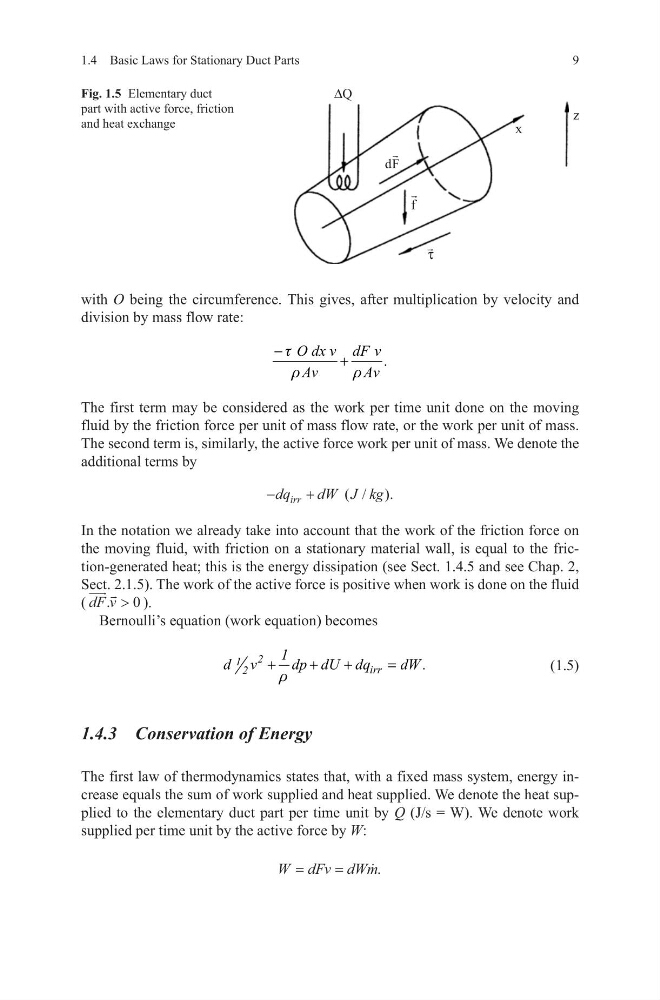
Fig. 1.5 Elementary duct
part with active force, friction
and heat exchange
1.4 Basic Laws for Stationary Duct Parts
with O being the circumference. This gives, after multiplication by velocity and
division by mass flow rate:
The first term may be considered as the work per time unit done on the moving
fluid by the friction force per unit of mass flow rate, or the work per unit of mass.
The second term is, similarly, the active force work per unit of mass. We denote the
additional terms by
In the notation we already take into account that the work of the friction force on
the moving fluid, with friction on a stationary material wall, is equal to the friction-generated heat; this is the energy dissipation (see Sect. 1.4.5 and see Chap. 2,
Sect. 2.1.5). The work of the active force is positive when work is done on the fluid
( dF v
. > 0 ).
Bernoulli’s equation (work equation) becomes
(1.5)
1.4.3 Conservation of Energy
The first law of thermodynamics states that, with a fixed mass system, energy increase equals the sum of work supplied and heat supplied. We denote the heat supplied to the elementary duct part per time unit by Q (J/s = W). We denote work
supplied per time unit by the active force by W:
O dx v dF v .
Av
Av
t
r
r
−
+
−
+
dq
dW J kg
irr
( / ).
2
1
irr
2
1
d v
dp dU dq
dW .
r
+
+
+
=
W dFv dWm
= =
.
Fig. 1.5 Elementary duct
part with active force, friction
and heat exchange