

8
1 Working Principles
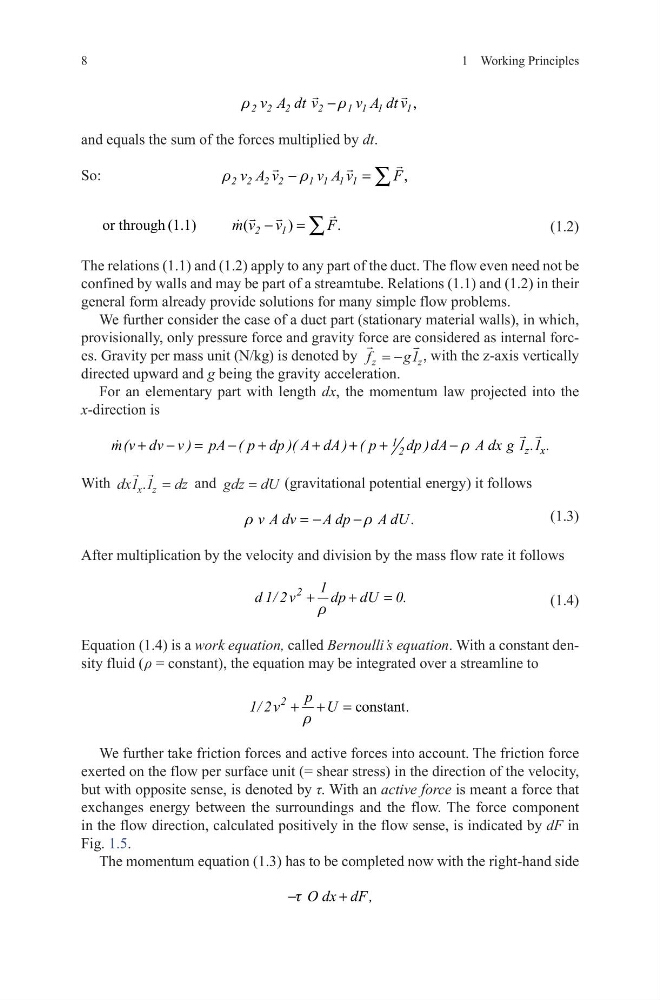
and equals the sum of the forces multiplied by dt.
So:
(1.2)
The relations (1.1) and (1.2) apply to any part of the duct. The flow even need not be
confined by walls and may be part of a streamtube. Relations (1.1) and (1.2) in their
general form already provide solutions for many simple flow problems.
We further consider the case of a duct part (stationary material walls), in which,
provisionally, only pressure force and gravity force are considered as internal forces. Gravity per mass unit (N/kg) is denoted by
f
g
z
z
= − 1 , with the z-axis vertically
directed upward and g being the gravity acceleration.
For an elementary part with length dx, the momentum law projected into the
x-direction is
With dx 1 dz
x z
1 . =
and gdz dU
=
(gravitational potential energy) it follows
(1.3)
After multiplication by the velocity and division by the mass flow rate it follows
(1.4)
Equation (1.4) is a work equation, called Bernoulli’s equation. With a constant density fluid ( ρ = constant), the equation may be integrated over a streamline to
We further take friction forces and active forces into account. The friction force
exerted on the flow per surface unit (= shear stress) in the direction of the velocity,
but with opposite sense, is denoted by τ. With an active force is meant a force that
exchanges energy between the surroundings and the flow. The force component
in the flow direction, calculated positively in the flow sense, is indicated by dF in
Fig. 1.5.
The momentum equation (1.3) has to be completed now with the right-hand side
,
2 2 2
2
1 1 1
1
v A dt v
v A dt v
r
r
−
,
2 2 2 2
1 1 1 1
v A v
v A v
F
r
r
−
= ∑
or through (1.1)
(
)
.
2
1
m v v
F
−
= ∑
1
z x
2
m(v dv v ) pA ( p dp )( A dA ) ( p
dp )dA
A dx g 1 .1 .
r
+ − =
− +
+
+ +
−
v A dv
A dp
A dU .
r
r
= −
−
2
1
d 1/ 2 v
dp dU 0.
r
+
+
=
constant
2
p
1/ 2 v
U
.
r
+ + =
O dx dF ,
t
−
+
1 Working Principles
and equals the sum of the forces multiplied by dt.
So:
(1.2)
The relations (1.1) and (1.2) apply to any part of the duct. The flow even need not be
confined by walls and may be part of a streamtube. Relations (1.1) and (1.2) in their
general form already provide solutions for many simple flow problems.
We further consider the case of a duct part (stationary material walls), in which,
provisionally, only pressure force and gravity force are considered as internal forces. Gravity per mass unit (N/kg) is denoted by
f
g
z
z
= − 1 , with the z-axis vertically
directed upward and g being the gravity acceleration.
For an elementary part with length dx, the momentum law projected into the
x-direction is
With dx 1 dz
x z
1 . =
and gdz dU
=
(gravitational potential energy) it follows
(1.3)
After multiplication by the velocity and division by the mass flow rate it follows
(1.4)
Equation (1.4) is a work equation, called Bernoulli’s equation. With a constant density fluid ( ρ = constant), the equation may be integrated over a streamline to
We further take friction forces and active forces into account. The friction force
exerted on the flow per surface unit (= shear stress) in the direction of the velocity,
but with opposite sense, is denoted by τ. With an active force is meant a force that
exchanges energy between the surroundings and the flow. The force component
in the flow direction, calculated positively in the flow sense, is indicated by dF in
Fig. 1.5.
The momentum equation (1.3) has to be completed now with the right-hand side
,
2 2 2
2
1 1 1
1
v A dt v
v A dt v
r
r
−
,
2 2 2 2
1 1 1 1
v A v
v A v
F
r
r
−
= ∑
or through (1.1)
(
)
.
2
1
m v v
F
−
= ∑
1
z x
2
m(v dv v ) pA ( p dp )( A dA ) ( p
dp )dA
A dx g 1 .1 .
r
+ − =
− +
+
+ +
−
v A dv
A dp
A dU .
r
r
= −
−
2
1
d 1/ 2 v
dp dU 0.
r
+
+
=
constant
2
p
1/ 2 v
U
.
r
+ + =
O dx dF ,
t
−
+