

12
1 Working Principles
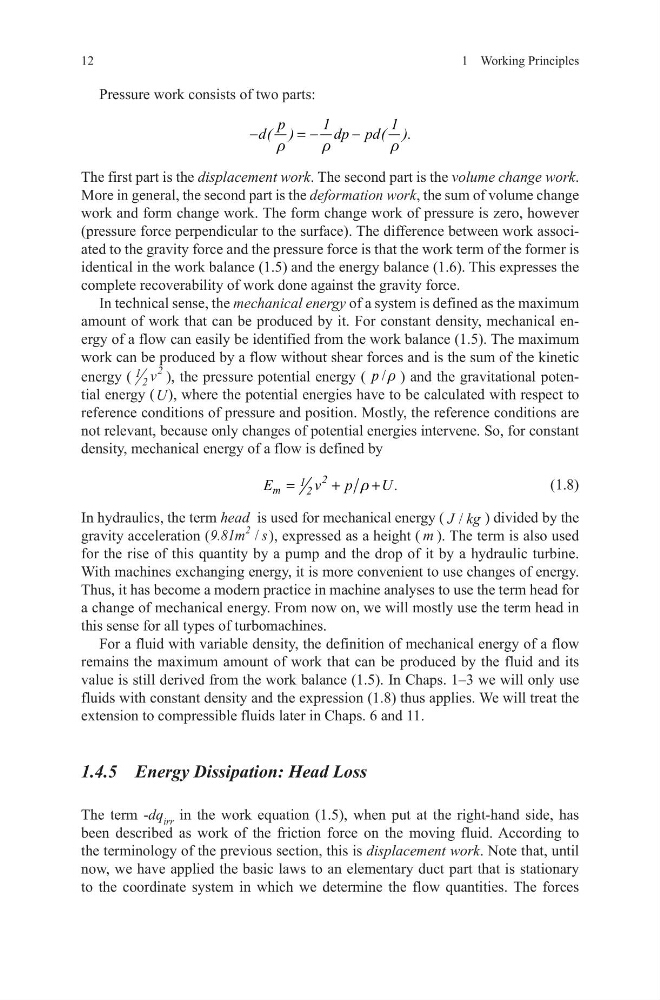
Pressure work consists of two parts:
The first part is the displacement work. The second part is the volume change work.
More in general, the second part is the deformation work, the sum of volume change
work and form change work. The form change work of pressure is zero, however
(pressure force perpendicular to the surface). The difference between work associated to the gravity force and the pressure force is that the work term of the former is
identical in the work balance (1.5) and the energy balance (1.6). This expresses the
complete recoverability of work done against the gravity force.
In technical sense, the mechanical energy of a system is defined as the maximum
amount of work that can be produced by it. For constant density, mechanical energy of a flow can easily be identified from the work balance (1.5). The maximum
work can be produced by a flow without shear forces and is the sum of the kinetic
energy ( 1 2
2
v ), the pressure potential energy ( /
p r ) and the gravitational potential energy (U), where the potential energies have to be calculated with respect to
reference conditions of pressure and position. Mostly, the reference conditions are
not relevant, because only changes of potential energies intervene. So, for constant
density, mechanical energy of a flow is defined by
(1.8)
In hydraulics, the term head is used for mechanical energy ( J kg
/ ) divided by the
gravity acceleration (9.81m s
2
/ ), expressed as a height ( m ). The term is also used
for the rise of this quantity by a pump and the drop of it by a hydraulic turbine.
With machines exchanging energy, it is more convenient to use changes of energy.
Thus, it has become a modern practice in machine analyses to use the term head for
a change of mechanical energy. From now on, we will mostly use the term head in
this sense for all types of turbomachines.
For a fluid with variable density, the definition of mechanical energy of a flow
remains the maximum amount of work that can be produced by the fluid and its
value is still derived from the work balance (1.5). In Chaps. 1–3 we will only use
fluids with constant density and the expression (1.8) thus applies. We will treat the
extension to compressible fluids later in Chaps. 6 and 11.
1.4.5 Energy Dissipation: Head Loss
The term -dq irr in the work equation (1.5), when put at the right-hand side, has
been described as work of the friction force on the moving fluid. According to
the terminology of the previous section, this is displacement work. Note that, until
now, we have applied the basic laws to an elementary duct part that is stationary
to the coordinate system in which we determine the flow quantities. The forces
p
1
1
d( )
dp pd( ).
r
r
r
−
= −
−
2
1
m
2
E
v
p
U .
r
=
+
+
1 Working Principles
Pressure work consists of two parts:
The first part is the displacement work. The second part is the volume change work.
More in general, the second part is the deformation work, the sum of volume change
work and form change work. The form change work of pressure is zero, however
(pressure force perpendicular to the surface). The difference between work associated to the gravity force and the pressure force is that the work term of the former is
identical in the work balance (1.5) and the energy balance (1.6). This expresses the
complete recoverability of work done against the gravity force.
In technical sense, the mechanical energy of a system is defined as the maximum
amount of work that can be produced by it. For constant density, mechanical energy of a flow can easily be identified from the work balance (1.5). The maximum
work can be produced by a flow without shear forces and is the sum of the kinetic
energy ( 1 2
2
v ), the pressure potential energy ( /
p r ) and the gravitational potential energy (U), where the potential energies have to be calculated with respect to
reference conditions of pressure and position. Mostly, the reference conditions are
not relevant, because only changes of potential energies intervene. So, for constant
density, mechanical energy of a flow is defined by
(1.8)
In hydraulics, the term head is used for mechanical energy ( J kg
/ ) divided by the
gravity acceleration (9.81m s
2
/ ), expressed as a height ( m ). The term is also used
for the rise of this quantity by a pump and the drop of it by a hydraulic turbine.
With machines exchanging energy, it is more convenient to use changes of energy.
Thus, it has become a modern practice in machine analyses to use the term head for
a change of mechanical energy. From now on, we will mostly use the term head in
this sense for all types of turbomachines.
For a fluid with variable density, the definition of mechanical energy of a flow
remains the maximum amount of work that can be produced by the fluid and its
value is still derived from the work balance (1.5). In Chaps. 1–3 we will only use
fluids with constant density and the expression (1.8) thus applies. We will treat the
extension to compressible fluids later in Chaps. 6 and 11.
1.4.5 Energy Dissipation: Head Loss
The term -dq irr in the work equation (1.5), when put at the right-hand side, has
been described as work of the friction force on the moving fluid. According to
the terminology of the previous section, this is displacement work. Note that, until
now, we have applied the basic laws to an elementary duct part that is stationary
to the coordinate system in which we determine the flow quantities. The forces
p
1
1
d( )
dp pd( ).
r
r
r
−
= −
−
2
1
m
2
E
v
p
U .
r
=
+
+