

8 Pumps
300
quired when the blades are extended into the suction eye, which means that the radius
of the inlet edge is not constant. The β 1 -angle then also varies along the inlet edge.
8.4.2 Mixed-Flow and Axial Pumps
Blade extension into the suction eye is required for larger values of the specific speed. Non-extended blades then become broader and shorter, impairing the
guidance of the flow. Extension lengthens the blades and also reduces cavitation
sensitivity, as the relative velocity decreases. So blades are extended into the suction
eye and become doubly curved from W ≈
s
0.6 onward. Due to a big difference in
the length of the streamlines, the outlet edge of a blade cannot be kept parallel to the
shaft from W ≈
s
1.25 onward (change in radius and deviation from the meridional
plane). This way, a mixed-flow pump is obtained. At a further increase of specific
speed, it is advantageous to omit the rotor shroud. The reason is that the relative velocity becomes larger than the absolute one. So, there is less friction without shroud.
Mixed-flow open rotor pumps are applied with a specific speed of about 1.5–3. A
radial diffuser followed by a volute or an axial diffuser (Fig. 8.12) may be mounted
downstream of the rotor. With further specific speed increase, the outlet diameter
becomes equal to the inlet diameter, resulting in an axial rotor, followed by an axial
diffuser. This type is applied for specific speeds above about 2.5. So, the application
field of axial pumps partially overlaps the field of mixed-flow pumps.
8.4.3 Pump Inlet
This part conveys the liquid to the suction eye of the pump rotor. A straight duct
in line with the shaft constitutes the best solution. It can only be applied when
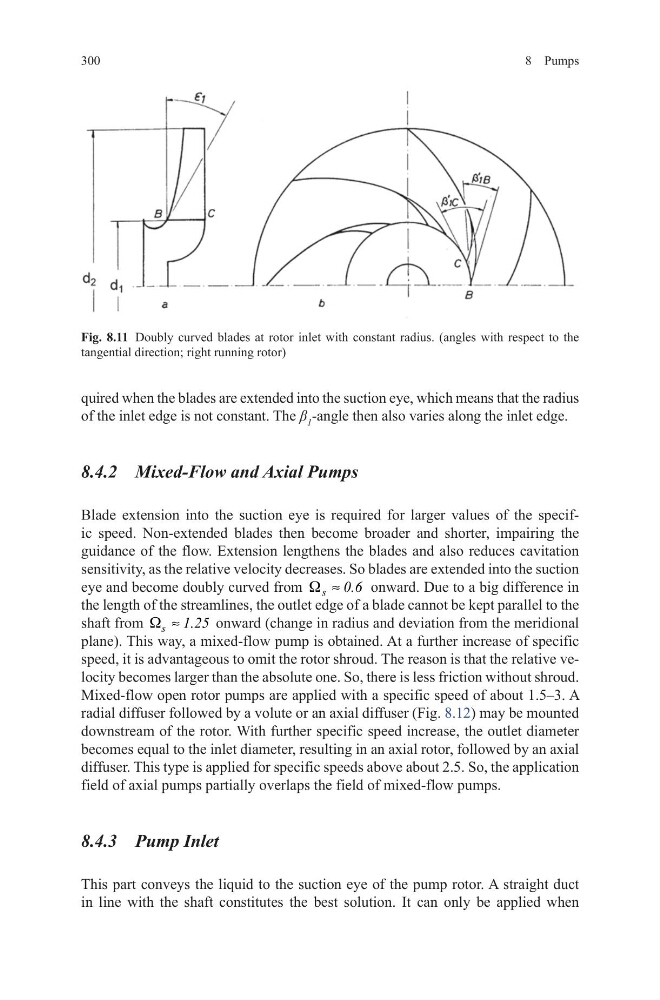
Fig. 8.11 Doubly curved blades at rotor inlet with constant radius. (angles with respect to the
tangential direction; right running rotor)
300
quired when the blades are extended into the suction eye, which means that the radius
of the inlet edge is not constant. The β 1 -angle then also varies along the inlet edge.
8.4.2 Mixed-Flow and Axial Pumps
Blade extension into the suction eye is required for larger values of the specific speed. Non-extended blades then become broader and shorter, impairing the
guidance of the flow. Extension lengthens the blades and also reduces cavitation
sensitivity, as the relative velocity decreases. So blades are extended into the suction
eye and become doubly curved from W ≈
s
0.6 onward. Due to a big difference in
the length of the streamlines, the outlet edge of a blade cannot be kept parallel to the
shaft from W ≈
s
1.25 onward (change in radius and deviation from the meridional
plane). This way, a mixed-flow pump is obtained. At a further increase of specific
speed, it is advantageous to omit the rotor shroud. The reason is that the relative velocity becomes larger than the absolute one. So, there is less friction without shroud.
Mixed-flow open rotor pumps are applied with a specific speed of about 1.5–3. A
radial diffuser followed by a volute or an axial diffuser (Fig. 8.12) may be mounted
downstream of the rotor. With further specific speed increase, the outlet diameter
becomes equal to the inlet diameter, resulting in an axial rotor, followed by an axial
diffuser. This type is applied for specific speeds above about 2.5. So, the application
field of axial pumps partially overlaps the field of mixed-flow pumps.
8.4.3 Pump Inlet
This part conveys the liquid to the suction eye of the pump rotor. A straight duct
in line with the shaft constitutes the best solution. It can only be applied when
Fig. 8.11 Doubly curved blades at rotor inlet with constant radius. (angles with respect to the
tangential direction; right running rotor)