

8.4 Component Shaping
299
8.4 Component Shaping
8.4.1 Simply and Doubly Curved Blades in Radial Rotors
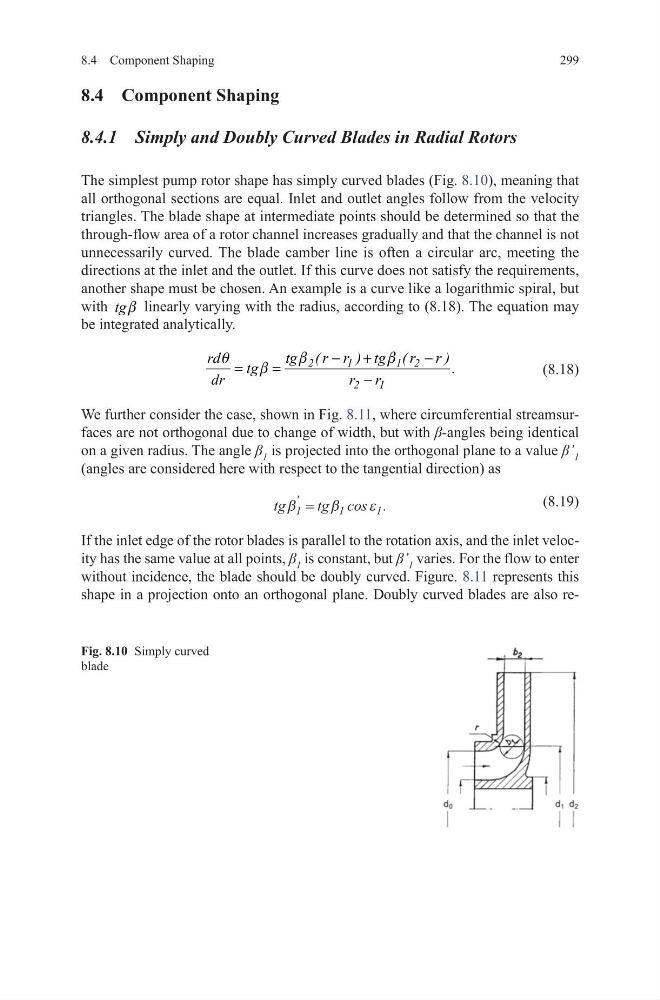
The simplest pump rotor shape has simply curved blades (Fig. 8.10), meaning that
all orthogonal sections are equal. Inlet and outlet angles follow from the velocity
triangles. The blade shape at intermediate points should be determined so that the
through-flow area of a rotor channel increases gradually and that the channel is not
unnecessarily curved. The blade camber line is often a circular arc, meeting the
directions at the inlet and the outlet. If this curve does not satisfy the requirements,
another shape must be chosen. An example is a curve like a logarithmic spiral, but
with b
tg linearly varying with the radius, according to (8.18). The equation may
be integrated analytically.
(8.18)
We further consider the case, shown in Fig. 8.11, where circumferential streamsurfaces are not orthogonal due to change of width, but with β-angles being identical
on a given radius. The angle β 1 is projected into the orthogonal plane to a value β’ 1
(angles are considered here with respect to the tangential direction) as
(8.19)
If the inlet edge of the rotor blades is parallel to the rotation axis, and the inlet velocity has the same value at all points, β 1 is constant, but β’ 1 varies. For the flow to enter
without incidence, the blade should be doubly curved. Figure. 8.11 represents this
shape in a projection onto an orthogonal plane. Doubly curved blades are also reb
b
q
b
−
+
−
=
=
−
2
1
1 2
2
1
tg ( r r ) tg ( r r )
rd
tg
.
dr
r r
tg
tg
β
β
ε
1
1
1
'
cos .
=
Fig. 8.10 Simply curved
blade
299
8.4 Component Shaping
8.4.1 Simply and Doubly Curved Blades in Radial Rotors
The simplest pump rotor shape has simply curved blades (Fig. 8.10), meaning that
all orthogonal sections are equal. Inlet and outlet angles follow from the velocity
triangles. The blade shape at intermediate points should be determined so that the
through-flow area of a rotor channel increases gradually and that the channel is not
unnecessarily curved. The blade camber line is often a circular arc, meeting the
directions at the inlet and the outlet. If this curve does not satisfy the requirements,
another shape must be chosen. An example is a curve like a logarithmic spiral, but
with b
tg linearly varying with the radius, according to (8.18). The equation may
be integrated analytically.
(8.18)
We further consider the case, shown in Fig. 8.11, where circumferential streamsurfaces are not orthogonal due to change of width, but with β-angles being identical
on a given radius. The angle β 1 is projected into the orthogonal plane to a value β’ 1
(angles are considered here with respect to the tangential direction) as
(8.19)
If the inlet edge of the rotor blades is parallel to the rotation axis, and the inlet velocity has the same value at all points, β 1 is constant, but β’ 1 varies. For the flow to enter
without incidence, the blade should be doubly curved. Figure. 8.11 represents this
shape in a projection onto an orthogonal plane. Doubly curved blades are also reb
b
q
b
−
+
−
=
=
−
2
1
1 2
2
1
tg ( r r ) tg ( r r )
rd
tg
.
dr
r r
tg
tg
β
β
ε
1
1
1
'
cos .
=
Fig. 8.10 Simply curved
blade