

8 Pumps
298
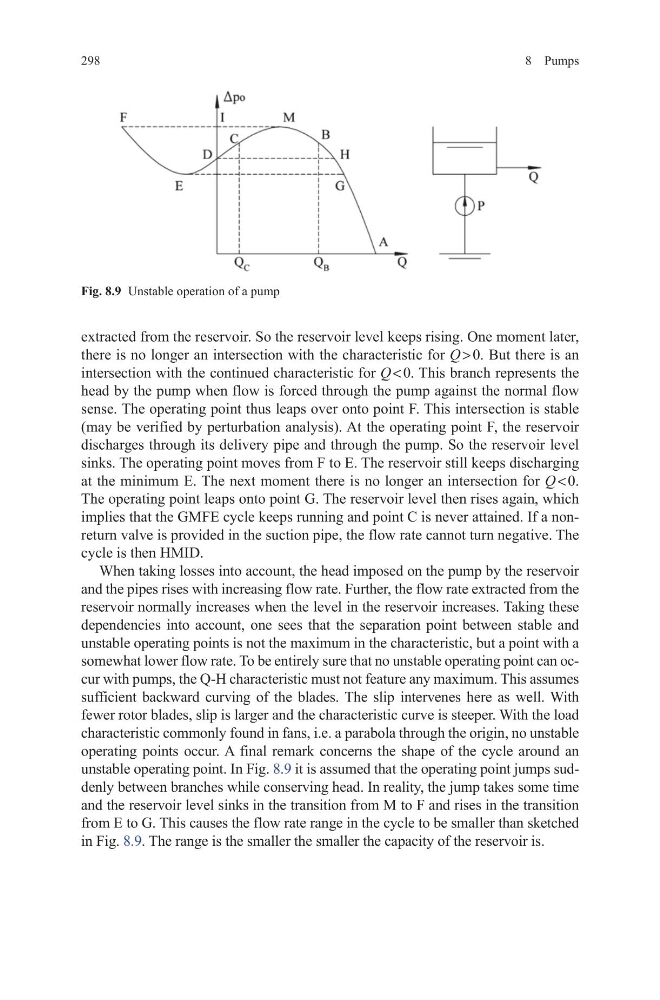
extracted from the reservoir. So the reservoir level keeps rising. One moment later,
there is no longer an intersection with the characteristic for Q > 0. But there is an
intersection with the continued characteristic for Q < 0. This branch represents the
head by the pump when flow is forced through the pump against the normal flow
sense. The operating point thus leaps over onto point F. This intersection is stable
(may be verified by perturbation analysis). At the operating point F, the reservoir
discharges through its delivery pipe and through the pump. So the reservoir level
sinks. The operating point moves from F to E. The reservoir still keeps discharging
at the minimum E. The next moment there is no longer an intersection for Q < 0.
The operating point leaps onto point G. The reservoir level then rises again, which
implies that the GMFE cycle keeps running and point C is never attained. If a nonreturn valve is provided in the suction pipe, the flow rate cannot turn negative. The
cycle is then HMID.
When taking losses into account, the head imposed on the pump by the reservoir
and the pipes rises with increasing flow rate. Further, the flow rate extracted from the
reservoir normally increases when the level in the reservoir increases. Taking these
dependencies into account, one sees that the separation point between stable and
unstable operating points is not the maximum in the characteristic, but a point with a
somewhat lower flow rate. To be entirely sure that no unstable operating point can occur with pumps, the Q-H characteristic must not feature any maximum. This assumes
sufficient backward curving of the blades. The slip intervenes here as well. With
fewer rotor blades, slip is larger and the characteristic curve is steeper. With the load
characteristic commonly found in fans, i.e. a parabola through the origin, no unstable
operating points occur. A final remark concerns the shape of the cycle around an
unstable operating point. In Fig. 8.9 it is assumed that the operating point jumps suddenly between branches while conserving head. In reality, the jump takes some time
and the reservoir level sinks in the transition from M to F and rises in the transition
from E to G. This causes the flow rate range in the cycle to be smaller than sketched
in Fig. 8.9. The range is the smaller the smaller the capacity of the reservoir is.
Fig. 8.9 Unstable operation of a pump
298
extracted from the reservoir. So the reservoir level keeps rising. One moment later,
there is no longer an intersection with the characteristic for Q > 0. But there is an
intersection with the continued characteristic for Q < 0. This branch represents the
head by the pump when flow is forced through the pump against the normal flow
sense. The operating point thus leaps over onto point F. This intersection is stable
(may be verified by perturbation analysis). At the operating point F, the reservoir
discharges through its delivery pipe and through the pump. So the reservoir level
sinks. The operating point moves from F to E. The reservoir still keeps discharging
at the minimum E. The next moment there is no longer an intersection for Q < 0.
The operating point leaps onto point G. The reservoir level then rises again, which
implies that the GMFE cycle keeps running and point C is never attained. If a nonreturn valve is provided in the suction pipe, the flow rate cannot turn negative. The
cycle is then HMID.
When taking losses into account, the head imposed on the pump by the reservoir
and the pipes rises with increasing flow rate. Further, the flow rate extracted from the
reservoir normally increases when the level in the reservoir increases. Taking these
dependencies into account, one sees that the separation point between stable and
unstable operating points is not the maximum in the characteristic, but a point with a
somewhat lower flow rate. To be entirely sure that no unstable operating point can occur with pumps, the Q-H characteristic must not feature any maximum. This assumes
sufficient backward curving of the blades. The slip intervenes here as well. With
fewer rotor blades, slip is larger and the characteristic curve is steeper. With the load
characteristic commonly found in fans, i.e. a parabola through the origin, no unstable
operating points occur. A final remark concerns the shape of the cycle around an
unstable operating point. In Fig. 8.9 it is assumed that the operating point jumps suddenly between branches while conserving head. In reality, the jump takes some time
and the reservoir level sinks in the transition from M to F and rises in the transition
from E to G. This causes the flow rate range in the cycle to be smaller than sketched
in Fig. 8.9. The range is the smaller the smaller the capacity of the reservoir is.
Fig. 8.9 Unstable operation of a pump