

8.3 Unstable Operation
297
8.2.4 Jet Pump
This pump is by far the most used in household applications. The principle is that
a water jet pump is internally mounted upstream of a centrifugal rotor. The water
leaving the rotor runs into a pump house that is connected to the nozzle. The water
jet entrains the air from the suction pipe. Wet operation is similar. The jet pump and
the centrifugal rotor are connected in series, which allows attaining a higher head.
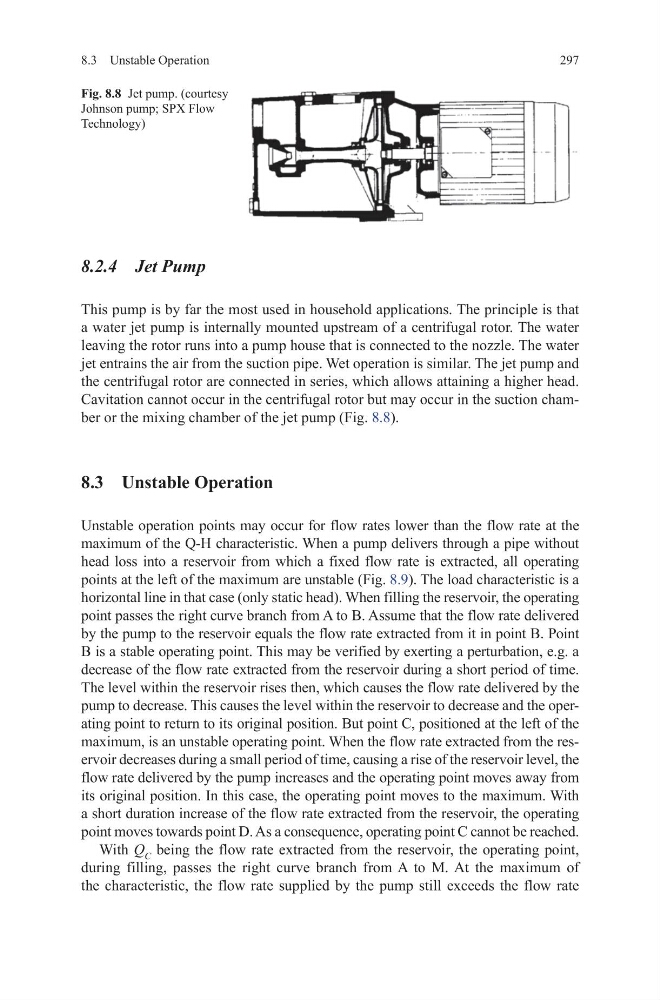
Cavitation cannot occur in the centrifugal rotor but may occur in the suction chamber or the mixing chamber of the jet pump (Fig. 8.8).
8.3 Unstable Operation
Unstable operation points may occur for flow rates lower than the flow rate at the
maximum of the Q-H characteristic. When a pump delivers through a pipe without
head loss into a reservoir from which a fixed flow rate is extracted, all operating
points at the left of the maximum are unstable (Fig. 8.9). The load characteristic is a
horizontal line in that case (only static head). When filling the reservoir, the operating
point passes the right curve branch from A to B. Assume that the flow rate delivered
by the pump to the reservoir equals the flow rate extracted from it in point B. Point
B is a stable operating point. This may be verified by exerting a perturbation, e.g. a
decrease of the flow rate extracted from the reservoir during a short period of time.
The level within the reservoir rises then, which causes the flow rate delivered by the
pump to decrease. This causes the level within the reservoir to decrease and the operating point to return to its original position. But point C, positioned at the left of the
maximum, is an unstable operating point. When the flow rate extracted from the reservoir decreases during a small period of time, causing a rise of the reservoir level, the
flow rate delivered by the pump increases and the operating point moves away from
its original position. In this case, the operating point moves to the maximum. With
a short duration increase of the flow rate extracted from the reservoir, the operating
point moves towards point D. As a consequence, operating point C cannot be reached.
With Q C being the flow rate extracted from the reservoir, the operating point,
during filling, passes the right curve branch from A to M. At the maximum of
the characteristic, the flow rate supplied by the pump still exceeds the flow rate
Fig. 8.8 Jet pump. (courtesy
Johnson pump; SPX Flow
Technology)
297
8.2.4 Jet Pump
This pump is by far the most used in household applications. The principle is that
a water jet pump is internally mounted upstream of a centrifugal rotor. The water
leaving the rotor runs into a pump house that is connected to the nozzle. The water
jet entrains the air from the suction pipe. Wet operation is similar. The jet pump and
the centrifugal rotor are connected in series, which allows attaining a higher head.
Cavitation cannot occur in the centrifugal rotor but may occur in the suction chamber or the mixing chamber of the jet pump (Fig. 8.8).
8.3 Unstable Operation
Unstable operation points may occur for flow rates lower than the flow rate at the
maximum of the Q-H characteristic. When a pump delivers through a pipe without
head loss into a reservoir from which a fixed flow rate is extracted, all operating
points at the left of the maximum are unstable (Fig. 8.9). The load characteristic is a
horizontal line in that case (only static head). When filling the reservoir, the operating
point passes the right curve branch from A to B. Assume that the flow rate delivered
by the pump to the reservoir equals the flow rate extracted from it in point B. Point
B is a stable operating point. This may be verified by exerting a perturbation, e.g. a
decrease of the flow rate extracted from the reservoir during a short period of time.
The level within the reservoir rises then, which causes the flow rate delivered by the
pump to decrease. This causes the level within the reservoir to decrease and the operating point to return to its original position. But point C, positioned at the left of the
maximum, is an unstable operating point. When the flow rate extracted from the reservoir decreases during a small period of time, causing a rise of the reservoir level, the
flow rate delivered by the pump increases and the operating point moves away from
its original position. In this case, the operating point moves to the maximum. With
a short duration increase of the flow rate extracted from the reservoir, the operating
point moves towards point D. As a consequence, operating point C cannot be reached.
With Q C being the flow rate extracted from the reservoir, the operating point,
during filling, passes the right curve branch from A to M. At the maximum of
the characteristic, the flow rate supplied by the pump still exceeds the flow rate
Fig. 8.8 Jet pump. (courtesy
Johnson pump; SPX Flow
Technology)