

7 Dynamic Similitude
252
7.1.6 Independent and Dependent Parameter Groups
The listing of problem-describing parameters requires a certain understanding of
the problem. For instance, we know that the performance of a turbomachine with
a constant density fluid is determined by the change of the mechanical energy
E m = p/ρ + ½v
2
+ gz. So ∆E m must be specified as a single parameter. If the three
components of ∆E m were specified apart as parameters, an Euler number and a
Froude number would appear as incorrect in the similitude conditions.
7.1.7 Dimensionless Parameter Groups in Turbomachines
with a Constant Density Fluid
For a pump (or fan), a possible set of independent parameters is
Fluid
ρ, ν
Geometry
D (Relevant rotor diameter)
Operating point
, m
Ω
The relevant diameter D is normally the outer diameter of the rotor. To determine
the operating point, we assume a rotational speed enforced by the driving motor and
a flow rate regulated by valves. The head is then a dependent parameter. Remark
that rotational speed and head may be considered as independent and flow rate as
dependent. It is important to understand that two parameters determine the operating point. There are three fundamental dimensions: L, M, t. Consequently, there are
5 − 3 = 2 independent dimensionless groups. These may be determined by means of
a dimensional analysis, analogous with the first example. Acting factors must be
chosen for that. They may be ν and Ω. On the base of the insight we meanwhile acquired, these groups can be formed directly, as the problem encompasses a dynamic
similitude condition (associated to viscosity) and a kinematic similitude condition
(associated to rotational speed).
A measure for the through-flow velocity is
.
2
m
V
D
r
=
A Reynolds number may thus be formed as
(7.3)
.
VD
m
m
Q
Re
D
D
D
r
m
=
=
=
=
v
v
v
ρ
ν
L
V
g
L
− 3
2
1
1
1
M
1
t
− 1
− 1 − 2
a
b
c
d
e
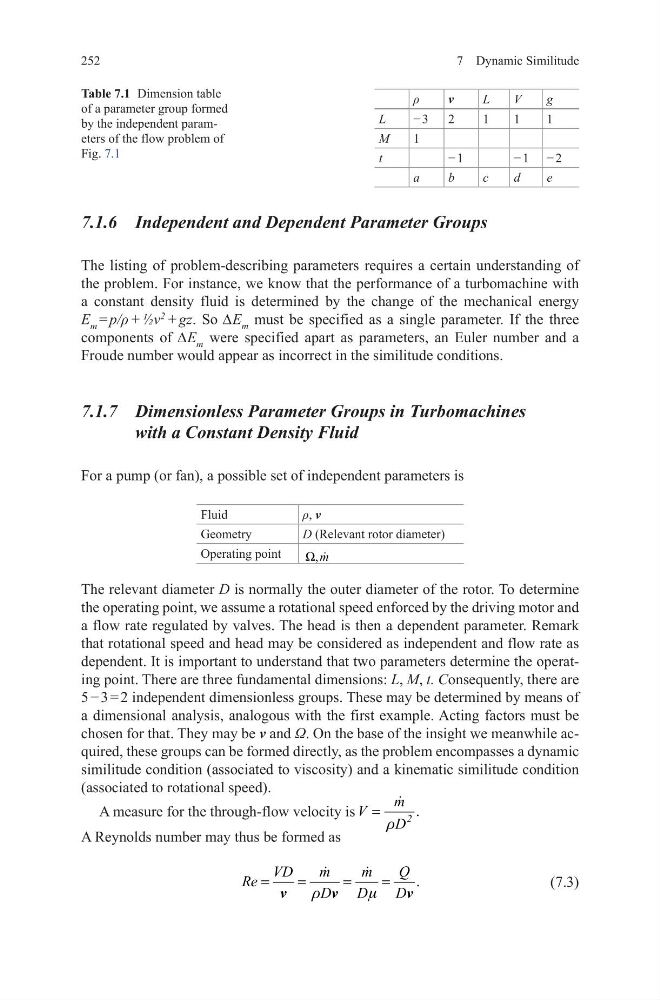
Table 7.1 Dimension table
of a parameter group formed
by the independent parameters of the flow problem of
Fig. 7.1
252
7.1.6 Independent and Dependent Parameter Groups
The listing of problem-describing parameters requires a certain understanding of
the problem. For instance, we know that the performance of a turbomachine with
a constant density fluid is determined by the change of the mechanical energy
E m = p/ρ + ½v
2
+ gz. So ∆E m must be specified as a single parameter. If the three
components of ∆E m were specified apart as parameters, an Euler number and a
Froude number would appear as incorrect in the similitude conditions.
7.1.7 Dimensionless Parameter Groups in Turbomachines
with a Constant Density Fluid
For a pump (or fan), a possible set of independent parameters is
Fluid
ρ, ν
Geometry
D (Relevant rotor diameter)
Operating point
, m
Ω
The relevant diameter D is normally the outer diameter of the rotor. To determine
the operating point, we assume a rotational speed enforced by the driving motor and
a flow rate regulated by valves. The head is then a dependent parameter. Remark
that rotational speed and head may be considered as independent and flow rate as
dependent. It is important to understand that two parameters determine the operating point. There are three fundamental dimensions: L, M, t. Consequently, there are
5 − 3 = 2 independent dimensionless groups. These may be determined by means of
a dimensional analysis, analogous with the first example. Acting factors must be
chosen for that. They may be ν and Ω. On the base of the insight we meanwhile acquired, these groups can be formed directly, as the problem encompasses a dynamic
similitude condition (associated to viscosity) and a kinematic similitude condition
(associated to rotational speed).
A measure for the through-flow velocity is
.
2
m
V
D
r
=
A Reynolds number may thus be formed as
(7.3)
.
VD
m
m
Q
Re
D
D
D
r
m
=
=
=
=
v
v
v
ρ
ν
L
V
g
L
− 3
2
1
1
1
M
1
t
− 1
− 1 − 2
a
b
c
d
e
Table 7.1 Dimension table
of a parameter group formed
by the independent parameters of the flow problem of
Fig. 7.1