

7.1 Principles of Dynamic Similitude
251
7.1.5 Dimensional Analysis
The above reasoning demonstrates that considering similar flow problems means
exactly the same as the dimensionless formulation of a flow problem. Dimensional
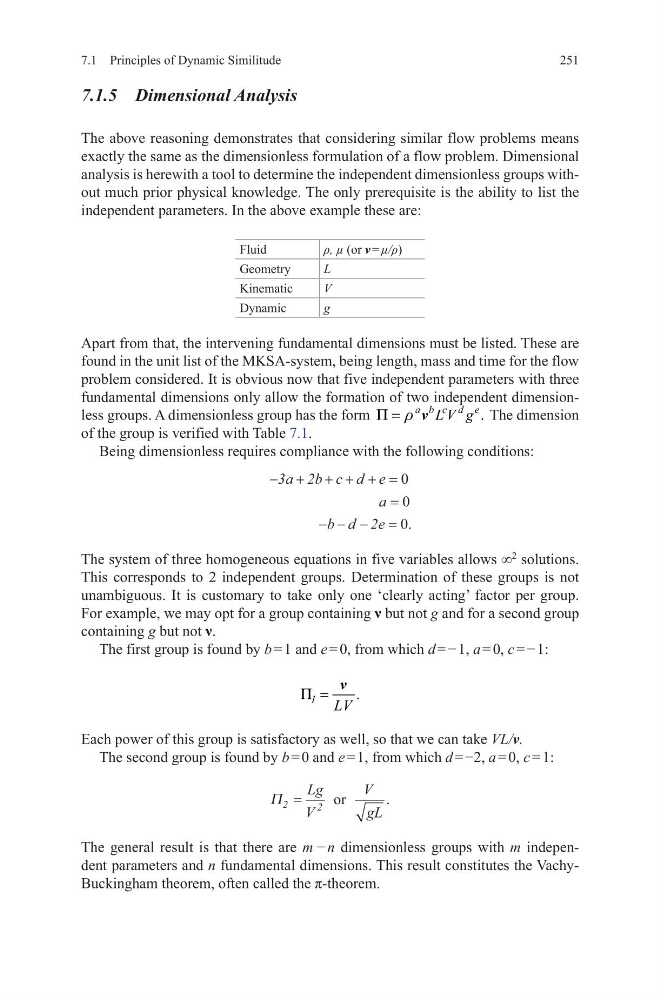
analysis is herewith a tool to determine the independent dimensionless groups without much prior physical knowledge. The only prerequisite is the ability to list the
independent parameters. In the above example these are:
Fluid
ρ, µ (or ν = µ/ρ)
Geometry
L
Kinematic
V
Dynamic
g
Apart from that, the intervening fundamental dimensions must be listed. These are
found in the unit list of the MKSA-system, being length, mass and time for the flow
problem considered. It is obvious now that five independent parameters with three
fundamental dimensions only allow the formation of two independent dimensionless groups. A dimensionless group has the form
.
a b c d e
L V g
P r
= v
The dimension
of the group is verified with Table 7.1.
Being dimensionless requires compliance with the following conditions:
The system of three homogeneous equations in five variables allows ∞
2
solutions.
This corresponds to 2 independent groups. Determination of these groups is not
unambiguous. It is customary to take only one ‘clearly acting’ factor per group.
For example, we may opt for a group containing ν but not g and for a second group
containing g but not ν.
The first group is found by b = 1 and e = 0, from which d = − 1, a = 0, c = − 1:
Each power of this group is satisfactory as well, so that we can take VL/ν.
The second group is found by b = 0 and e = 1, from which d = −2, a = 0, c = 1:
The general result is that there are m − n dimensionless groups with m independent parameters and n fundamental dimensions. This result constitutes the VachyBuckingham theorem, often called the π-theorem.
− + + + + =
=
− − − =
3 2
2
a b c d e
a
b d
e
0
0
0.
.
1
LV
P =
v
Π 2
2
=
Lg
V
V
gL
or
.
251
7.1.5 Dimensional Analysis
The above reasoning demonstrates that considering similar flow problems means
exactly the same as the dimensionless formulation of a flow problem. Dimensional
analysis is herewith a tool to determine the independent dimensionless groups without much prior physical knowledge. The only prerequisite is the ability to list the
independent parameters. In the above example these are:
Fluid
ρ, µ (or ν = µ/ρ)
Geometry
L
Kinematic
V
Dynamic
g
Apart from that, the intervening fundamental dimensions must be listed. These are
found in the unit list of the MKSA-system, being length, mass and time for the flow
problem considered. It is obvious now that five independent parameters with three
fundamental dimensions only allow the formation of two independent dimensionless groups. A dimensionless group has the form
.
a b c d e
L V g
P r
= v
The dimension
of the group is verified with Table 7.1.
Being dimensionless requires compliance with the following conditions:
The system of three homogeneous equations in five variables allows ∞
2
solutions.
This corresponds to 2 independent groups. Determination of these groups is not
unambiguous. It is customary to take only one ‘clearly acting’ factor per group.
For example, we may opt for a group containing ν but not g and for a second group
containing g but not ν.
The first group is found by b = 1 and e = 0, from which d = − 1, a = 0, c = − 1:
Each power of this group is satisfactory as well, so that we can take VL/ν.
The second group is found by b = 0 and e = 1, from which d = −2, a = 0, c = 1:
The general result is that there are m − n dimensionless groups with m independent parameters and n fundamental dimensions. This result constitutes the VachyBuckingham theorem, often called the π-theorem.
− + + + + =
=
− − − =
3 2
2
a b c d e
a
b d
e
0
0
0.
.
1
LV
P =
v
Π 2
2
=
Lg
V
V
gL
or
.