

222
6 Steam Turbines
outlet flow. For other applications, the choice is a low degree of reaction, namely
R s ≈ 0.10–0.15 and corresponding l ≈ 0.57 (y ≈ 1.40). In principle, such a turbine yields a somewhat lower efficiency (about one percentage point), but it can be
designed with fewer stages than a turbine with R s = 0.50. The types are denoted with
the names reaction turbine and impulse turbine. The term reaction turbine implies
a degree of reaction around 50 %. The term impulse turbine implies zero degree of
reaction or a low degree of reaction R s = 0.10–0.15. As discussed earlier, the blade
shape is disadvantageous with R s = 0 (Figs. 6.9 and 6.10), even if rounding of the
leading edge is possible. With a degree of reaction somewhat above zero, the rotor blade becomes asymmetrical and creation of a leading edge stagnation region
increases its load capacity. In modern reaction type turbines, the degree of reaction
is not exactly 50 % at the mean radius. Modern optimisation methods are numerical. The degree of reaction is a parameter that is optimised. It varies somewhat from
stage to stage and varies also with the radius in a given stage. Moreover, blade
shapes are three-dimensional (see Sect. 6.9)
6.7.3 Axial Inlet and Outlet
From the foregoing analysis follows that the inlet and outlet flows of an optimised
stage are near to the axial direction. A priori assumption of axial outlet velocity
enables a very simple analysis of the axial turbine.
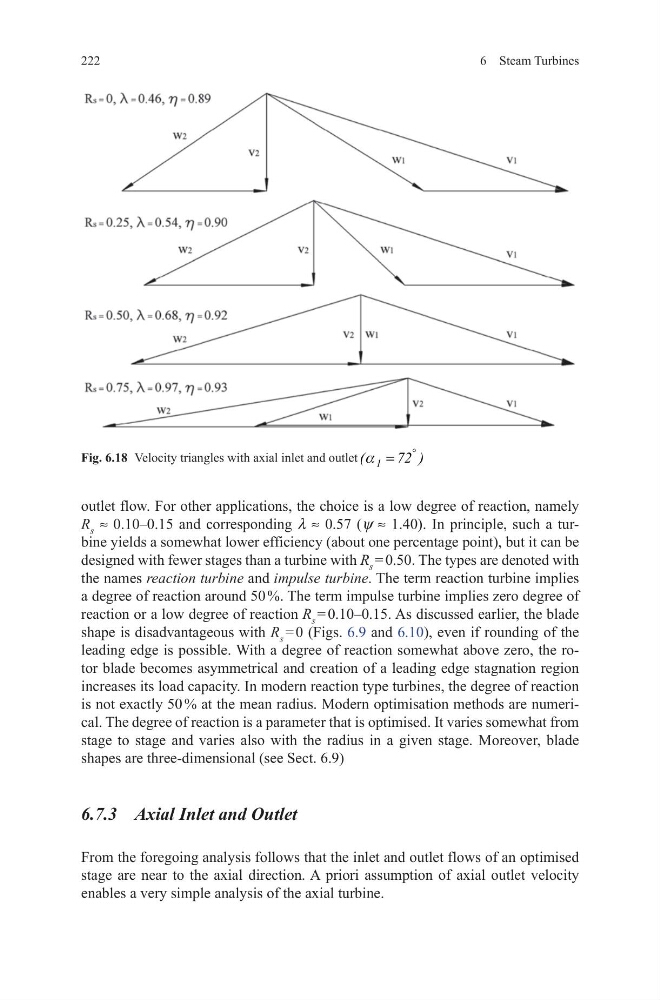
Fig. 6.18 Velocity triangles with axial inlet and outlet 1
(
72 )
°
=
a
6 Steam Turbines
outlet flow. For other applications, the choice is a low degree of reaction, namely
R s ≈ 0.10–0.15 and corresponding l ≈ 0.57 (y ≈ 1.40). In principle, such a turbine yields a somewhat lower efficiency (about one percentage point), but it can be
designed with fewer stages than a turbine with R s = 0.50. The types are denoted with
the names reaction turbine and impulse turbine. The term reaction turbine implies
a degree of reaction around 50 %. The term impulse turbine implies zero degree of
reaction or a low degree of reaction R s = 0.10–0.15. As discussed earlier, the blade
shape is disadvantageous with R s = 0 (Figs. 6.9 and 6.10), even if rounding of the
leading edge is possible. With a degree of reaction somewhat above zero, the rotor blade becomes asymmetrical and creation of a leading edge stagnation region
increases its load capacity. In modern reaction type turbines, the degree of reaction
is not exactly 50 % at the mean radius. Modern optimisation methods are numerical. The degree of reaction is a parameter that is optimised. It varies somewhat from
stage to stage and varies also with the radius in a given stage. Moreover, blade
shapes are three-dimensional (see Sect. 6.9)
6.7.3 Axial Inlet and Outlet
From the foregoing analysis follows that the inlet and outlet flows of an optimised
stage are near to the axial direction. A priori assumption of axial outlet velocity
enables a very simple analysis of the axial turbine.
Fig. 6.18 Velocity triangles with axial inlet and outlet 1
(
72 )
°
=
a