

218
6 Steam Turbines
with
h h
w
w
1
2
2
2
1
2
2
2
− =
−
,
and
h
h
u v
v
u w
w
u
u
u
u
01
02
1
2
1
2
−
=
−
=
−
(
) (
) .
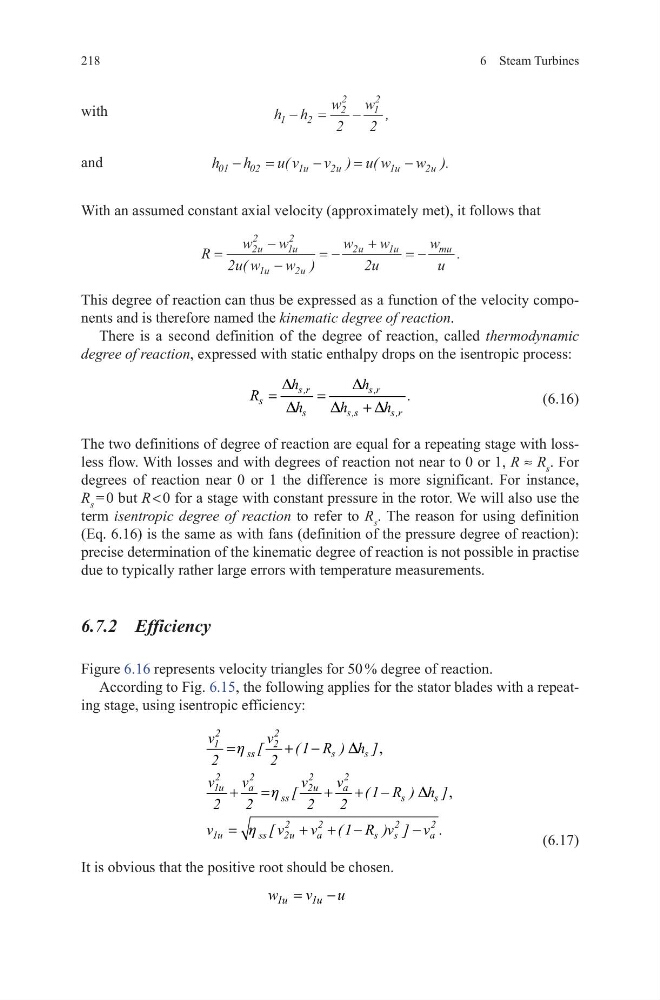
With an assumed constant axial velocity (approximately met), it follows that
R
w
w
u w
w
w
w
u
w
u
u
u
u
u
u
u
mu
=
−
−
= −
+
= −
2
2
1
2
1
2
2
1
2
2
(
)
.
This degree of reaction can thus be expressed as a function of the velocity components and is therefore named the kinematic degree of reaction.
There is a second definition of the degree of reaction, called thermodynamic
degree of reaction, expressed with static enthalpy drops on the isentropic process:
(6.16)
The two definitions of degree of reaction are equal for a repeating stage with lossless flow. With losses and with degrees of reaction not near to 0 or 1, R ≈ R s . For
degrees of reaction near 0 or 1 the difference is more significant. For instance,
R s = 0 but R < 0 for a stage with constant pressure in the rotor. We will also use the
term isentropic degree of reaction to refer to R s . The reason for using definition
(Eq. 6.16) is the same as with fans (definition of the pressure degree of reaction):
precise determination of the kinematic degree of reaction is not possible in practise
due to typically rather large errors with temperature measurements.
6.7.2 Efficiency
Figure 6.16 represents velocity triangles for 50 % degree of reaction.
According to Fig. 6.15, the following applies for the stator blades with a repeating stage, using isentropic efficiency:
(6.17)
It is obvious that the positive root should be chosen.
s ,r
s ,r
s
s
s,s
s,r
h
h
R
.
h
h
h
=
=
+
D
D
D
D
D
,
,
2
2
1
2
ss
s
s
2
2
2
2
1 u
a
2u
a
ss
s
s
2
2
2
2
1u
ss
2u
a
s s
a
v
v
[
( 1 R ) h ]
2
2
v
v
v
v
[
( 1 R ) h ]
2
2
2
2
v
[ v
v ( 1 R )v ] v .
h
D
h
D
h
=
+ −
+
=
+ + −
=
+ + −
−
1u
1u
w
v
u
=
−
6 Steam Turbines
with
h h
w
w
1
2
2
2
1
2
2
2
− =
−
,
and
h
h
u v
v
u w
w
u
u
u
u
01
02
1
2
1
2
−
=
−
=
−
(
) (
) .
With an assumed constant axial velocity (approximately met), it follows that
R
w
w
u w
w
w
w
u
w
u
u
u
u
u
u
u
mu
=
−
−
= −
+
= −
2
2
1
2
1
2
2
1
2
2
(
)
.
This degree of reaction can thus be expressed as a function of the velocity components and is therefore named the kinematic degree of reaction.
There is a second definition of the degree of reaction, called thermodynamic
degree of reaction, expressed with static enthalpy drops on the isentropic process:
(6.16)
The two definitions of degree of reaction are equal for a repeating stage with lossless flow. With losses and with degrees of reaction not near to 0 or 1, R ≈ R s . For
degrees of reaction near 0 or 1 the difference is more significant. For instance,
R s = 0 but R < 0 for a stage with constant pressure in the rotor. We will also use the
term isentropic degree of reaction to refer to R s . The reason for using definition
(Eq. 6.16) is the same as with fans (definition of the pressure degree of reaction):
precise determination of the kinematic degree of reaction is not possible in practise
due to typically rather large errors with temperature measurements.
6.7.2 Efficiency
Figure 6.16 represents velocity triangles for 50 % degree of reaction.
According to Fig. 6.15, the following applies for the stator blades with a repeating stage, using isentropic efficiency:
(6.17)
It is obvious that the positive root should be chosen.
s ,r
s ,r
s
s
s,s
s,r
h
h
R
.
h
h
h
=
=
+
D
D
D
D
D
,
,
2
2
1
2
ss
s
s
2
2
2
2
1 u
a
2u
a
ss
s
s
2
2
2
2
1u
ss
2u
a
s s
a
v
v
[
( 1 R ) h ]
2
2
v
v
v
v
[
( 1 R ) h ]
2
2
2
2
v
[ v
v ( 1 R )v ] v .
h
D
h
D
h
=
+ −
+
=
+ + −
=
+ + −
−
1u
1u
w
v
u
=
−